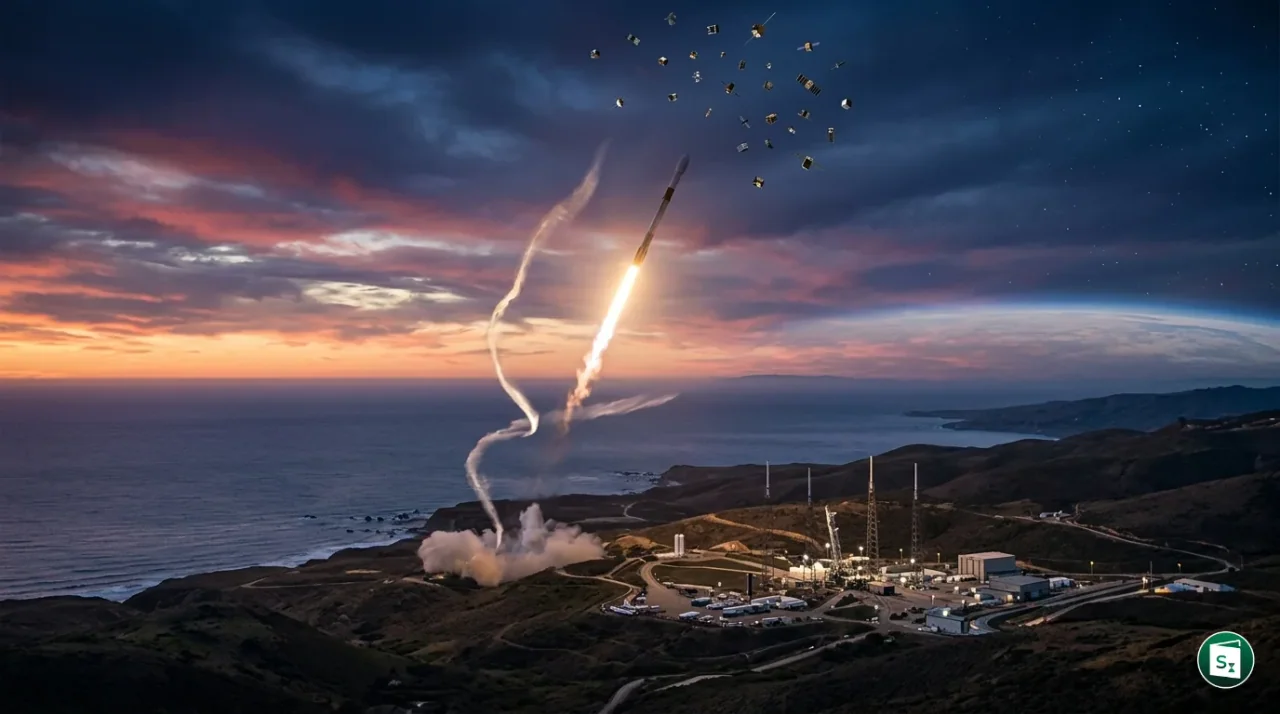
SpaceX successfully launched a Falcon 9 rocket from the Vandenberg Space Force Base in California on May 9, 2026, marking another milestone in international space collaboration. The mission primarily deployed South Korea’s CAS500-2 Earth observation satellite alongside 45 smaller payloads into a precise Sun-synchronous orbit (SSO). This multi-customer rideshare operation significantly enhances the Republic of Korea’s indigenous capability for high-resolution planetary monitoring and disaster management.
Technical Specifications and Purpose of CAS500-2
The Compact Advanced Satellite 500-2 (CAS500-2) is the second in a series of standardized, 500 kg-class Earth observation satellites developed by the Korea Aerospace Research Institute (KARI). While KARI led the development of the first satellite in the series, the production of CAS500-2 involved a strategic transition of technology to the domestic private sector, specifically to Korea Aerospace Industries (KAI). This move is part of South Korea’s broader initiative to foster a robust commercial space ecosystem by shifting satellite manufacturing from government research bodies to private industry.
Equipped with a high-resolution optical payload, the satellite provides 0.5-meter resolution panchromatic imagery and 2.0-meter resolution multispectral color data. These technical capabilities are tailored for a wide range of public service requirements, including national land resource management, urban planning, and agricultural monitoring. The satellite also plays a critical role in South Korea’s disaster response strategy, offering real-time data to track environmental hazards and support emergency management efforts over the Korean Peninsula and beyond.
Understanding Sun-Synchronous Orbit and Polar Launches
The deployment of CAS500-2 into a Sun-synchronous orbit (SSO) is a deliberate choice for Earth observation missions. An SSO is a type of polar orbit that allows a satellite to pass over any given point on the Earth’s surface at the same local mean solar time. This ensures that the illumination conditions, such as the angle of sunlight, remain consistent for every pass, which is vital for comparing high-resolution images taken at different times to detect changes on the ground accurately.
The mission was executed from Space Launch Complex 4 East (SLC-4E) at the Vandenberg Space Force Base. Located on the central coast of California, Vandenberg is the primary U.S. spaceport for polar and Sun-synchronous launches. Its geographic position allows rockets to fly directly south over the Pacific Ocean, avoiding populated landmasses during the critical early stages of ascent. This makes it an indispensable facility for missions requiring high-inclination orbits that cover the entire globe.
The Economics of Multi-Customer Rideshare Missions
The inclusion of 45 secondary payloads alongside the primary CAS500-2 satellite highlights the efficiency of the SpaceX SmallSat Rideshare Program. By aggregating numerous small satellites from different customers on a single heavy-lift Falcon 9 launch, the cost per kilogram of sending instruments into orbit is dramatically reduced. This model has revolutionized the space industry, making orbital access feasible for universities, smaller nations, and private startups that previously found the cost of a dedicated launch prohibitive.
These multi-customer missions often include a diverse array of instruments, ranging from experimental communications cubesats to scientific sensors for climate research. By maintaining a high frequency of such rideshare opportunities, SpaceX has effectively created a “bus service” to space, providing reliable and scheduled access to specific orbits like the SSO. This predictable cadence allows mission planners to design and build satellites with the assurance that a launch window will be available upon completion.
South Korea’s Expanding Footprint in Space Technology
The successful launch of CAS500-2 marks a significant milestone for the Korea Aerospace Research Institute (KARI), the national space agency of the Republic of Korea. Established on October 10, 1989, and headquartered in Daejeon, KARI has been the driving force behind South Korea’s rapid ascent in the global space sector. The CAS500 program represents a strategic shift toward creating a standardized, mass-producible satellite bus platform that can be easily adapted for various scientific and commercial needs.
This mission builds on the success of CAS500-1, which was launched in March 2021. By transitioning the manufacturing and technology of the second satellite to the private sector, South Korea is following a global trend of “New Space,” where government agencies act as facilitators and primary customers while the private industry handles production. This approach not only strengthens the domestic aerospace industry but also positions the country as a competitive player in the international satellite export market.
Key Takeaways
- SpaceX launched a Falcon 9 rocket carrying South Korea’s CAS500-2 satellite and 45 secondary payloads on May 9, 2026.
- The launch was conducted from Space Launch Complex 4 East (SLC-4E) at the Vandenberg Space Force Base in California.
- CAS500-2 is a high-resolution Earth observation satellite with a 0.5-meter resolution panchromatic imaging capability.
- The Korea Aerospace Research Institute (KARI), headquartered in Daejeon, was established in 1989 to spearhead South Korea’s aerospace development.
- A Sun-synchronous orbit (SSO) is a polar orbit that maintains constant solar illumination conditions, which is essential for accurate Earth monitoring.
- The transition of the CAS500-2 project to Korea Aerospace Industries (KAI) reflects South Korea’s strategy to foster a commercial, private-sector-led space economy.