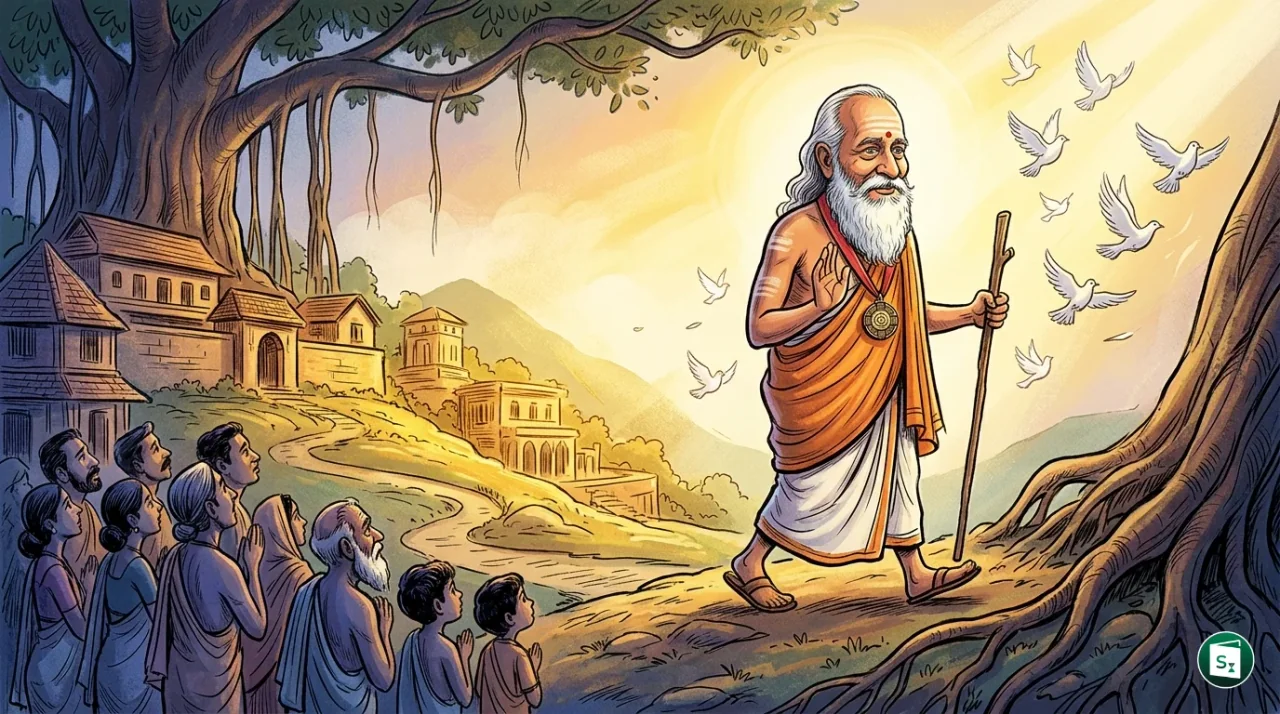
Swami Muni Narayana Prasad, the revered head of Narayana Gurukulam and a distinguished scholar of Indian philosophy, passed away at the age of 87. A recipient of the Padma Shri in 2024, he was widely recognized for his prolific contributions to the interpretation of Advaita Vedanta and the Upanishads. His demise marks a significant loss to the spiritual and intellectual landscape of India, particularly in the lineage of Sree Narayana Guru.
A Prolific Scholar of Indian Philosophy
Born in 1938, Swami Muni Narayana Prasad dedicated over five decades of his life to the study and propagation of Indian philosophy. He joined the Narayana Gurukulam in 1968 and became an inmate under the guidance of Guru Nitya Chaitanya Yati. In 1999, he succeeded Guru Nitya Chaitanya Yati as the head and guru of the institution. His scholarly approach was characterized by a deep integration of traditional Vedantic wisdom with modern rational thought, making complex metaphysical concepts accessible to a global audience.
Swami Prasad’s expertise spanned the Upanishads, the Bhagavad Gita, and the works of Sree Narayana Guru. He was particularly known for his ability to explain the non-dualistic philosophy of Advaita Vedanta through a unitive lens. His life was a testament to the pursuit of Brahma-Vidya, or the Science of the Absolute, which he promoted as a means to achieve universal brotherhood.
The Literary Legacy of Swami Muni Narayana Prasad
With over 130 books to his credit, including 100 in Malayalam and 30 in English, Swami Muni Narayana Prasad was a prolific author whose works are studied by philosophy enthusiasts worldwide. His commentaries on the major Upanishads, such as the Aitareya, Isavasya, Kena, Mandukya, Taittiriya, and Chandogya, are considered definitive resources for understanding these ancient texts in a contemporary context.
Among his most celebrated English works is “Life’s Pilgrimage Through Gita”, a comprehensive commentary on the Bhagavad Gita. He also authored several books on the teachings of Sree Narayana Guru, including “The Philosophy of Narayana Guru” and “Vedanta Up to Narayana Guru”. His autobiography, “Atmayanam”, was honored with the Kerala Sahitya Akademi Award in 2018. Beyond Indian philosophy, his works like “Christ the Guru” and “In the Name of Allah” reflected his commitment to interfaith dialogue and the search for a common spiritual thread across religions.
Narayana Gurukulam: Preserving the Wisdom of the Absolute
The Narayana Gurukulam, where Swami Prasad served as the spiritual head for 27 years, was established on June 8, 1923, by Nataraja Guru. Nataraja Guru was a direct disciple of Sree Narayana Guru, the legendary social reformer and sage of Kerala. The institution is dedicated to the pursuit of Brahma-Vidya and the promotion of universal brotherhood, transcending the barriers of caste, religion, and nationality.
Headquartered in Varkala, Kerala, the Gurukulam has evolved into a global foundation with centers across India and internationally, including in the United States, Europe, and Australia. Under Swami Muni Narayana Prasad’s leadership, the Gurukulam continued its mission of blending Indian Upanishadic traditions with contemporary educational methodologies. The institution’s motto, “One Caste, One Religion, One God for Man”, remains its guiding light in fostering spiritual unity.
Sree Narayana Guru and the Advaita Tradition
The philosophical foundation of Swami Muni Narayana Prasad’s work was deeply rooted in the teachings of Sree Narayana Guru (1856–1928). Sree Narayana Guru was a transformative figure in Indian history who led a reform movement against the caste system and social injustice. His historic Aruvippuram consecration in 1888, where he installed a Shiva idol despite not being a Brahmin, challenged the traditional social hierarchy and paved the way for temple entry movements.
Sree Narayana Guru’s philosophy was a practical application of Advaita Vedanta, emphasizing that all human beings are essentially the same. Swami Muni Narayana Prasad spent his life interpreting these teachings for the modern age, ensuring that the message of “One Caste, One Religion, One God” reached a diverse audience. By bridging the gap between ancient Sanskrit texts and common languages, he ensured that the wisdom of the Upanishads remained a living tradition in the 21st century.
Key Takeaways
- Swami Muni Narayana Prasad, the spiritual head of Narayana Gurukulam, passed away at the age of 87.
- He was a recipient of the Padma Shri in 2024 for his immense contributions to literature and education.
- Swami Prasad authored over 130 books, including renowned commentaries on the Upanishads and the Bhagavad Gita.
- He served as the head of Narayana Gurukulam since 1999, succeeding Guru Nitya Chaitanya Yati.
- The Narayana Gurukulam was founded in 1923 by Nataraja Guru, a direct disciple of the social reformer Sree Narayana Guru.
- Swami Prasad’s literary works, such as “Atmayanam”, received the Kerala Sahitya Akademi Award in 2018.