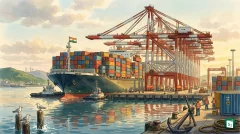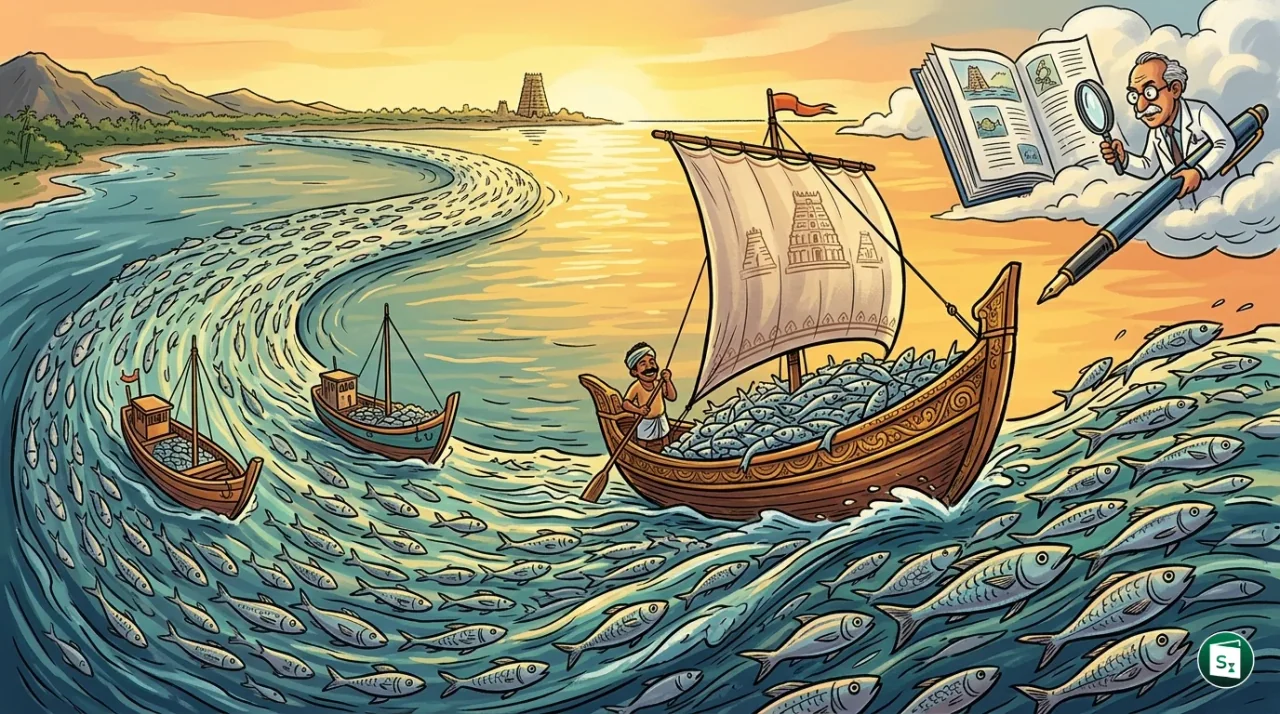
India’s marine fish production witnessed a steady growth of 3% in 2025, reaching a total of 35.7 lakh tonnes. According to the latest annual report from the ICAR-Central Marine Fisheries Research Institute, Tamil Nadu emerged as the leading producer with an output of 6.85 lakh tonnes. This growth highlights the increasing efficiency of India’s coastal fisheries and the success of various sustainable mariculture initiatives.
India’s Marine Fish Production Reaches 35.7 Lakh Tonnes in 2025
The ICAR-Central Marine Fisheries Research Institute (CMFRI) released its annual report for the year 2025, providing a comprehensive analysis of marine fish landings across India’s 8,129 km coastline. The data reveals that the country’s aggregate marine fish production increased by 3%, rising from previous levels to 35.7 lakh tonnes. This upward trend is seen as a positive indicator for India’s Blue Economy, reflecting a resilient fisheries sector despite various climatic and environmental challenges.
The report, which utilizes the Stratified Multistage Random Sampling Method for estimation, noted that the increase in landings was supported by better fishing efforts and a recovery in certain key fish stocks. The total value of these landings was estimated at ₹69,254 crore at the landing centres, marking a significant 10.45% increase in economic value compared to the previous year. At the retail level, the estimated value reached ₹97,702 crore, underscoring the vital role of the marine fisheries sector in supporting livelihoods and national food security.
State-wise Performance: Tamil Nadu Leads as Gujarat Slips
In a significant shift in regional rankings, Tamil Nadu secured the top position in marine fish production for 2025. The state recorded an output of 6.85 lakh tonnes, driven by a surge in the landings of species like Indian mackerel and various crustaceans. This performance helped Tamil Nadu overtake Gujarat, which had traditionally held the top spot. Gujarat experienced a 15% decline in its marine landings, primarily due to adverse weather conditions, cyclonic disturbances, and the extension of fishing bans in certain zones.
Kerala maintained its stronghold as the third-largest producer, contributing 6.24 lakh tonnes, which represented a marginal growth of 2% over the preceding year. The rankings for the top five states in 2025 are as follows:
| Rank | State | Production (Lakh Tonnes) |
|---|---|---|
| 1 | Tamil Nadu | 6.85 |
| 2 | Gujarat | (Declined by 15%) |
| 3 | Kerala | 6.24 |
| 4 | Karnataka | (Data as per report) |
| 5 | Maharashtra | (Data as per report) |
The decline in Gujarat’s production was balanced by substantial gains in the eastern coastal states and steady performance along the southern coast. Karnataka and Maharashtra occupied the fourth and fifth positions respectively, contributing significantly to the overall national pool.
Dominant Species and Economic Impact of Marine Landings
The species composition of the 2025 landings highlighted a mix of traditional and emerging resources. The Indian mackerel was the most landed resource, accounting for 2.70 lakh tonnes. It was followed by cephalopods (including squid and cuttlefish) at 2.57 lakh tonnes and the oil sardine at 2.53 lakh tonnes. A notable finding of the report was the significant growth in cephalopods and threadfin breams, both of which reached decadal-high levels in 2025.
The economic implications of these landings are substantial. The increased production of high-value species like cephalopods and threadfin breams contributed to the double-digit growth in the economic value of fish at landing centres. The report emphasizes that while the volume of fish increased by only 3%, the economic value rose by over 10%, indicating a shift towards higher-quality and more marketable marine resources. This trend is particularly beneficial for the fishing communities, as it translates to better price realization for their catch.
Institutional Framework: About ICAR-CMFRI and PMMSY
The Central Marine Fisheries Research Institute (CMFRI) is the premier organization responsible for monitoring and assessing India’s marine fishery resources. Established on February 3, 1947, by the Government of India, it originally operated under the Ministry of Food and Agriculture. Since 1967, the institute has been under the administrative control of the Indian Council of Agricultural Research (ICAR). Headquartered in Kochi, Kerala, CMFRI has been instrumental in developing scientific methods for fish landing estimation and promoting sustainable fishing practices.
The growth in India’s marine production aligns with the broader goals of the Pradhan Mantri Matsya Sampada Yojana (PMMSY). Launched in 2020 with an outlay of ₹20,050 crore, PMMSY aims to achieve a Blue Revolution by modernizing the fisheries value chain and doubling the incomes of fishers. The scheme focuses on enhancing productivity, improving post-harvest infrastructure, and strengthening the digital ecosystem for fisheries management. India currently stands as the second-largest fish producer in the world, contributing approximately 8% to global fish production.
Key Takeaways
- India’s total marine fish production reached 35.7 lakh tonnes in 2025, marking a 3% increase over the previous year.
- Tamil Nadu emerged as the top marine fish-producing state with an output of 6.85 lakh tonnes.
- Indian mackerel was the most landed marine resource in the country, with total landings of 2.70 lakh tonnes.
- The economic value of marine fish landings at the landing centre level grew by 10.45% to reach ₹69,254 crore in 2025.
- The ICAR-Central Marine Fisheries Research Institute (CMFRI), established in 1947 and headquartered in Kochi, is the nodal agency for marine fish landing data.
- The Pradhan Mantri Matsya Sampada Yojana (PMMSY), launched in 2020, is the flagship scheme driving India’s Blue Revolution.