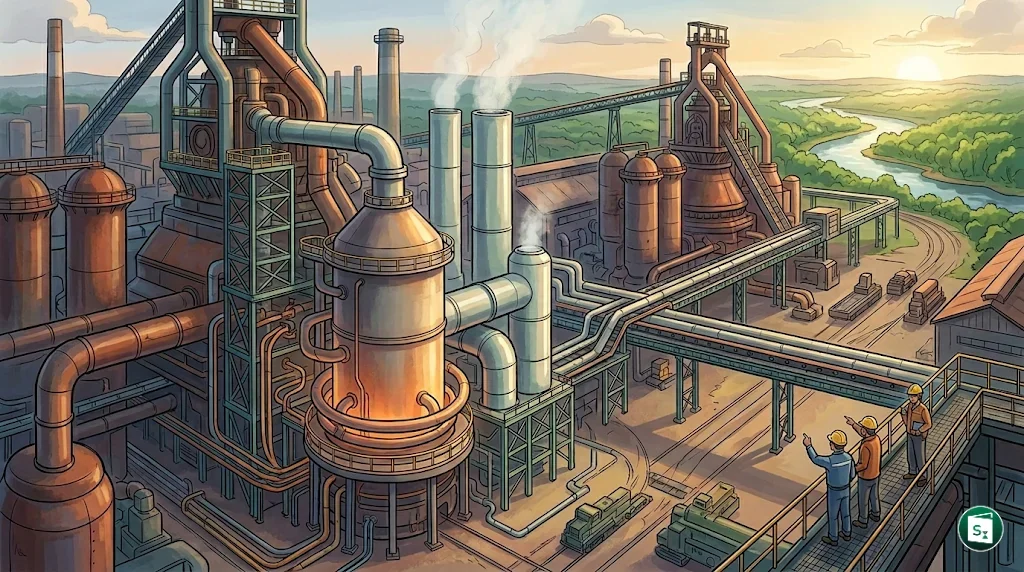
Tata Steel Limited has entered into a definitive agreement with Paul Wurth, an SMS group company, to deploy the world’s first industrial scale EASyMelt technology at its Jamshedpur plant in Jharkhand. The pioneering project aims to transform the conventional blast furnace process by significantly reducing coke consumption and cutting carbon dioxide emissions by more than 50 percent. This initiative marks a crucial milestone in the company’s roadmap to achieve its net zero carbon emission target by the year 2045.
Understanding EASyMelt Technology
EASyMelt, which stands for Electrically Assisted Syngas Smelter, is an innovative ironmaking technology designed to modernize existing blast furnaces. The process focuses on replacing a substantial portion of metallurgical coke with syngas, a mixture primarily composed of hydrogen and carbon monoxide. This syngas is generated by recycling the blast furnace top gas and reforming it with hydrocarbon rich gases, such as natural gas or coke oven gas.
A defining feature of the EASyMelt system is the integration of plasma torches at the tuyere level. These torches use electricity to superheat the injected syngas to temperatures between 1,700 and 2,200 degrees Celsius. This partial electrification of the smelting process provides the necessary thermal energy that would otherwise come from burning fossil fuels. Unlike some other low carbon technologies that require expensive high grade iron ore, EASyMelt is compatible with conventional sinter feed, which is more readily available and cost effective.
Key Technical Aspects of EASyMelt
| Feature | Details |
|---|---|
| Primary Objective | Over 50 percent reduction in carbon dioxide emissions |
| Fuel Substitution | Replaces metallurgical coke with syngas (hydrogen and carbon monoxide) |
| Energy Source | Uses electricity via plasma torches for superheating |
| Process Type | Brownfield retrofit for existing blast furnaces |
| Material Flexibility | Operates with conventional sinter feed and diverse gas inputs |
Analogy · Hybrid Industrial Heating Expand analogy
Imagine a traditional blast furnace as a wood fire that needs constant logs to stay hot. EASyMelt is like adding an electric heater and a fan that blows recycled heat back into the fire. This allows the furnace to maintain high temperatures while using much fewer logs, thereby reducing the smoke and carbon produced.
Scope of the Tata Steel and Paul Wurth Agreement
The definitive agreement follows a Memorandum of Understanding signed between the two parties in June 2023. The project will be implemented in a phased manner at Tata Steel’s Jamshedpur Works, which was established in 1907 as India’s first integrated steel plant. The initial focus will be the conversion of Blast Furnace E, which has a capacity of 649 cubic metres.
This industrial scale demonstration project aims to prove the effectiveness of EASyMelt in a real world setting. By retrofitting existing infrastructure, the technology provides a brownfield solution for decarbonization, avoiding the massive capital expenditure required for entirely new plants. Once fully operational, the system is expected to reduce the blast furnace’s baseline carbon emissions by more than 50 percent, significantly lowering the environmental footprint of the steel manufacturing process.
Significance for India’s Steel Sector
India is currently the world’s second largest steel producer, and the sector is a vital pillar of the national economy. However, steelmaking is also one of the most carbon intensive industries, accounting for approximately 10 to 12 percent of India’s total greenhouse gas emissions. The average emission intensity of Indian steel plants is about 2.65 tonnes of carbon dioxide per tonne of crude steel, which is higher than the global average.
The adoption of EASyMelt technology aligns with the National Steel Policy, which aims to reduce the sector’s emission intensity to 2.0 tonnes of carbon dioxide per tonne of finished steel by the mid-2030s. Moreover, the flexibility of the EASyMelt system allows it to use diverse energy sources, including natural gas, hydrogen, and ammonia, depending on their availability and cost. This versatility is crucial as India prepares for the Carbon Border Adjustment Mechanism (CBAM) and other international trade regulations that favor low carbon products.
Decarbonization Goals and the Path to Net Zero
Tata Steel has committed to reaching net zero carbon emissions by 2045, ahead of India’s national pledge to achieve net zero by 2070. The EASyMelt project is a central element of this roadmap, alongside other initiatives such as carbon capture, utilization, and storage (CCUS) and the transition to scrap based electric arc furnaces.
In Luxembourg, where Paul Wurth is headquartered, the company has established itself as a global leader in engineering for the iron and steel industry since its founding in 1870. Now a part of the SMS group based in Germany, Paul Wurth serves as a hub for developing sustainable metallurgical technologies. This collaboration between an Indian industrial giant and a European technology leader highlights the global nature of the transition toward Green Steel and sustainable industrial practices.
Key Takeaways
- Tata Steel and Paul Wurth, an SMS group company, signed a definitive agreement to implement the world’s first industrial scale EASyMelt technology.
- The project will be established at the Jamshedpur Works in Jharkhand, specifically targeting the conversion of Blast Furnace E.
- EASyMelt technology uses plasma torches to superheat syngas, which is expected to reduce carbon emissions by more than 50 percent.
- India is the second largest steel producer globally, with the steel sector accounting for approximately 10 to 12 percent of the country’s total emissions.
- Tata Steel has set a target to achieve net zero carbon emissions across its global operations by the year 2045.
- Paul Wurth, which is headquartered in Luxembourg, was founded in 1870 and currently serves as a global research hub for the German-based SMS group.