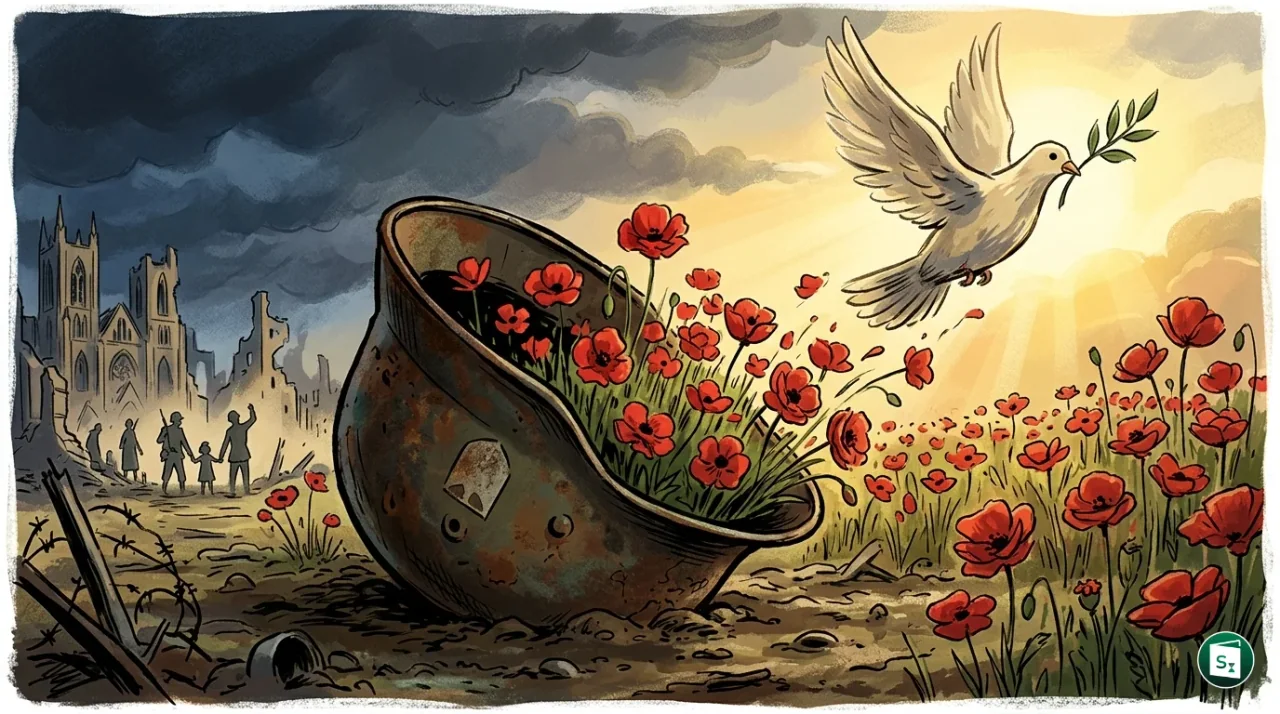
The global community observed the Time of Remembrance and Reconciliation for Those Who Lost Their Lives during the Second World War on May 8 and 9, 2026. Established by the United Nations General Assembly in 2004, the annual observance pays tribute to all victims of the conflict and promotes reconciliation among former adversaries. The dates coincide with the anniversary of the unconditional surrender of Nazi Germany in 1945, which brought an end to the war in Europe.
Background and Establishment of the Observance
The United Nations General Assembly officially established the observance on November 22, 2004, by adopting Resolution 59/26. Titled the Commemoration of the sixtieth anniversary of the end of the Second World War, the resolution declared May 8 and May 9 as a time of remembrance and reconciliation. While the United Nations recognizes that individual member nations celebrate their own specific days of victory, liberation, or mourning, it created this joint period to allow the global community to unite in paying tribute to all victims of the war.
The establishment of the United Nations is itself deeply connected to the legacy of the conflict. The war caused unprecedented suffering to humanity, prompting world leaders to form a global body to prevent future world wars. The preamble of the United Nations Charter, signed in San Francisco in June 1945, explicitly pledges to save succeeding generations from the scourge of war. Through this annual observance, the United Nations invites member states, non-governmental organisations, and individuals to conduct memorial services, educational exhibitions, and reconciliation programmes to honor the dead and reaffirm their commitment to international peace.
The Historical Divide: May 8 versus May 9
The choice of two separate days for celebrating the end of the war in Europe is a result of timezone differences and political negotiations in 1945. On May 7, 1945, German representative Alfred Jodl signed the first instrument of unconditional surrender at Reims, France, with Allied commanders. The surrender was scheduled to take effect at 23:01 Central European Time on May 8, 1945. However, Soviet leader Joseph Stalin insisted on a second signing in Berlin, the capital of defeated Germany, to mark the Soviet contribution to the victory.
This formal document was signed late on May 8, 1945, in Berlin. Because of the geographic timezone difference, the moment of surrender occurred at 01:01 Moscow Time on May 9, 1945. Consequently, Western nations like the United Kingdom and the United States celebrate Victory in Europe Day on May 8, while Russia and several post-Soviet nations observe Victory Day on May 9.
Changing Geopolitics of Commemoration
In recent years, the choice between these dates has become a political symbol in Eastern Europe. Several countries that formerly belonged to the Soviet bloc have officially shifted their commemorations from May 9 to May 8. For instance, Ukraine passed a law in 2023 to observe the Day of Remembrance and Victory over Nazism on May 8, aligning its calendar with Western Europe and distancing its national history from Moscow.
| Aspect | Western Europe and United States (VE Day) | Eastern Europe and Russia (Victory Day) |
|---|---|---|
| Date of Observance | May 8 | May 9 |
| Primary Focus | Solemn remembrance, honoring victims, and reconciliation | Celebration of military triumph and national strength |
| Key Historical Event | Signing of the Reims surrender and taking effect of the armistice | Moscow time of the Berlin surrender ceremony |
| Typical Activities | Wreath-laying ceremonies and moments of silence | Grand military parades and patriotic rallies |
India’s Monumental Contribution to the Allied War Effort
India played a critical role in the Allied victory during the Second World War, although it was under British rule at the time. The British Indian Army underwent an unprecedented expansion, growing from fewer than 200,000 men in 1939 to more than 2.5 million personnel by August 1945. This massive force became the largest volunteer army in recorded history. Indian soldiers fought on multiple fronts across the globe, including campaigns in North Africa, East Africa, the Middle East, Italy, and South-East Asia.
The Burma Campaign and Key Theatres
The most critical theatre of operation for Indian forces was the Burma Campaign against the forces of Imperial Japan. Indian troops formed the core of the British Fourteenth Army, which successfully defended the Indian border at Imphal and Kohima, and subsequently pushed Japanese forces out of Burma. Beyond active combat, India served as a key logistical and industrial base for Allied operations in Asia. This included hosting the supply lines that supported Allied operations in China, making India’s strategic location vital to the defeat of the Axis powers in the eastern hemisphere.
Recognition and Post-War Impact
The contribution came at a heavy cost, with more than 87,000 Indian servicemen losing their lives in the line of duty. Their valor was recognized with numerous military honors, including the prestigious Victoria Cross. The critical role of the force was acknowledged by Field Marshal Claude Auchinleck, the Commander-in-Chief of the Indian Army, who noted that Britain could not have survived both World Wars without the support of the Indian Army. The return of millions of trained, experienced soldiers also transformed the domestic political landscape. It created a highly organized group of veterans and contributed significantly to the growing momentum that led to India’s independence in 1947.
Key Takeaways
- The Time of Remembrance and Reconciliation for Those Who Lost Their Lives during the Second World War is observed annually on May 8 and May 9.
- The United Nations General Assembly established this observance in November 2004 through the adoption of Resolution 59/26.
- Western nations celebrate the end of the conflict in Europe as Victory in Europe Day on May 8, while Russia and other post-Soviet states celebrate it as Victory Day on May 9 due to timezone differences.
- During the Second World War, the British Indian Army grew to over 2.5 million soldiers, making it the largest volunteer army in recorded history.
- More than 87,000 Indian servicemen lost their lives during the war, fighting in major theatres such as the Burma Campaign.