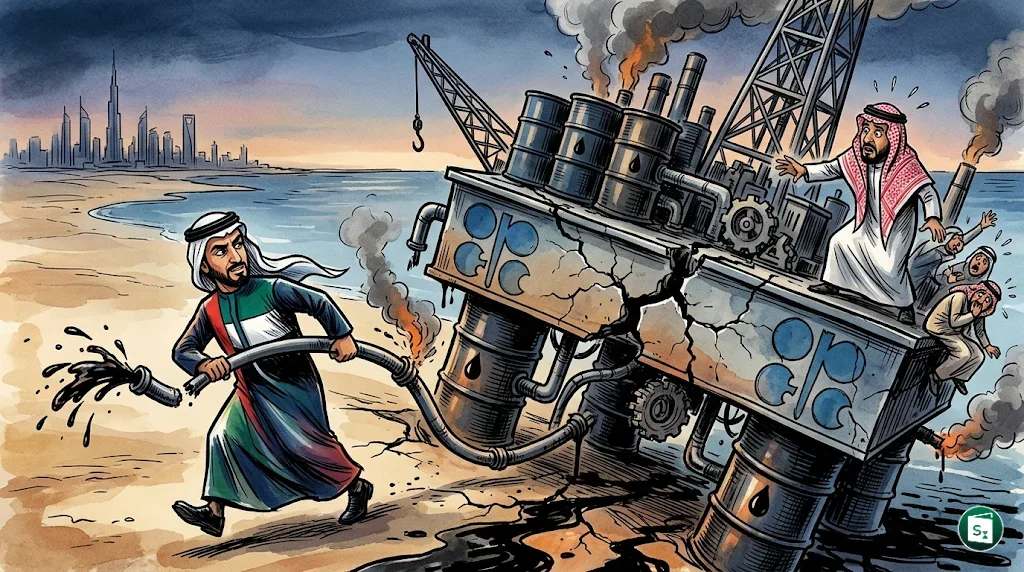
The United Arab Emirates officially announced its withdrawal from the Organization of the Petroleum Exporting Countries (OPEC) and the wider OPEC+ alliance on April 29, 2026. This historic decision marks the exit of one of the world’s most significant oil producers from the 66-year-old cartel, signaling a major shift in the global energy landscape. The move is expected to fundamentally alter production dynamics and challenge the longstanding leadership of Saudi Arabia within the group.
Reasons Behind the Strategic Departure
The UAE’s decision to leave follows years of simmering tension over production baselines and quotas. Since the formation of the OPEC+ alliance, the UAE has consistently argued that its allocated production limits do not reflect its massive investments in capacity expansion. The state-owned Abu Dhabi National Oil Company (ADNOC) has been working toward a target of 5 million barrels per day (mbpd) by 2027, a goal that was recently accelerated from 2030.
Under the previous OPEC agreements, the UAE was forced to keep a significant portion of its production capacity idle to support global prices. This strategy increasingly clashed with the nation’s broader economic goal of maximizing oil revenues in the short term to fund its transition to a post-oil economy. By exiting the group, the UAE gains the autonomy to set its own production levels, allowing it to better monetize its natural resources while global demand remains robust.
Impact on OPEC and the Global Oil Market
The departure of the UAE is a severe blow to OPEC’s ability to manage global oil supply. As one of the few members with genuine spare capacity, which is the ability to quickly ramp up production during global shortages, the UAE has been a pillar of the group’s market-stabilizing efforts. Its exit leaves OPEC more reliant on a smaller pool of heavy hitters, primarily Saudi Arabia, and reduces the group’s overall share of global production.
Analysts predict that the withdrawal will lead to increased price volatility in the short term. Without the discipline of OPEC quotas, the UAE could potentially flood the market with additional crude, putting downward pressure on prices. This move also sets a concerning precedent for other members who may feel similarly constrained by production caps. The group has already seen high-profile exits in recent years, including Qatar in 2019, Ecuador in 2020, and Angola in early 2024.
The Saudi-UAE Geopolitical Rivalry
The withdrawal is also a clear manifestation of the growing geopolitical rift between the UAE and Saudi Arabia. While the two nations have traditionally been close allies, they have recently diverged on several fronts, including regional conflicts, economic competition, and energy policy. Saudi Arabia has favored a higher-for-longer oil price strategy to fund its Vision 2030 transformation projects, which requires strict production cuts. In contrast, the UAE has prioritized a volume-based strategy to capture market share before global demand potentially peaks.
This move effectively weakens Saudi Arabia’s de facto leadership of the Arab world’s energy policy. By charting an independent course, the UAE is challenging the one-size-fits-all approach that has defined the region’s oil diplomacy for decades. The competition between Abu Dhabi and Riyadh for regional dominance is now likely to intensify, with both nations vying to become the primary hub for finance, tourism, and technology in West Asia.
Understanding OPEC and the OPEC+ Alliance
The Organization of the Petroleum Exporting Countries (OPEC) was founded in September 1960 at the Baghdad Conference. Its founding members included Iran, Iraq, Kuwait, Saudi Arabia, and Venezuela. The organization is headquartered in Vienna, Austria, and its primary objective is to coordinate and unify the petroleum policies of its member countries to ensure the stabilization of oil markets.
In 2016, OPEC expanded its reach by forming the OPEC+ alliance. This group includes the 12 core members of OPEC along with 10 other major oil-producing countries, most notably Russia. The alliance was created to give the group greater control over global oil supply in response to the rise of American shale oil production. With the exit of the UAE, the group loses one of its most technologically advanced and financially stable members, potentially signaling a new era of fragmentation in global energy governance.
Key Takeaways
- The United Arab Emirates officially withdrew from OPEC and the OPEC+ alliance on April 29, 2026.
- The decision was driven by frustrations over production quotas that constrained the UAE’s 5 million barrels per day (mbpd) capacity target set for 2027.
- OPEC was established in 1960 at the Baghdad Conference and is currently headquartered in Vienna, Austria.
- The OPEC+ alliance was formed in 2016 to include non-member allies like Russia in global production management.
- The UAE follows other recent exits from the organization, including Qatar (2019), Ecuador (2020), and Angola (2024).
- The move signals a weakening of the geopolitical influence of Saudi Arabia and indicates a shift toward individual national energy strategies in West Asia.