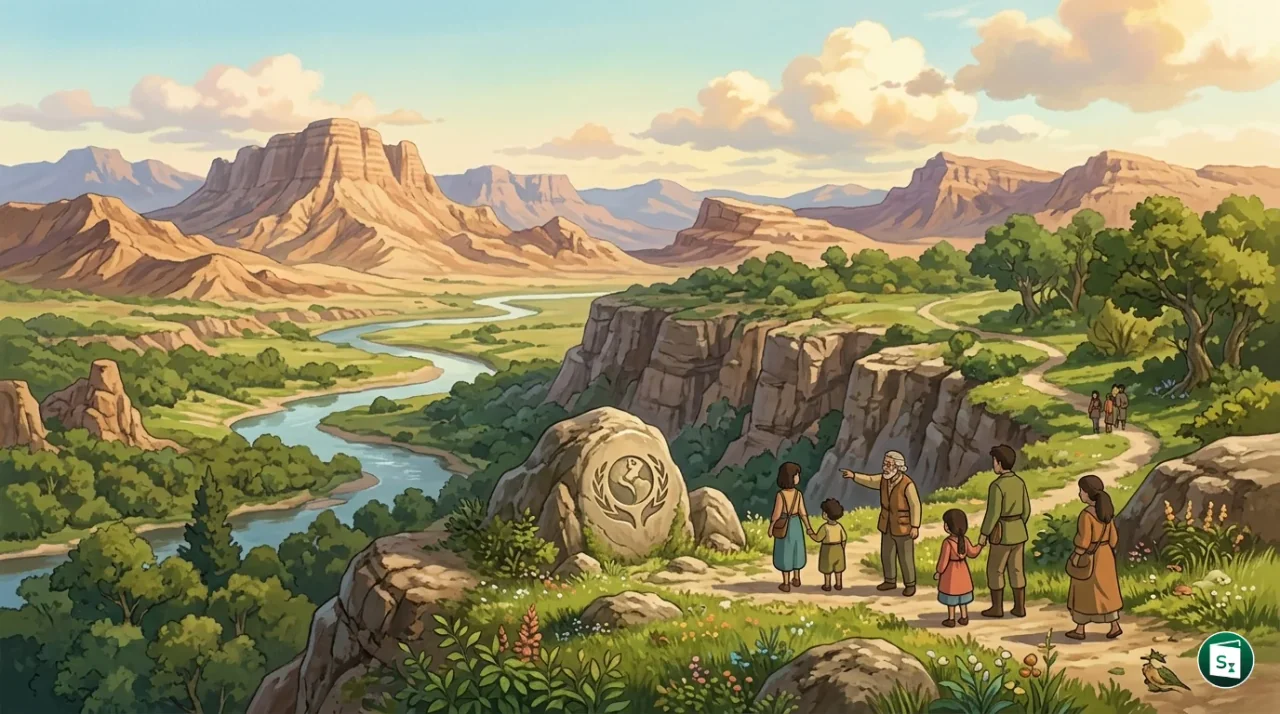
UNESCO has officially designated 12 new sites to its Global Geoparks Network, bringing the total number of recognized geoparks to 241 across 51 countries. This announcement, made in April 2026, marks a significant expansion of the network, which now covers a combined area of over 8.82 lakh square kilometres. The new additions highlight the organization’s continued commitment to preserving international geological heritage through sustainable, community-led management.
Global Expansion of UNESCO Geopark Network
The 2026 expansion includes a diverse array of sites ranging from the karst plateaus of Japan to the fortified granaries of Tunisia. With the addition of these 12 new geoparks, the network now spans 51 countries. Notably, Tunisia has entered the network for the first time, marking a significant milestone for North African geological representation.
The following table lists the 12 sites newly added to the UNESCO Global Geoparks Network:
| Country | Newly Designated UNESCO Global Geopark |
|---|---|
| China | Changshan, Mt. Siguniang |
| France | Terres d’Hérault |
| Greece | Nisyros |
| Ireland | Joyce Country and Western Lakes |
| Japan | Miné-Akiyoshidai Karst Plateau |
| Malaysia | Lenggong, Sarawak Delta |
| Portugal | Algarvensis |
| Russia | Toratau |
| Tunisia | Dahar |
| Uruguay | Manantiales Serranos |
Spotlight on Tunisia’s First Global Geopark
The Dahar UNESCO Global Geopark in southeastern Tunisia is the country’s first such designation and only the third in Africa, joining sites in Morocco and Tanzania. Covering over 6,000 square kilometres, the park spans the governorates of Tataouine, Médenine, and Gabès. This territory provides a continuous geological record dating back 250 million years.
One of its most prominent features is Jebel Tebaga, which contains Africa’s only known marine outcrop from the Upper Permian period. Beyond its geological wealth, Dahar is celebrated for its cultural landscape, featuring ksour (fortified granaries) and traditional troglodytic dwellings that demonstrate how local communities have adapted to the arid desert environment for centuries.
Governance and the Bottom-Up Approach
The UNESCO Global Geopark label was established in 2015 to recognize areas of international geological significance. Unlike other heritage designations, geoparks follow a bottom-up approach, meaning the management involves local communities, indigenous peoples, and regional stakeholders from the start. This model ensures that geological conservation is linked with sustainable economic development, primarily through geo-tourism.
A designation as a UNESCO Global Geopark is not permanent. Each site receives the status for a period of four years. After this term, the site must undergo a rigorous revalidation process to demonstrate that it continues to meet UNESCO’s standards for management, education, and conservation. If a site fails this process, it may lose its official status.
Status and Future of Geoparks in India
While the Global Geoparks Network continues to grow, India does not currently have any designated UNESCO Global Geoparks. However, the Geological Survey of India (GSI) has identified several potential sites for this status. Some of the prominent candidates include the Lonar Lake in Maharashtra, the Stramatolites in Rajasthan, and the Eocene fossils of the Kutch region in Gujarat.
Establishing a geopark in India would require a shift towards the UNESCO-mandated community-led management model, moving beyond traditional top-down conservation methods. Such a designation could provide a significant boost to local economies by promoting scientific research and educational tourism centered on India’s diverse geological features.
Key Takeaways
- UNESCO added 12 new sites to its Global Geoparks Network in April 2026, bringing the total to 241 sites.
- The network now spans 51 countries and covers a total area exceeding 8.82 lakh square kilometres.
- Tunisia gained its first-ever geopark with the designation of the Dahar UNESCO Global Geopark.
- The Dahar site is only the third UNESCO Global Geopark in Africa, following sites in Morocco and Tanzania.
- The UNESCO Global Geopark label was established in 2015 and emphasizes a bottom-up management model involving local communities.
- Designation is valid for four years, after which a revalidation process is mandatory for retaining the status.
- India currently does not have any UNESCO Global Geoparks, though the Geological Survey of India has identified potential candidate sites.