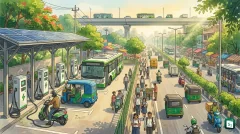
Union Minister for Heavy Industries and Steel HD Kumaraswamy unveiled the Unified Bharat e-Charge (UBC) platform, a national digital system designed to integrate the country’s fragmented electric vehicle charging network. The platform was launched during the National Conference on Enabling Nationwide EV Charging Infrastructure held in Bengaluru on May 12, 2026. This initiative aims to establish a seamless digital gateway to locate, reserve, and pay for charging slots across different operators nationwide.
Unveiling of the Unified Bharat e-Charge Platform
The Unified Bharat e-Charge (UBC) platform marks a major milestone in India’s electric vehicle journey by addressing the critical challenge of fragmented charging systems. Currently, electric vehicle owners must download and register on multiple mobile applications to access chargers operated by different companies. This separation of networks causes significant inconvenience, as users need to manage multiple digital wallets and navigate different user interfaces just to charge their vehicles.
The launch of the platform aims to solve this fragmentation by acting as a central digital gateway. Often described as the UPI for electric vehicle charging, the system allows users to search, locate, book slots, and make payments across different charging networks through a single, unified interface. This interoperable approach simplifies the user journey and reduces range anxiety, which is a major barrier to widespread clean mobility adoption in India.
Core Technologies and Platform Architecture
The architecture of the Unified Bharat e-Charge platform is built on an open, decentralized framework utilizing the Beckn Protocol. Rather than relying on a single, monolithic database, this open network allows diverse software applications to communicate with each other seamlessly. This structure is similar to the open protocols that power India’s digital public infrastructure, such as the Open Network for Digital Commerce (ONDC).
The system architecture consists of two main software layers that enable real-time communication. User-facing systems, known as Beckn Application Providers, serve as the frontend interface for consumers, letting them search for chargers through mobile apps or vehicle dashboards. On the other hand, the backend systems managed by charging network operators function as Beckn Platform Providers, which receive booking signals and coordinate the charging process. A decentralized registry acts as a discovery layer, broadcasting user queries to these providers to fetch real-time availability.
To ensure compatibility across different hardware configurations, the platform integrates standard industry communication protocols. It utilizes the Open Charge Point Protocol (OCPP) to connect physical charging stations with their management systems, and the Open Charge Point Interface (OCPI) to handle roaming transactions across different operators. This combination of open standards ensures that an electric vehicle can access chargers from public utilities and private companies alike without technical bottlenecks.
Institutional Synergy: Role of BHEL and NPCI
The development of the platform is a collaborative effort between two key public sector institutions. Bharat Heavy Electricals Limited (BHEL) is leading the development of the platform. BHEL was established in 1964 under the Ministry of Heavy Industries and is headquartered in New Delhi. In this initiative, BHEL serves as the nodal agency for demand aggregation, overseeing the creation of the digital super-app and coordination with charge point operators.
Technical support for the digital transaction framework is provided by the National Payments Corporation of India (NPCI). Established in 2008 as a joint initiative of the Reserve Bank of India and the Indian Banks’ Association, NPCI is headquartered in Mumbai. NPCI has designed the backend billing and settlement system, creating a secure clearinghouse for transactions across different operator networks. This ensures that payments made by consumers are split and routed to the correct charging service provider immediately, mimicking the efficiency of India’s retail payment systems.
Scaling EV Infrastructure in Karnataka and Nationwide
To support the expansion of clean mobility, the government has approved targeted funding for setting up charging stations across the country. As part of this push, the Union Minister approved the installation of 1,243 electric vehicle charging stations in Karnataka with a dedicated financial outlay of ₹123.26 crore. This state-specific approval is part of a broader nationwide effort to expand public charging accessibility.
Cumulatively, charging infrastructure proposals worth ₹503.86 crore have been cleared, which will support the setup of 4,874 chargers across various regions. These installations will be managed by state governments and Central Public Sector Enterprises (CPSEs), including major oil marketing companies such as Bharat Petroleum Corporation Limited (BPCL), Indian Oil Corporation Limited (IOCL), and Hindustan Petroleum Corporation Limited (HPCL).
The table below summarizes the key financial allocations and target charger counts approved under the national charging infrastructure expansion initiative.
| Target Location / Enterprise Type | Number of Approved Chargers | Financial Outlay | Participating Entities |
|---|---|---|---|
| Karnataka State | 1,243 chargers | ₹123.26 crore | Karnataka State Government agencies |
| National Total (Including CPSEs) | 4,874 chargers | ₹503.86 crore | HPCL, IOCL, BPCL, and various state governments |
Policy Alignment: PM E-DRIVE Scheme
The expansion of charging infrastructure and the development of the unified digital platform align with the targets of the PM Electric Drive Revolution in Innovative Vehicle Enhancement (PM E-DRIVE) scheme. This central program is implemented by the Ministry of Heavy Industries and was officially notified on September 29, 2024, before coming into effect on October 1, 2024. The government has extended the tenure of this flagship scheme until March 31, 2028, to provide a sustained policy framework for electric mobility in India.
The PM E-DRIVE scheme has a total budget allocation of ₹10,900 crore, with a dedicated sub-allocation of ₹2,000 crore set aside for public electric vehicle charging stations. Under this funding window, the government aims to support the installation of 72,300 charging units across the country, focusing on highways, cities, and heavy transit corridors. The Unified Bharat e-Charge platform acts as the digital counterpart to this massive hardware deployment, ensuring that the physical network of chargers is accessible, interconnected, and convenient for consumers.
Key Takeaways
- Union Minister HD Kumaraswamy launched the Unified Bharat e-Charge (UBC) platform, a unified national electric vehicle charging platform, during a conference in Bengaluru.
- The platform is developed by Bharat Heavy Electricals Limited (BHEL), which was established in 1964 under the Ministry of Heavy Industries with headquarters in New Delhi.
- Technical and transaction support for the system is provided by the National Payments Corporation of India (NPCI), which was established in 2008 and is headquartered in Mumbai.
- The Minister approved the installation of 1,243 electric vehicle charging stations in Karnataka with a financial outlay of ₹123.26 crore.
- Cumulative approvals for charging infrastructure now stand at ₹503.86 crore to install 4,874 chargers across multiple states and public sector enterprises.
- The initiative is aligned with the PM Electric Drive Revolution in Innovative Vehicle Enhancement (PM E-DRIVE) scheme, which has a total outlay of ₹10,900 crore and is active until March 31, 2028.