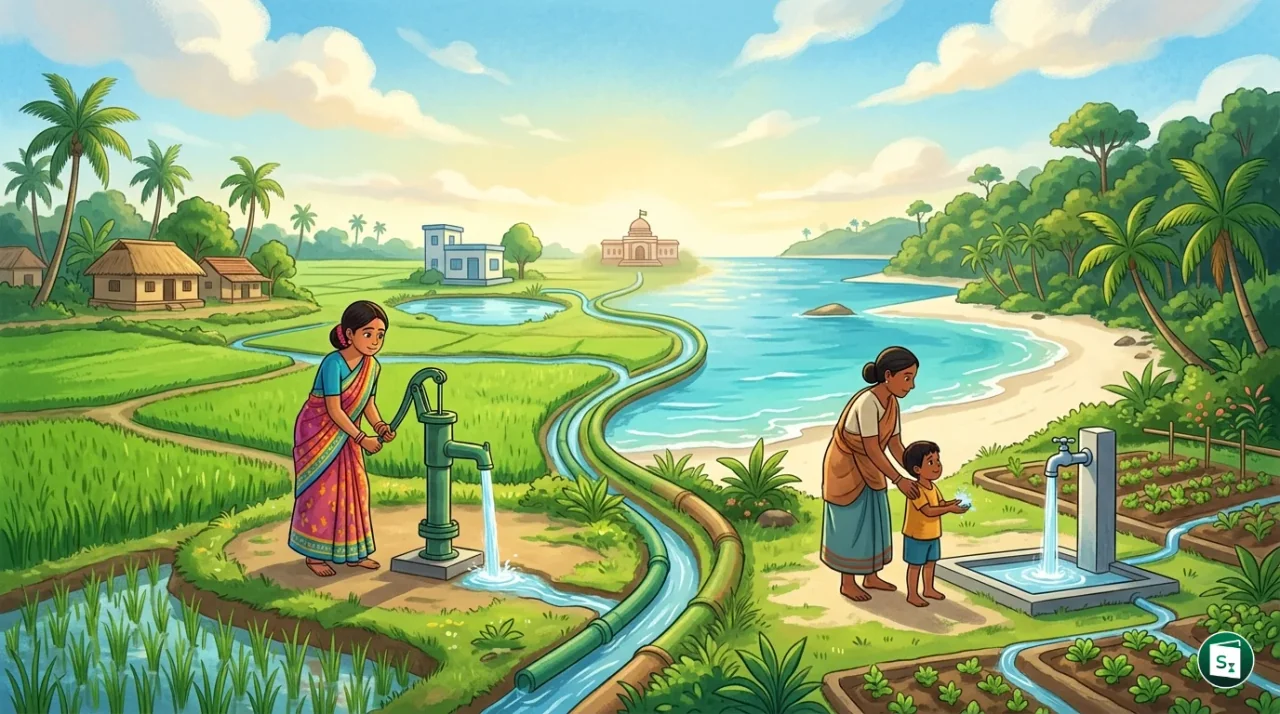
The Union Government signed reform-linked Memorandums of Understanding with West Bengal and the Andaman and Nicobar Islands under the newly approved Jal Jeevan Mission (JJM) 2.0. Signed in the presence of Union Jal Shakti Minister C.R. Patil on May 18, 2026, the agreements mark a strategic transition from building initial water infrastructure to ensuring long-term sustainability, reliable service delivery, and local accountability. This shift signals a major evolution in India’s flagship rural drinking water initiative as it works toward achieving comprehensive utility-based governance.
Strategic Shift: What is Jal Jeevan Mission 2.0?
The Jal Jeevan Mission (JJM) 2.0 represents the restructured second phase of India’s flagship rural water program, approved by the Union Cabinet on March 10, 2026. This updated phase extends the mission’s operational period until December 2028. Under the governance of the Ministry of Jal Shakti and executed by the Department of Drinking Water and Sanitation (DDWS), the initiative aims to consolidate the gains made during the first phase of implementation.
The primary objective of this phase is to transition from mere infrastructure creation to ensuring that tap water connections deliver clean water consistently. While the initial phase focused on building networks and laying water pipelines to establish Functional Household Tap Connections (FHTC), the second phase prioritizes service delivery and operational efficiency. The government has designed this update to build a professional, utility-based management system for rural water supplies across India.
Core Provisions of the Reform-Linked MoUs
The reform-linked Memorandums of Understanding serve as the primary mechanism for distributing central funds under the second phase. To unlock financial support, states and Union Territories must agree to implement structural and governance changes. The new agreements establish a decentralized model where the responsibility for water supply management moves away from centralized government departments and into the hands of local communities.
Under this reform framework, states must formalize the handover of in-village water supply infrastructure to Gram Panchayats and Village Water and Sanitation Committees (VWSCs). These local institutions are designated as the official water service providers in their respective areas. They are responsible for managing the day-to-day operation and maintenance of local water supply networks. They also collect water tariffs from households to cover operational costs and conduct regular water quality testing using field test kits.
Regional Implementation in Andaman & Nicobar and West Bengal
The signing of these MoUs marks the rollout of JJM 2.0 reforms tailored to specific regional challenges. The Union Territory of Andaman and Nicobar Islands and the State of West Bengal represent two distinct environments with unique infrastructure and governance needs.
Focus on Andaman and Nicobar Islands
The Andaman and Nicobar Islands administration was commended for achieving 100% rural tap water coverage in 2021 and securing its certification as a Har Ghar Jal territory. Because the islands rely heavily on rainwater harvesting and local aquifers, long-term water security depends on managing these resources carefully. The local administration has already started decentralized trial runs under the second phase guidelines. A successful pilot project was launched in the Sippighat Gram Panchayat in South Andaman. This pilot serves as a model for transferring management authority to village committees.
Directives for West Bengal
Union Jal Shakti Minister C.R. Patil urged the West Bengal administration to accelerate the implementation of the new guidelines. While progress has been made, the ministry highlighted the need to focus on historically lagging districts. Specific physical reviews have been ordered for water supply projects in the districts of Darjeeling, Kalimpong, and Purulia. The central government also recommended that the state adopt the Jal Sanchay Jan Bhagidari public water conservation initiative. Additionally, the state was urged to expand campaigns like Karmabhoomi se Matrubhoomi to encourage local community participation in water stewardship.
Digital Accountability via the Sujalam Bharat Framework
A key component of the reforms mandated under the new MoUs is the implementation of the Sujalam Bharat national digital framework. This uniform digital platform is designed to track rural drinking water systems from source to tap, ensuring that water supply networks are functional. The platform moves monitoring efforts beyond simple counts of pipe connections and instead measures real-time service delivery and water availability in rural households.
Under the framework, each village is assigned a unique Sujal Gaon ID, also known as a Service Area ID. This digital identifier serves as the foundation for geospatial mapping of all rural water infrastructure. Developed with technical support from the Bhaskaracharya National Institute for Space Applications and Geo-informatics (BISAG-N), the system is fully integrated with the national PM Gati Shakti GIS database. States are required to validate all village-level schemes against this digital registry before the central government releases funding, ensuring complete transparency and preventing asset duplication.
Historical Context: The Original Jal Jeevan Mission
The parent initiative, the Jal Jeevan Mission (JJM), was launched by Prime Minister Narendra Modi on August 15, 2019. Implemented under the Ministry of Jal Shakti, the original goal of the mission was to provide a Functional Household Tap Connection (FHTC) to every rural household in India by 2024. The program designed its infrastructure to deliver 55 litres per capita per day (lpcd) of safe, potable drinking water. Since its inception, the initiative has transformed rural water access across the country, expanding the network from approximately 17% coverage in 2019 to more than 81% coverage by late 2025.
To achieve complete coverage and sustain the water supply networks already built, the Union Government extended the mission timeline to December 2028 and restructured it into Jal Jeevan Mission 2.0. The government supported this extension with a budgetary allocation of ₹67,000 crore in the Union Budget 2025-26. The new phase builds on previous milestones, which include providing tap water access to nearly 89% of schools and 85% of Anganwadi centers nationwide.
The table below summarizes the key milestones and operational details of the Jal Jeevan Mission since its launch:
| Parameter | Details and Achievements |
|---|---|
| Launch Date | August 15, 2019 |
| Nodal Ministry | Ministry of Jal Shakti |
| Target Service Delivery | 55 litres of water per person per day |
| Coverage at Launch (2019) | 17% of rural households (3.23 crore connections) |
| Coverage by Late 2025 | Over 81% of rural households (15.72 crore connections) |
| Extended Mission Deadline | December 2028 |
| Union Budget 2025-26 Allocation | ₹67,000 crore |
Key Takeaways
- The Jal Jeevan Mission 2.0 is the restructured second phase of India’s flagship rural water program, extending operations until December 2028.
- The new agreements establish a decentralized model, transferring operation and maintenance of in-village water systems to Gram Panchayats and Village Water and Sanitation Committees.
- The uniform national digital framework Sujalam Bharat was introduced to map rural water assets using a unique Sujal Gaon ID for each village.
- The digital mapping system under Sujalam Bharat is developed with support from BISAG-N and integrated with the PM Gati Shakti GIS platform.
- The original Jal Jeevan Mission was launched by Prime Minister Narendra Modi on August 15, 2019 under the Ministry of Jal Shakti.
- The parent mission aimed to provide 55 litres per capita per day of drinking water, raising coverage from 17% in 2019 to over 81% by late 2025.