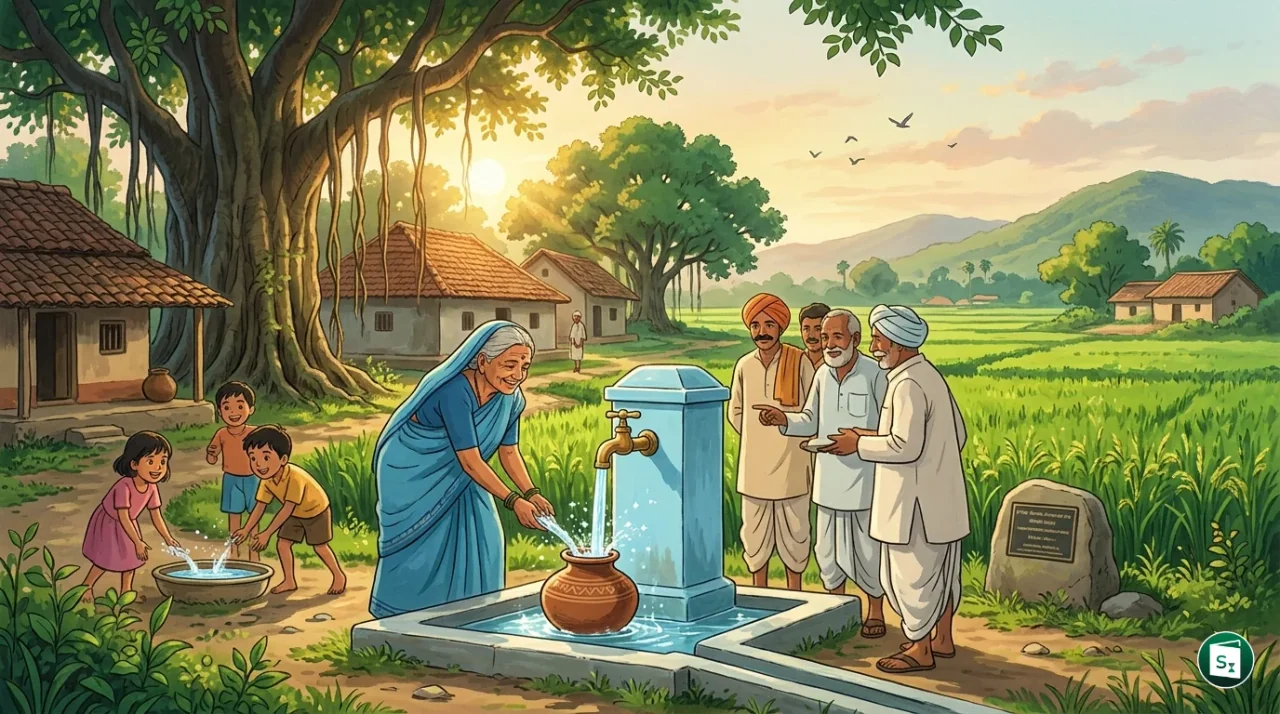
Uttar Pradesh has become the first state in India to mandate a 10-year operation and maintenance (O&M) warranty for rural water schemes under the Jal Jeevan Mission. This shift, implemented through the ‘Jal Arpan’ initiative, aims to ensure the long-term sustainability of water infrastructure by holding construction agencies accountable for a full decade. By transferring ownership to local Gram Panchayats, the state is pioneering a decentralized service-delivery model that prioritizes community management and reliable water supply.
What Is the ‘Jal Arpan’ Initiative?
The ‘Jal Arpan’ initiative is a transformative policy designed to transition from a construction-led approach to a service-delivery model in rural water management. Under this framework, the Uttar Pradesh government formally transfers the ownership and operational oversight of rural water supply infrastructure to the respective Gram Panchayats (GPs) and their Village Water and Sanitation Committees (VWSCs), commonly known as Paani Samitis.
This decentralized approach aligns with the 73rd Constitutional Amendment Act, which empowers local bodies to manage essential services like drinking water. By making the community the primary owner of the assets, the state aims to foster a sense of responsibility and ensure that water systems are tailored to local needs. The transfer of assets ensures that village-level institutions have the authority to manage water distribution, collect user fees, and oversee the quality of service.
Mandating a Decade of Accountability
The most significant feature of the new model is the 10-year mandatory maintenance warranty. Traditionally, construction contracts in rural water projects included a short maintenance period of one to two years, after which the systems were often neglected due to lack of funds or technical expertise at the village level. Uttar Pradesh has now extended this period to ten years, making it a benchmark for long-term accountability in the water sector.
Under this policy, the construction agencies are contractually bound to:
- Handle all major and minor repairs for the entire decade.
- Ensure the regular operation of the pumping machinery and distribution network.
- Maintain the quality of water supplied to households as per national standards.
- Provide technical training and handholding to the Village Water and Sanitation Committees.
This long-term commitment ensures that any initial construction defects are rectified by the same agency that built the system, incentivizing high-quality engineering from the start.
Empowering Gram Panchayats for Sustainable Water Management
The transition of ownership to Gram Panchayats is accompanied by several structural reforms to ensure financial and operational sustainability. A critical component is the promotion of solar energy to power water schemes. By May 2026, Uttar Pradesh had already transitioned over 33,000 schemes to solar power, significantly reducing electricity costs and dependency on the grid.
To improve service standards, the government is introducing a Citizen Charter under the Public Service Guarantee Act. This charter defines specific benchmarks for:
- Quantity: Ensuring a minimum of 55 litres per capita per day (lpcd).
- Quality: Adhering to BIS 10500 standards for potable water.
- Reliability: Timely supply and prompt grievance redressal.
Gram Panchayats are empowered to collect user charges from households, which are used to cover operational costs beyond the contractor’s warranty. This model creates a circular economy where the community contributes to the upkeep of their own assets, ensuring that the schemes do not become defunct after the initial government funding ends.
Progress of Jal Jeevan Mission in Uttar Pradesh
The Jal Jeevan Mission (JJM), launched by the Central Government on August 15, 2019, initially aimed to provide functional household tap connections (FHTC) to every rural household by 2024. The mission has since been extended to 2028 to ensure 100% coverage across the country. Uttar Pradesh, given its massive rural population, has been a key focus area for the Ministry of Jal Shakti.
By May 2026, Uttar Pradesh achieved a significant milestone by providing tap water connections to approximately 90% of its rural households, covering nearly 2.44 crore families. The state has also prioritized the shift from groundwater to surface water sources in regions affected by arsenic and fluoride contamination. To monitor water safety, the state has established a network of over 136 NABL-accredited laboratories at the state and district levels, complemented by mobile testing units.
The mission is a restructuring of the former National Rural Drinking Water Programme (NRDWP) and operates as a Centrally Sponsored Scheme (CSS). In Uttar Pradesh, the funding is shared in a 50:50 ratio between the Centre and the State, reflecting a collaborative effort to achieve the goal of ‘Har Ghar Jal’.
Key Takeaways
- Uttar Pradesh is the first state in India to mandate a 10-year operation and maintenance (O&M) warranty for rural water schemes.
- The ‘Jal Arpan’ initiative transfers the ownership and management of water infrastructure to Gram Panchayats and Paani Samitis.
- The Jal Jeevan Mission (JJM) was launched on August 15, 2019, with the goal of providing 55 litres per capita per day (lpcd) of potable water.
- Over 33,000 rural water schemes in Uttar Pradesh are now powered by solar energy to reduce operational costs.
- The state has achieved nearly 90% coverage of rural households with tap water connections, reaching 2.44 crore families by May 2026.
- A Citizen Charter under the Public Service Guarantee Act has been introduced to ensure accountability in water quality and delivery.