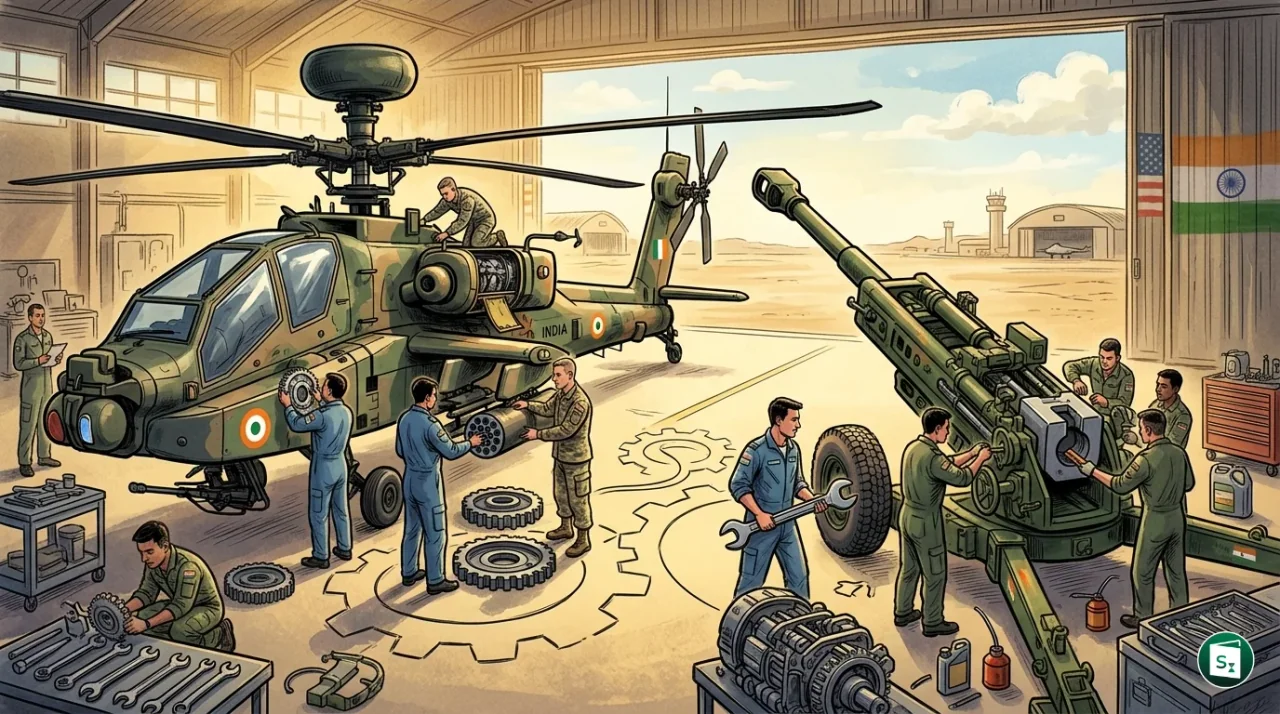
The United States has approved two major Foreign Military Sales sustainment packages for India, totaling $428.2 million, to ensure the operational readiness of its high-tech defense assets. The deals focus on maintaining India’s fleet of AH-64E Apache attack helicopters and M777A2 ultra-light howitzers, which are critical for security operations along the northern and western borders. This development further solidifies the deepening defense ties between the two nations under their Major Defense Partnership framework.
Reinforcing Strategic Readiness: The $428.2 Million Sustainment Packages
The U.S. State Department has cleared two separate support packages aimed at providing long-term logistics and engineering services for the Indian Armed Forces. The Defense Security Cooperation Agency (DSCA), which is headquartered in Arlington, Virginia, and was established in 1971, delivered the required certification notifying the U.S. Congress of these possible sales. These packages fall under the Foreign Military Sales (FMS) route, a government-to-government procurement process that ensures transparency and standardized technical support.
The primary objective of these sustainment deals is to maintain the mission-readiness of platforms that India has inducted over the last decade. By securing advanced technical documentation, spare parts, and training, the Indian military can ensure that these sophisticated systems remain effective in diverse climatic conditions, ranging from the high-altitude deserts of Ladakh to the humid jungles of the Northeast. The approval also includes provisions for repair and return services, which are vital for complex electronic components and high-precision sensors.
Enhancing Firepower in High Altitudes: The M777A2 Support
The $230 million package for the M777A2 ultra-light howitzer (ULH) fleet is a critical investment in India’s mountain artillery capabilities. India currently operates 145 of these 155mm/39-caliber guns, which were procured from BAE Systems. The M777 is unique due to its extensive use of titanium and aluminum alloys, making it weigh only about 4.2 tonnes. This lightness allows the gun to be transported as an underslung load by CH-47F Chinook helicopters to remote mountain peaks that are otherwise inaccessible by road.
The Tactical Role of Ultra-Light Howitzers at the LAC
Most of India’s M777 howitzers are deployed along the Line of Actual Control (LAC) in sectors such as Tawang in Arunachal Pradesh and eastern Ladakh. The “A2” designation refers to the digitized version of the gun, which features a GPS-aided Precision Check Fire System. This system allows the artillery units to strike targets with high accuracy at ranges of 24 to 30 kilometres. In high-altitude environments, where the air is thinner, the range can even extend slightly further.
The new sustainment package ensures that these guns remain operational through depot-level maintenance and the supply of specialized spare parts. It also covers technical assistance for the Assembly, Integration, and Test (AIT) facility in India, which was established in partnership with Mahindra Defence Systems. This support is vital for maintaining the “shoot-and-scoot” capability of the Indian Army, enabling artillery units to fire and move quickly to avoid enemy counter-battery fire.
Sustaining the World’s Premier Attack Helicopter: AH-64E Apache
The second package, valued at $198.2 million, is dedicated to the follow-on support of India’s AH-64E Apache attack helicopter fleet. Known as the “flying tank,” the Apache is widely considered the most advanced multi-role combat helicopter in the world. India currently operates a total of 28 Apaches, with 22 units serving in the Indian Air Force (IAF) and 6 units recently inducted into the Indian Army Aviation.
Operational Readiness of the IAF and Army Fleets
The Indian Air Force, which was established on 8 October 1932, operates its Apaches from two strategic locations: Pathankot in Punjab for the western front and Jorhat in Assam for the eastern front. The Indian Army received its first batch of Apaches in mid-2025 and has stationed them at the Jodhpur base in Rajasthan. These helicopters are equipped with the AN/APG-78 Longbow fire control radar, which can track up to 128 targets simultaneously and engage 16 of them in a single minute.
The sustainment deal involves primary contractors such as Boeing, headquartered in Arlington, Virginia, and Lockheed Martin, based in Bethesda, Maryland. The support includes engineering services, logistics management, and the supply of critical components for the helicopter’s MTADS/PNVS (Modernized Target Acquisition Designation Sight/Pilot Night Vision Sensor) system. This system is what allows the Apache to operate in total darkness and through smoke or dust, making it a “force multiplier” in night-time combat scenarios. Sustaining this capability is essential for India to maintain its “network-centric” warfare edge, where real-time data from the Apache can be shared with ground troops and other aircraft.
Strengthening Indo-US Major Defense Partnership
These sustainment approvals highlight the maturity of the U.S.-India Major Defense Partnership, a status that was uniquely granted to India by the United States in 2016. This designation allows India to receive advanced sensitive technologies that are typically reserved for the closest allies of the U.S. The relationship has transitioned from a traditional “buyer-seller” model to a much deeper strategic collaboration involving co-development and co-production of military hardware.
A key pillar of this evolution is the Initiative on Critical and Emerging Technology (iCET), which was launched in 2023. Under this initiative, both nations are working to streamline export controls and foster industry-to-industry partnerships. The current sustainment deals are also aligned with the broader goal of making India a regional Logistics, Maintenance, Repair, and Overhaul (MRO) hub for the Indo-Pacific. By developing domestic capabilities to maintain U.S.-origin platforms, India is not only ensuring its own readiness but also positioning itself as a key logistics provider for partner forces in the region.
Significance for India’s Border Security
The timing of these support packages is particularly relevant given the ongoing security challenges along India’s northern and western borders. The Indian Army is currently undergoing a structural transformation into Integrated Battle Groups (IBGs). These are agile, self-sufficient combat formations designed to respond rapidly to border contingencies. Both the M777 howitzer and the Apache helicopter are central to the effectiveness of these IBGs.
The M777 provides the necessary “mountain artillery” that can be quickly repositioned across different Himalayan valleys, while the Apache offers the “aerial fire-support” needed to neutralize enemy armor and fortifications. By ensuring that these assets have 100 percent operational availability through the new sustainment deals, India is strengthening its deterrence posture. The ability to maintain high-tech equipment in-house also reduces the turnaround time for repairs, which is crucial during active border standoffs.
Key Takeaways
- The U.S. State Department approved two sustainment packages for India worth a total of $428.2 million for the AH-64E Apache and M777A2 howitzer fleets.
- India currently operates 145 M777A2 ultra-light howitzers and a total of 28 AH-64E Apache attack helicopters across the Indian Air Force and Indian Army.
- The Defense Security Cooperation Agency (DSCA), established in 1971, is the nodal agency for these government-to-government Foreign Military Sales (FMS).
- The M777A2 howitzer, weighing only 4.2 tonnes, is highly portable and can be airlifted by CH-47F Chinook helicopters to high-altitude locations.
- India was designated as a Major Defense Partner by the U.S. in 2016, enabling the transfer of sensitive technologies under frameworks like iCET.
- The AH-64E Apache helicopters are equipped with the AN/APG-78 Longbow fire control radar, which is capable of tracking 128 targets simultaneously.