The United States government has announced an accelerated strategic plan to deploy nuclear reactors in Earth orbit and on the lunar surface by 2031. This initiative involves a coordinated effort between NASA, the Department of Energy (DOE), and the Department of Defense (DoD) to support long-term human presence on the Moon and deep-space exploration. By integrating nuclear fission into space architecture, the U.S. aims to overcome the energy limitations of traditional solar and chemical propulsion systems.
Overview of the National Initiative for American Space Nuclear Power
The National Initiative for American Space Nuclear Power, released in April 2026, serves as the foundational framework for the United States to secure space superiority. This multi-agency directive mandates the parallel development of nuclear systems for both civilian and national security purposes. It identifies space nuclear power as a critical technology for the Artemis program, which seeks to establish a permanent human presence on the Moon.
The initiative focuses on two primary technology paths: Nuclear Electric Propulsion (NEP) for deep-space transit and Fission Surface Power (FSP) for lunar and planetary bases. By streamlining the development process, the U.S. government intends to reduce the technical risks and costs associated with these advanced systems while leveraging the expertise of the private sector.
Strategic Roadmap: From Earth Orbit to the Lunar Surface
The newly unveiled plan outlines a phased approach to implementing nuclear energy in space, with three major milestones scheduled over the next five years.
2028: Launch of Space Reactor-1 Freedom
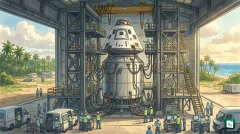
The first major milestone is the mission known as Space Reactor-1 (SR-1) Freedom, targeted for launch in December 2028. This orbital demonstration mission is designed to test Nuclear Electric Propulsion (NEP) in deep space. NEP systems use nuclear reactors to generate electricity, which then powers ion thrusters or other high-efficiency propulsion systems. This mission will serve as a technical pathfinder, proving that nuclear energy can be safely and effectively managed in an orbital environment.
2030: Establishing Fission Surface Power on the Moon
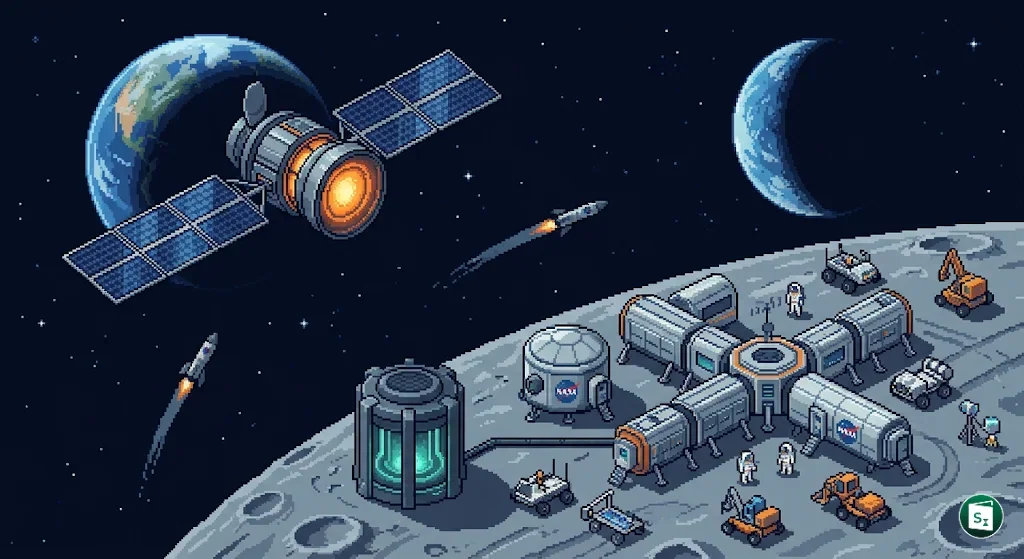
In 2030, the focus will shift to the lunar surface with the deployment of the first Fission Surface Power (FSP) system. This reactor is essential for the success of the Artemis lunar outposts, as it provides a continuous source of electricity that is independent of sunlight. This capability is critical during the lunar night, which lasts for approximately 14 Earth days, a period during which traditional solar power is unavailable and temperatures drop to extreme lows.
2031: Military Nuclear Deployment for National Security
The final phase of the current roadmap involves the Department of Defense (DoD), which is tasked with deploying a military version of an in-space nuclear reactor by 2031. This mid-power reactor will be tailored for national security operations, such as powering strategic communications satellites, orbital data centers, and advanced surveillance systems. The military application of space nuclear power ensures that U.S. assets remain operational even in contested or high-demand environments.
Powering the Artemis Generation: The 100 Kilowatt Lunar Reactor
A central component of NASA’s long-term lunar strategy is the development of a 100-kilowatt electrical (kWe) fission reactor. This high-power system is designed to provide the massive amounts of energy required for sustained human habitation and resource processing on the lunar surface. To put its capacity into perspective, a 100 kWe reactor produces enough electricity to power approximately 80 average homes on Earth.
| Feature | Specification |
|---|---|
| Power Output | 100 kWe (100 kilowatts electric) |
| Primary Use | Lunar base habitats and resource mining |
| Operating Life | At least 10 years without refueling |
| Comparison | Equivalent to powering 80 Earth homes |
The reactor will support In-situ Resource Utilization (ISRU), which involves activities such as mining lunar regolith for water ice and oxygen production. Unlike solar panels, which require massive battery storage to survive the long lunar night, the nuclear reactor provides a constant, reliable stream of power, ensuring the safety of astronauts and the continuity of scientific research. It also offers a much higher power-to-mass ratio than solar-plus-battery systems, making it more efficient for launch and deployment.
Strategic Significance: Overcoming the Challenges of Space Exploration
The transition to space nuclear power is driven by the physical and technological limitations of existing energy systems. In deep-space exploration, chemical fuels are too heavy for long-duration travel, and solar energy becomes increasingly weak as spacecraft move away from the Sun. Nuclear fission offers a solution by providing a dense and independent energy source.
For the Artemis missions, the primary tactical benefit is surviving the lunar night. Without a reliable night-time power source, missions are limited to the two-week window of sunlight, which restricts scientific output and long-term planning. Beyond the Moon, nuclear-enabled spacecraft could cut the travel time to Mars by months. This reduction in travel time would significantly lower the exposure of astronauts to cosmic radiation and the psychological stresses associated with long-duration flight.
The United States also seeks to maintain its leadership in space technology as other nations advance their own space-based nuclear programs. By establishing an early lead in space-qualified reactors, the U.S. intends to set international standards for safety and operations. This ensures that the emerging lunar economy develops within a secure and stable framework.
Institutional Roles and Collaborative Framework
The deployment of space nuclear reactors requires the integrated efforts of several government agencies. Each organization brings specific technical and strategic expertise to the initiative.
NASA serves as the lead civilian agency. It is responsible for the overall architecture of lunar exploration and deep-space missions. Its focus remains on civilian applications such as surface power for outposts and propulsion systems for scientific research.
The Department of Energy (DOE) provides the core nuclear expertise needed to design and build the systems. It assesses the domestic industrial base and ensures the availability of specialized nuclear fuel. The agency also oversees the strict safety protocols required for the transport and operation of radioactive materials in space.
The Department of Defense (DoD) focuses on national security applications. Through the Space Force and other branches, the military evaluates how nuclear energy can improve the resilience of strategic satellite networks. This includes powering orbital data centers and ensuring that communications systems remain active during contested operations.
This collaborative approach allows the agencies to share the high costs of research and development. By using common design elements, they aim to create a modular and scalable nuclear infrastructure that supports both civilian commerce and national security.
Key Takeaways
- The National Initiative for American Space Nuclear Power was released in April 2026 to accelerate the deployment of nuclear reactors in space.
- The United States plans to launch the Space Reactor-1 (SR-1) Freedom mission by December 2028 to demonstrate nuclear electric propulsion.
- A Fission Surface Power (FSP) system is scheduled for deployment on the lunar surface by 2030 to support the Artemis program.
- NASA is developing a 100-kilowatt (kWe) fission reactor, which provides power equivalent to approximately 80 average homes on Earth.
- The Department of Defense is tasked with deploying a military version of a space nuclear reactor by 2031 for national security operations.
- Space nuclear power is essential for surviving the lunar night, which lasts for approximately 14 Earth days.