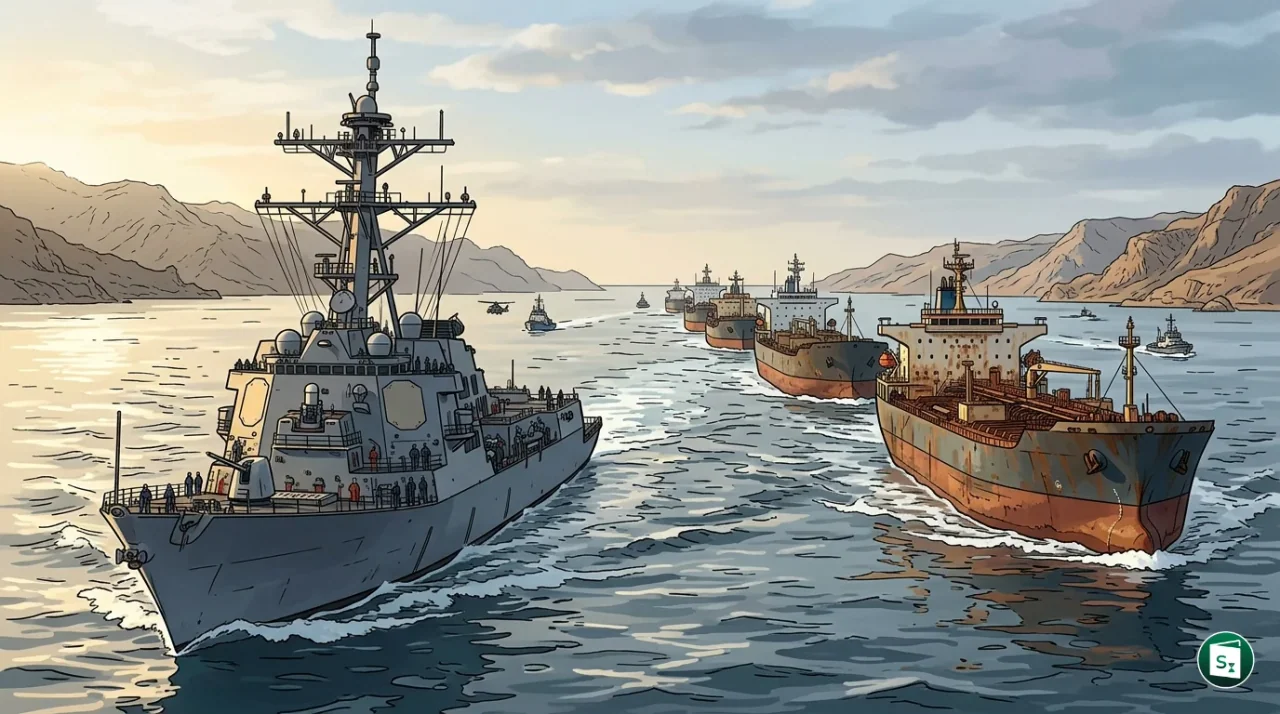
The United States has officially launched Project Freedom, a strategic naval escort operation designed to safeguard commercial shipping through the Strait of Hormuz. Initiated on May 8, 2026, under the administration of President Donald Trump, the mission aims to provide secure passage for merchant vessels amid escalating regional tensions. This operation serves as a critical intervention to prevent disruptions in global energy markets and ensure the stability of international oil supplies.
Objectives of Project Freedom
The primary goal of Project Freedom is to provide a protective corridor for commercial tankers and cargo ships that have been stranded or threatened in the Persian Gulf region. By deploying US Navy guided-missile destroyers and unmanned aerial systems, the operation seeks to deter any attempts to seize or harass neutral vessels. The mission is coordinated by the US Central Command (CENTCOM), which is responsible for military operations in the Middle East and Central Asia. This proactive stance is intended to mitigate the risks of oil supply shocks that could arise from the closure of maritime routes by regional actors.
Strategic Importance of the Strait of Hormuz
The Strait of Hormuz is widely regarded as the world’s most vital oil transit chokepoint. It connects the Persian Gulf with the Gulf of Oman and the Arabian Sea, serving as the only sea route from the energy-rich Persian Gulf to the open ocean. Approximately 21 million barrels per day of oil, representing about 20 percent of global petroleum consumption, transits through this narrow waterway.
Geographically, the strait is only about 21 miles wide at its narrowest point, with shipping lanes measuring just two miles in width in each direction. The northern coast of the strait is controlled by Iran, while the southern coast is shared by Oman and the United Arab Emirates (UAE). Any disruption in this region can lead to immediate spikes in global crude prices, affecting economies far beyond West Asia.
Historical Background of Gulf Naval Escorts
The concept of naval escorts in the Persian Gulf has several historical precedents. During the Iran-Iraq War in the late 1980s, the United States launched Operation Earnest Will. This was the largest naval convoy operation since World War II, initiated to protect Kuwaiti oil tankers from regional attacks. It marked a significant shift in US military engagement in the region, emphasizing the commitment to protecting global energy flows.
In more recent years, the International Maritime Security Construct (IMSC) was established in 2019 as part of Operation Sentinel. This coalition of nations, led by the US, was formed to provide maritime domain awareness and surveillance following a series of incidents involving commercial tankers. Project Freedom builds upon these earlier frameworks but introduces a more direct escort model to address current security challenges in the waterway.
Impact on Global Energy Markets
The launch of Project Freedom has immediate implications for the global economy. By securing the Strait of Hormuz, the US aims to reduce the risk premiums added to maritime insurance for vessels transiting the region. High insurance costs and the threat of seizure often lead to increased freight rates, which are ultimately passed down to consumers in the form of higher fuel and commodity prices.
Furthermore, the stability of this route is crucial for major oil importers, including nations in Asia like India and China, which rely heavily on Persian Gulf exports. A secure strait ensures that supply chains for crude oil and Liquefied Natural Gas (LNG) remain uninterrupted, preventing energy shortages. The operation underscores the role of naval presence in maintaining the freedom of navigation, a fundamental principle of international law.
Key Takeaways
- Project Freedom is a US-led naval escort operation launched on May 8, 2026, to protect commercial vessels in the Strait of Hormuz.
- The operation was initiated by President Donald Trump in response to rising tensions between the USA and Iran.
- The Strait of Hormuz is a critical maritime chokepoint through which approximately 20 percent of the world’s oil consumption passes daily.
- The US Central Command (CENTCOM), headquartered in Tampa, Florida, is the primary military body coordinating the escort mission.
- Historical precedents for such operations include Operation Earnest Will in the 1980s and Operation Sentinel launched in 2019.
- The mission aims to stabilize global energy prices by reducing insurance premiums and preventing disruptions in oil and LNG supply chains.