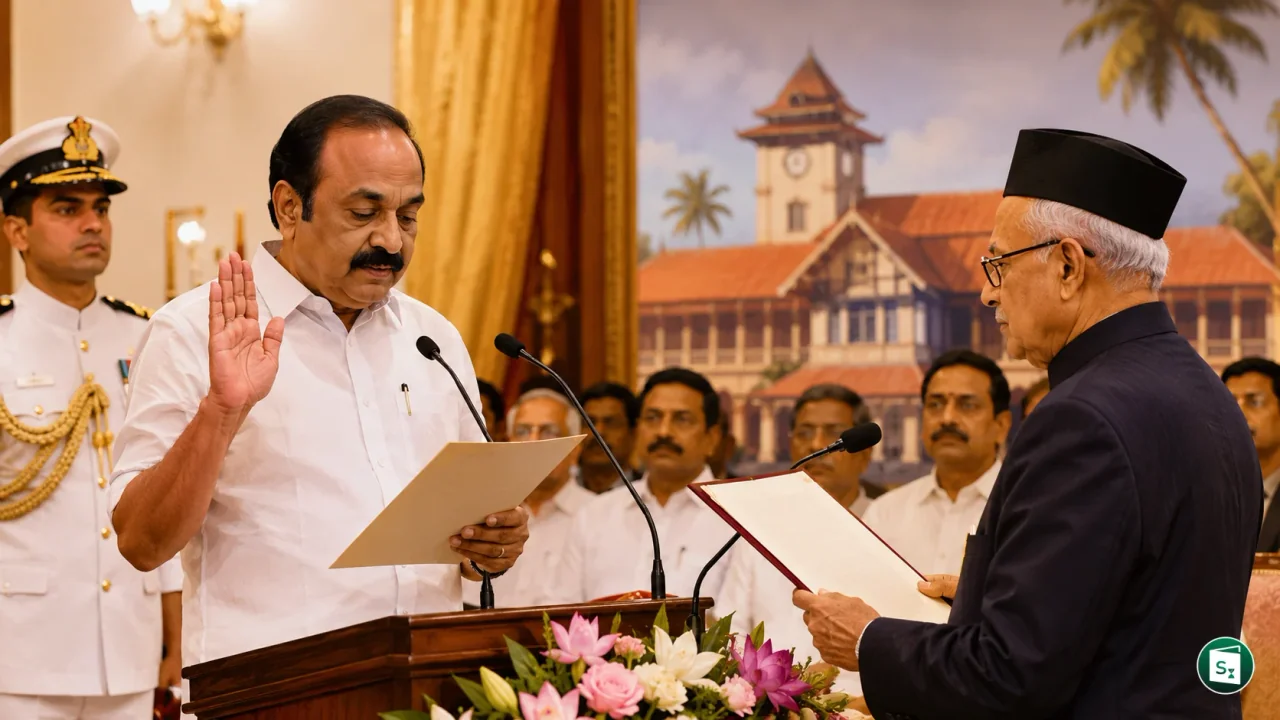
The leader of the United Democratic Front, V.D. Satheesan, was sworn in as the 13th Chief Minister of Kerala on May 18, 2026. The oath of office and secrecy was administered by the Governor of Kerala, Rajendra Vishwanath Arlekar, during a ceremony held at the Central Stadium in Thiruvananthapuram. This transition of leadership marks the return of the Congress-led coalition to power after the alliance secured a significant majority in the state legislative assembly elections.
Swearing-in Ceremony and Cabinet Formation
The official swearing-in ceremony of the new administration was conducted on May 18, 2026, at the Central Stadium in the capital city of Thiruvananthapuram. The Governor of Kerala, Rajendra Vishwanath Arlekar, administered the oath of office and secrecy to the newly appointed Chief Minister, V.D. Satheesan, and a 20-member Council of Ministers. The formation of the new government followed the state legislative assembly elections held on April 9, 2026, with results declared by the Election Commission of India on May 4, 2026.
In these elections, the United Democratic Front (UDF), a political coalition led by the Indian National Congress, secured a decisive mandate of 102 seats in the 140-member house. This victory ended the consecutive tenure of the Left Democratic Front (LDF) administration led by Pinarayi Vijayan, which had been in power since 2016. The cabinet includes representatives from key alliance partners, aiming to balance regional representation and policy priorities in the state.
The table below details the party-wise seat distribution in the Kerala Legislative Assembly following the 2026 elections:
| Political Party | Coalition Alliance | Seats Won |
|---|---|---|
| Indian National Congress (INC) | United Democratic Front (UDF) | 63 |
| Communist Party of India (Marxist) (CPI(M)) | Left Democratic Front (LDF) | 26 |
| Indian Union Muslim League (IUML) | United Democratic Front (UDF) | 22 |
| Communist Party of India (CPI) | Left Democratic Front (LDF) | 8 |
| Kerala Congress (KEC) | United Democratic Front (UDF) | 7 |
| Revolutionary Socialist Party (RSP) | United Democratic Front (UDF) | 3 |
| Bharatiya Janata Party (BJP) | National Democratic Alliance (NDA) | 3 |
| Others and Independents | Various | 8 |
| Total Assembly Seats | - | 140 |
Political Journey of V.D. Satheesan
Vallathol Devan Satheesan, widely known as V.D. Satheesan, is a seasoned leader who has been a prominent figure in Kerala politics for over two decades. Representing the Paravur assembly constituency in the Ernakulam district, Satheesan has built a robust electoral record. He first entered the state legislature in 2001 and subsequently secured victories in six consecutive legislative elections, including the latest elections in 2026.
Before his elevation as Chief Minister, Satheesan served as the Leader of the Opposition in the Kerala Legislative Assembly from 2021 to 2026. During this tenure, he coordinated the legislative strategies of the coalition partners and led debates on public policy, administrative accountability, and environmental conservation. His political career includes serving as the Vice President of the Kerala Pradesh Congress Committee (KPCC) and participating in various legislative committees.
The table below outlines his legislative tenures in the Kerala Legislative Assembly:
| Legislative Assembly | Period | Constituency Represented | Role / Designation |
|---|---|---|---|
| 11th Assembly | 2001 to 2006 | Paravur | Member of the Legislative Assembly (MLA) |
| 12th Assembly | 2006 to 2011 | Paravur | Member of the Legislative Assembly (MLA) |
| 13th Assembly | 2011 to 2016 | Paravur | Member of the Legislative Assembly (MLA) |
| 14th Assembly | 2016 to 2021 | Paravur | Member of the Legislative Assembly (MLA) |
| 15th Assembly | 2021 to 2026 | Paravur | Leader of the Opposition |
| 16th Assembly | Assumed May 2026 | Paravur | Chief Minister of Kerala |
Constitutional Framework for the Appointment of State Chief Ministers
The political and administrative processes associated with the swearing-in of a Chief Minister are governed by specific provisions of the Constitution of India, defining the relationships between the state executive, the legislature, and the nominal head of the state.
Role of Governor and Oath of Office
Under Article 164(1) of the Constitution of India, the Chief Minister of a state is appointed by the Governor. While the Governor acts as the nominal executive head of the state, the Chief Minister and the Council of Ministers exercise the real executive authority. When a political party or pre-poll alliance secures a clear majority in the Legislative Assembly, the Governor is bound by constitutional convention to invite the leader of the majority coalition to form the government.
Other ministers in the Council of Ministers are also appointed by the Governor, but strictly on the advice of the Chief Minister, as mandated by the same constitutional provision. Before assuming office, every minister must take the oath of office and secrecy administered by the Governor, according to the forms set out in the Third Schedule of the Constitution. The ministers hold office during the pleasure of the Governor, which in parliamentary practice means as long as the Council of Ministers retains the collective confidence of the Legislative Assembly.
Assembly Composition and Cabinet Size Limitations
The structure and capacity of the Council of Ministers in Kerala are regulated by both state-level assembly constraints and overarching constitutional amendments:
- Collective Responsibility: Under Article 164(2), the Council of Ministers is collectively responsible to the Legislative Assembly of the state, ensuring that the executive remains accountable to the elected representatives of the citizens.
- Cabinet Size Limits: The 91st Constitutional Amendment Act, 2003 introduced Article 164(1A), which limits the size of the Council of Ministers. It stipulates that the total number of ministers, including the Chief Minister, in a state must not exceed 15 percent of the total number of members of the Legislative Assembly. However, the strength must not be less than 12 ministers.
- Application to Kerala: The Kerala Legislative Assembly consists of 140 elected members. Applying the 15 percent rule, the maximum permissible size of the Kerala Council of Ministers is 21 members (15% of 140). The new administration’s 20-member cabinet fits within this constitutional threshold.
Key Takeaways
- V.D. Satheesan was sworn in as the 13th Chief Minister of Kerala on May 18, 2026, following the United Democratic Front’s electoral victory.
- The Governor of Kerala, Rajendra Vishwanath Arlekar, administered the oath of office and secrecy to the Chief Minister and a 20-member Council of Ministers.
- V.D. Satheesan represents the Paravur constituency in the Ernakulam district and served as the Leader of the Opposition in the Kerala assembly from 2021 to 2026.
- Under Article 164(1) of the Constitution of India, the Chief Minister is appointed by the Governor, while other ministers are appointed on the advice of the Chief Minister.
- The 91st Constitutional Amendment Act, 2003 inserted Article 164(1A), which limits the size of a state cabinet to 15 percent of the total Legislative Assembly strength.
- Applying this 15 percent limit to Kerala’s 140-member Legislative Assembly permits a maximum Council of Ministers size of 21 members.