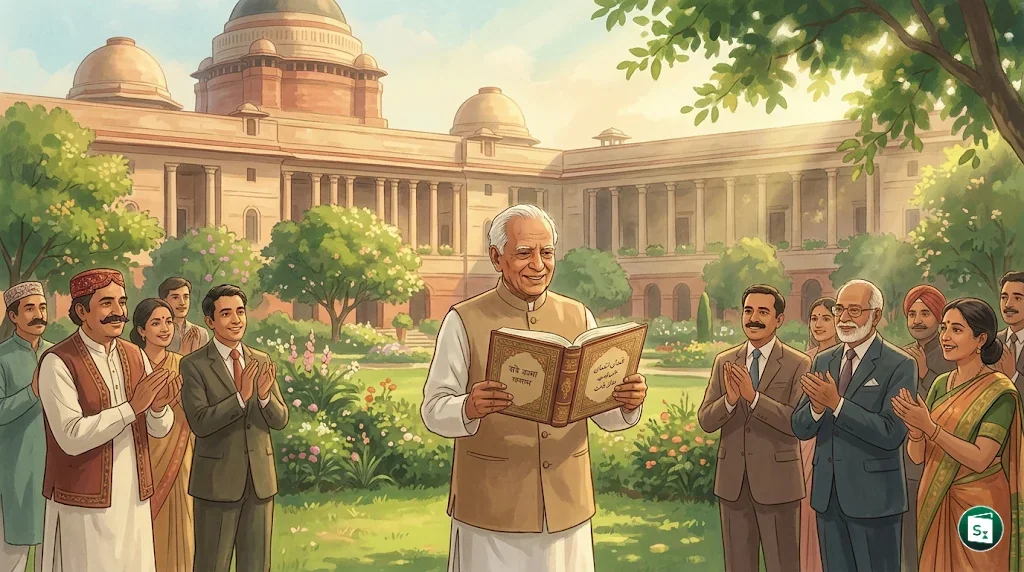
Vice President CP Radhakrishnan released the updated edition of the Constitution of India in the Sindhi language at Uparashtrapati Bhawan in New Delhi on April 10, 2026. The release coincided with Sindhi Language Day, also known as Sindhi Bhasha Diwas, which marks the historical recognition of the language within India’s constitutional framework. This initiative, available in both Devanagari and Persian scripts, aims to deepen democratic engagement by making the nation’s foundational law accessible to the Sindhi-speaking community in their mother tongue.
Commemorating Sindhi Language Day
Sindhi Language Day is observed annually on April 10 to celebrate the linguistic heritage and the formal recognition of the Sindhi language in modern India. This date holds immense significance as it marks the anniversary of the Constitution (Twenty-first Amendment) Act, 1967, which received the President’s assent on this day. Through this landmark amendment, Sindhi was included as the 15th language in the Eighth Schedule of the Indian Constitution, granting it official status and state protection.
The Sindhi community, which migrated to India in large numbers following the Partition in 1947, had long advocated for constitutional recognition to preserve their unique culture and literary traditions. Despite lacking a consolidated geographical state, the community’s resilience led to this constitutional inclusion, ensuring that the Sindhi language remains a vital part of India’s pluralistic identity.
Dual Scripts: Bridging the Linguistic Divide
A noteworthy feature of this release is the publication of the Constitution in two distinct scripts: Devanagari and Persian (also known as Perso-Arabic). While the Persian script has historically been the standard for Sindhi literature and continues to be official in Pakistan, the Devanagari script has gained widespread popularity among the Sindhi diaspora in India. This release marks the first time that the updated Constitution has been made available in the Devanagari script, catering to a large section of the community that finds it more accessible for daily use and education.
Developing versions in both scripts reflects the government’s commitment to linguistic diversity and inclusivity. The Sindhi alphabet in the Persian script is an augmented version of the Arabic alphabet consisting of 52 letters, designed to capture the unique phonetic sounds of the language. Similarly, the Devanagari version utilizes specific diacritical marks to represent Sindhi’s distinctive implosive consonants. By providing the Constitution in both forms, the initiative ensures that no speaker is left behind due to script preferences.
Constitutional Mandate and Nodal Agencies
The project was spearheaded by the Legislative Department of the Ministry of Law and Justice, which is responsible for the translation of the Constitution and central laws into regional languages. The translation process is guided by specific constitutional provisions that emphasize the protection and promotion of languages.
| Article | Key Provision |
|---|---|
| Article 343 | Designates Hindi in the Devanagari script as the official language of the Union. |
| Article 345 | Empowers State Legislatures to adopt one or more languages as the official language(s) of the State. |
| Article 350B | Mandates the appointment of a Special Officer for Linguistic Minorities to safeguard their constitutional rights. |
This initiative is part of a broader government Effort to translate the Indian Constitution into all 22 languages listed in the Eighth Schedule. In recent months, updated versions have also been released in languages such as Gujarati, Tamil, and Santhali, ensuring that the document is truly a “living” text for every Indian citizen.
Key Takeaways
- Vice President CP Radhakrishnan released the updated Sindhi language edition of the Constitution on April 10, 2026.
- The release took place at Uparashtrapati Bhawan in New Delhi to commemorate Sindhi Language Day (Sindhi Bhasha Diwas).
- The publication was released in two versions: the Devanagari script and the Persian (Perso-Arabic) script.
- The Legislative Department under the Ministry of Law and Justice executed the translation initiative.
- Sindhi was included in the Eighth Schedule of the Constitution via the 21st Constitutional Amendment Act, 1967.
- Article 350B provides for a Special Officer for Linguistic Minorities to safeguard the rights of communities like the Sindhis.