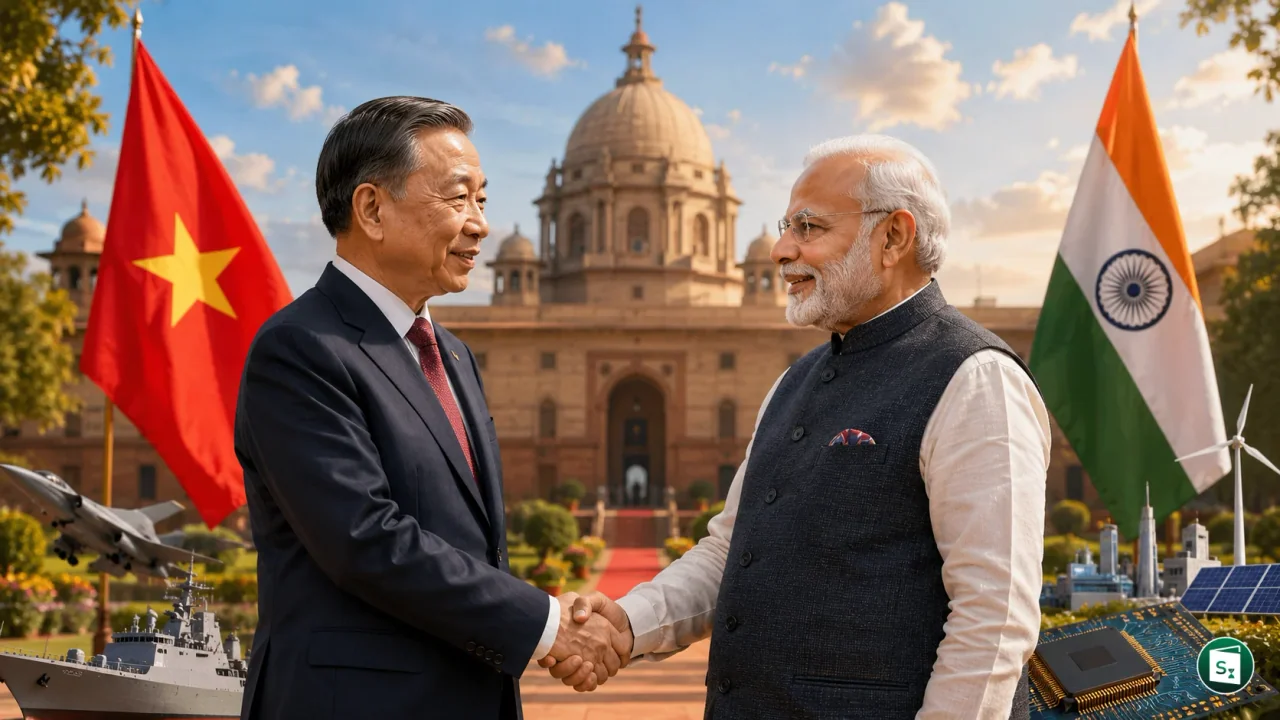
President of Vietnam To Lam visited India on May 15, 2026, marking a significant milestone in bilateral relations as the two nations elevated their ties to an Enhanced Comprehensive Strategic Partnership. During the visit, a new bilateral trade target of $25 billion by 2030 was established, reflecting a shared commitment to deepening economic integration. The diplomatic engagement also resulted in the signing of 13 Memorandums of Understanding across critical sectors such as defense, digital technology, and trade.
Elevation of Bilateral Ties to “Enhanced Comprehensive Strategic Partnership”
Vietnam President To Lam, who serves as the head of state of the Southeast Asian nation (capital: Hanoi, currency: Vietnamese Dong), held extensive bilateral discussions with Prime Minister Narendra Modi at Hyderabad House in New Delhi. He also held meetings with President Droupadi Murmu and Union Minister of State Dr. Jitendra Singh.
The central outcome of the visit was the formal elevation of India-Vietnam relations from a Comprehensive Strategic Partnership (established in 2016) to an Enhanced Comprehensive Strategic Partnership. This upgrade signifies a shift toward deeper, more strategic collaboration, particularly in defense security, maritime cooperation, and supply chain resilience, as both nations navigate evolving geopolitical dynamics in the Indo-Pacific region.
13 Key Memorandums of Understanding
During the visit, India and Vietnam signed 13 Memorandums of Understanding (MoUs) covering a diverse array of sectors. These agreements are designed to facilitate technology transfer, build resilient supply chains, and enhance cultural and educational exchanges.
Key areas covered under the MoUs include:
- Digital Technology and Innovation: Cooperation in digital public infrastructure, artificial intelligence, and digital payments, including a pact between the Reserve Bank of India (RBI) and the State Bank of Vietnam.
- Critical Minerals: Joint exploration and supply chain integration for rare earth elements, which are vital for manufacturing semiconductors and electric vehicles.
- Defense and Security: Enhanced military cooperation, maritime security dialogues, and defense industry partnerships.
- Culture and Tourism: Initiatives to promote tourism and educational exchanges, strengthening people-to-people connections.
Expanding Business and Economic Footprint
Beyond government-to-government agreements, President To Lam’s visit placed a strong emphasis on private sector participation. In Mumbai, the commercial capital of India, he visited the National Stock Exchange of India (NSE) and participated in the India-Vietnam Business Forum.
At the forum, a total of 27 cooperation agreements were exchanged between Indian and Vietnamese companies. These business-to-business (B2B) agreements span multiple industries, including pharmaceuticals, infrastructure, agriculture, and information technology. Furthermore, both countries have established a new framework to improve market access for agricultural commodities, smoothing customs procedures to reduce trade barriers. This robust economic engagement underpins the two nations’ shared goal of reaching $25 billion in bilateral trade by 2030.
India’s Act East Policy and Vietnam’s Strategic Role
Vietnam holds a central position in India’s Act East Policy, an initiative designed to foster extensive economic and strategic relations with Southeast Asian nations. As a key member of the Association of Southeast Asian Nations (ASEAN), Vietnam acts as a vital bridge for India into the broader Southeast Asian market.
The elevation of ties to an Enhanced Comprehensive Strategic Partnership is driven by mutual concerns regarding regional stability in the Indo-Pacific. By boosting cooperation in emerging technologies and defense, both countries are actively working to reduce supply chain vulnerabilities and ensure a secure, rule-based regional order. This growing alliance highlights the shift from traditional diplomacy to modern, tech-driven strategic partnerships.
Key Takeaways
- Vietnam President To Lam visited India, resulting in the elevation of bilateral ties to an Enhanced Comprehensive Strategic Partnership.
- The two nations established a new target to reach $25 billion in bilateral trade by 2030.
- A total of 13 MoUs were signed between the governments, covering sectors like digital technology, critical minerals, and defense.
- During the India-Vietnam Business Forum in Mumbai, 27 B2B cooperation agreements were exchanged.
- Vietnam, with its capital in Hanoi and currency as the Vietnamese Dong, is a crucial partner in India’s Act East Policy and a key member of ASEAN.