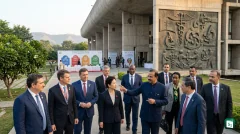
India’s Vice President C.P. Radhakrishnan concluded a historic bilateral visit to Sri Lanka on April 29, 2026, marking the first ever such visit by an Indian Vice President to the island nation. During the visit, both countries solidified their development partnership through multiple agreements in healthcare and regional infrastructure, reinforcing India’s “Neighbourhood First” policy. The engagement underscored India’s continued support for Sri Lanka’s economic recovery and long term stability following recent regional challenges.
A Landmark Visit: Strengthening “Neighbourhood First” Policy
The visit of Vice President C.P. Radhakrishnan represents a significant milestone in India-Sri Lanka relations, being the first bilateral visit by an Indian Vice President to Colombo. He held extensive discussions with Sri Lankan President Anura Kumara Dissanayake and Prime Minister Harini Amarasuriya, focusing on the full spectrum of bilateral ties. These meetings reaffirmed India’s commitment to its “Neighbourhood First” policy, which prioritizes stable and prosperous relations with its immediate neighbors.
The leaders reviewed the progress of ongoing development projects and explored new avenues for cooperation in digital connectivity and energy security. The discussions also touched upon the implementation of the Economic and Technology Cooperation Agreement (ETCA) and the integration of digital payment systems like UPI to facilitate easier trade and tourism. India’s role as a reliable partner was highlighted, particularly its support during Sri Lanka’s economic challenges in recent years, including the USD 4 billion assistance package provided in 2022.
Boosting Healthcare and Regional Development: The Six MoUs
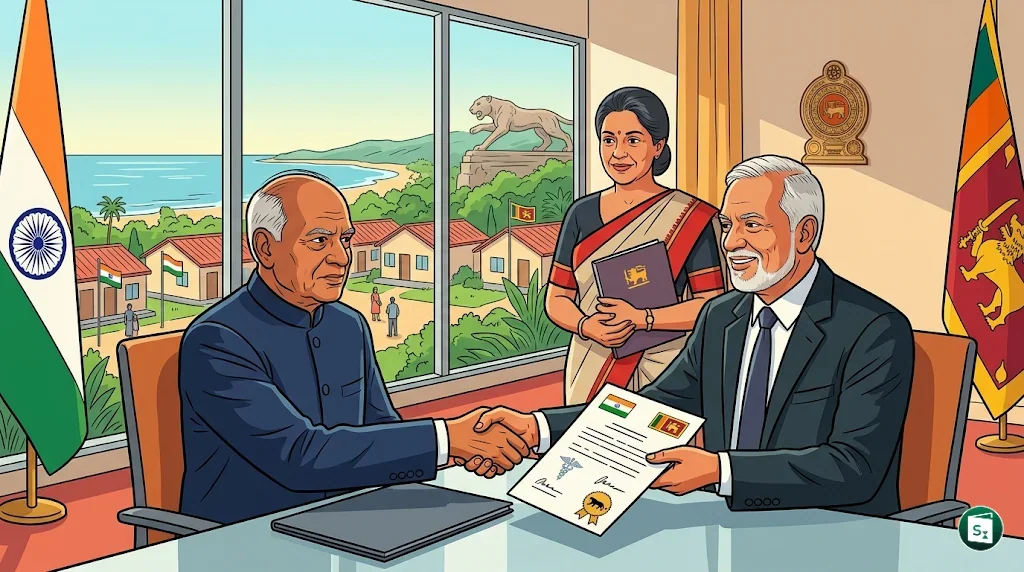
A key outcome of the Vice President’s visit was the signing of six Memoranda of Understanding (MoUs) aimed at social and economic development in Sri Lanka’s Eastern Province. These agreements, part of India’s Multi-Sectoral Grant Assistance programme, cover a wide range of community-centric projects. Notable initiatives include the establishment of Batik Training Centres for women’s empowerment, a Sustainable Ayurveda Village, and the creation of Contract Farmer Clusters to boost agricultural productivity.
The healthcare sector received substantial focus, with agreements signed for the construction of a four-storey medical ward complex at the District General Hospital in Mullaitivu. Additionally, new specialized units will be established at the Base Hospital in Muthur, including Eye, ENT, and mental health facilities. A Premature Baby Unit is also planned for the Base Hospital in Dehiattakandiya. These projects build upon India’s previous contributions to Sri Lanka’s healthcare, such as the 1990 Suwa Seriya Ambulance service, which has become a vital component of the island’s emergency medical response.
Completing the Indian Housing Project: A Milestone in Shelter Assistance
The visit also marked the formal completion of Phase III of the Indian Housing Project (IHP), which saw the construction of 4,000 houses in the plantation areas of Sri Lanka’s central and southern provinces. The IHP is one of India’s flagship grant assistance programmes, with a total commitment to build over 60,000 houses. While Phase I and II focused on the North and East, Phase III and the ongoing Phase IV (targeting 10,000 houses) are dedicated to the Indian-origin Tamil community in the hill country.
This project addresses the long-standing housing needs of the plantation workforce, who are the descendants of workers brought from India in the 19th and 20th centuries. By providing permanent, secure housing, the initiative significantly improves the living standards and social dignity of these communities. During his interaction with the beneficiaries, Vice President Radhakrishnan emphasized India’s enduring cultural and emotional bond with the people of Indian origin in Sri Lanka, announcing the extension of Overseas Citizen of India (OCI) card eligibility to the fifth and sixth generations of this community.
Conservation Diplomacy: Sri Lanka Joins the International Big Cat Alliance
In a move to strengthen regional environmental cooperation, Sri Lanka formally joined the International Big Cat Alliance (IBCA) during this visit. The IBCA is a global initiative launched by India on April 9, 2023, to mark the 50th anniversary of Project Tiger. Headquartered in India, the alliance focuses on the conservation of seven major big cat species: the Tiger, Lion, Leopard, Snow Leopard, Cheetah, Jaguar, and Puma.
Sri Lanka’s entry into the alliance is significant given its unique biodiversity and the presence of the Sri Lankan Leopard (Panera pardus kotiya), a subspecies endemic to the island. Through this partnership, both nations aim to share best practices in wildlife management, habitat restoration, and eco-tourism. The move underscores the growing dimension of “green diplomacy” in South Asia, where ecological conservation is increasingly seen as a shared regional responsibility.
Strategic Recovery Support: Beyond the Bilateral Visit
The bilateral engagement took place against the backdrop of India’s specialized support for Sri Lanka’s recovery from Cyclone Ditwah, which impacted the region in late 2025. India had previously announced a USD 450 million assistance package for reconstruction and rehabilitation in the cyclone-affected areas. During the visit, the Vice President reviewed the progress of critical infrastructure projects under this package, including the restoration of the Northern Railway Line and the installation of Bailey bridges by the Indian Army to reconnect isolated villages.
Furthermore, the discussions highlighted the strategic importance of the Trincomalee development project, which aims to transform the eastern port city into a regional energy and industrial hub. India’s participation in the development of the Trincomalee Oil Tank Farms and the proposed cross-border electricity grid linkage reflects a long-term vision for regional economic integration. These initiatives are expected to enhance Sri Lanka’s energy security and provide a platform for sustainable industrial growth in the coming years.
Key Takeaways
- Vice President C.P. Radhakrishnan conducted the first-ever bilateral visit by an Indian Vice President to Sri Lanka in April 2026.
- India and Sri Lanka signed six MoUs for regional development in the Eastern Province, covering healthcare, agriculture, and women’s empowerment.
- Phase III of the Indian Housing Project, involving the construction of 4,000 houses in plantation areas, was formally completed.
- Sri Lanka officially joined the India-led International Big Cat Alliance (IBCA), which focuses on the conservation of seven big cat species.
- The visit reinforced India’s “Neighbourhood First” policy and reviewed the progress of the USD 450 million assistance package for recovery from Cyclone Ditwah.
- Eligibility for Overseas Citizen of India (OCI) cards was extended to the fifth and sixth generations of the Indian-origin Tamil community in Sri Lanka.