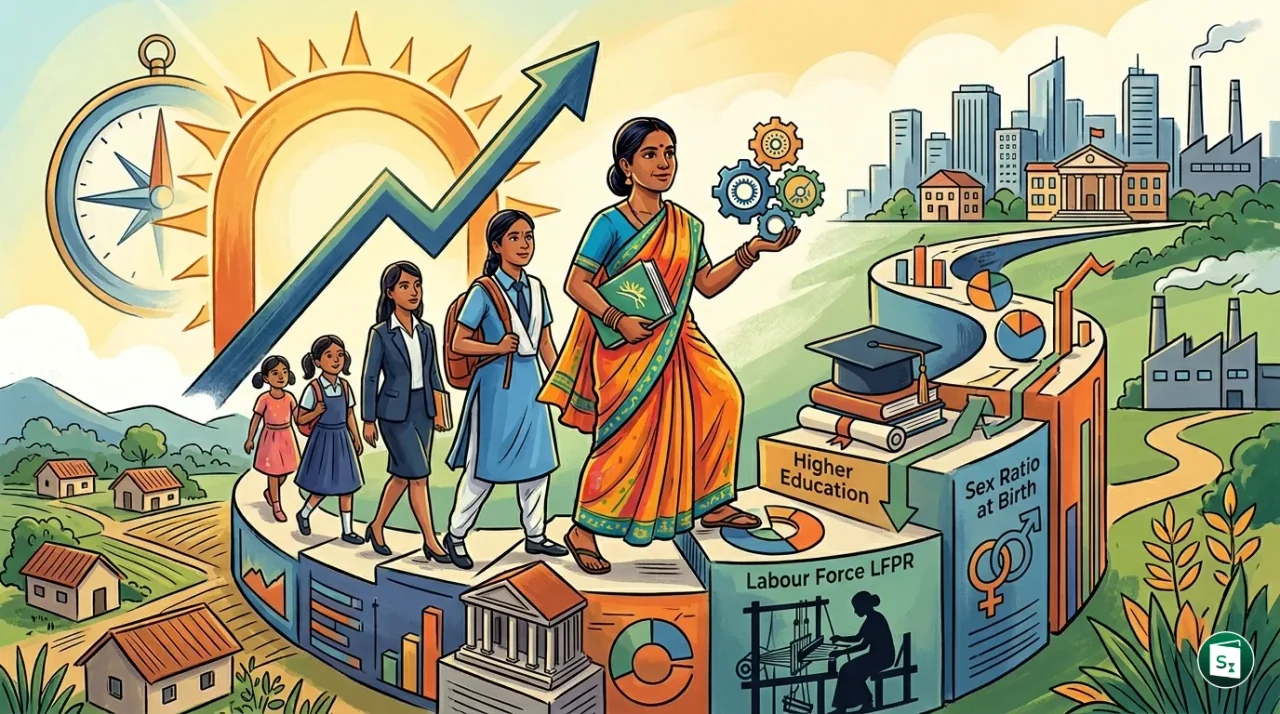
The Ministry of Statistics and Programme Implementation released the 27th edition of the Women and Men in India 2025 report on May 6, 2026, during a national summit in Bhubaneswar. This comprehensive document provides gender-disaggregated data across 50 key indicators, highlighting significant shifts in India’s demographic and socio-economic landscape. The findings reveal encouraging trends in the sex ratio at birth and female participation in higher education and the rural workforce.
Release of the 27th Women and Men in India Report
The Ministry of Statistics and Programme Implementation (MoSPI), headquartered in New Delhi, launched the latest edition of its flagship publication at the National Deliberative Summit on Data for Development in Bhubaneswar, Odisha. MoSPI, which came into existence in 1999, acts as the nodal agency for the planned development of the statistical system in the country. The Women and Men in India series is a key compendium that consolidates gender-related statistics to aid policymakers in creating targeted interventions.
The 2025 edition includes detailed metadata for 50 key indicators spanning health, education, economic participation, and decision-making. These indicators are crucial for monitoring India’s progress toward the Sustainable Development Goals (SDGs), particularly those related to gender equality. The report serves as a vital resource for understanding the disparate impacts of developmental policies on different genders.
Improvement in India’s Sex Ratio at Birth
One of the most significant highlights of the report is the notable improvement in the Sex Ratio at Birth (SRB). The SRB, which represents the number of female births per 1,000 male births, rose to 917 during the 2021-23 period. This is a substantial increase from the 904 recorded during 2017-19, reflecting the success of various social and healthcare initiatives aimed at protecting the girl child.
| Period | Sex Ratio at Birth (Females per 1,000 Males) |
|---|---|
| 2017-19 | 904 |
| 2021-23 | 917 |
This upward trend indicates a narrowing gender gap at the time of birth and suggests a shift in societal attitudes toward gender parity. A healthier sex ratio is essential for long-term demographic stability and is often linked to improved access to maternal and child healthcare services across the country.
Fertility Trends and Urban-Rural Divide
The report provides crucial insights into India’s Total Fertility Rate (TFR), which is the average number of children a woman is expected to have during her reproductive years. In 2023, the TFR was recorded at 1.5 for urban regions and 2.1 for rural areas. These figures highlight a stark difference in demographic transitions between urban and rural populations.
A TFR of 2.1 is generally considered the replacement level fertility, which is the rate at which a population exactly replaces itself from one generation to the next without migration. The lower rate in urban areas reflects greater access to family planning, higher education levels among women, and changing socio-economic preferences. Overall, these fertility trends suggest that India is moving toward demographic stabilization, albeit at different speeds across its geographical landscape.
Gender Parity in Higher Education
Education is another sector where women have made significant strides. The Gross Enrolment Ratio (GER) in higher education, which measures the percentage of the population in the relevant age group enrolled in tertiary institutions, showed a positive trajectory. Between the academic years 2021-22 and 2022-23, the GER for females rose from 28.5 to 30.2, while for males, it increased from 28.3 to 28.9.
Notably, the female enrolment ratio has surpassed that of males, indicating a higher propensity for young women to pursue university education compared to their male counterparts. This shift is a critical indicator of long-term social empowerment, as higher education often leads to better career prospects, delayed marriage, and enhanced decision-making power within the household.
Rising Female Labour Force Participation
Economic participation among women has also witnessed a substantial rise, particularly in rural India. The Labour Force Participation Rate (LFPR) for the population aged 15 and above increased from 37.5% to 45.9% for rural females between 2022 and 2025. The LFPR is a measure of the proportion of the country’s working-age population that is either employed or actively looking for work.
This surge in rural female participation is often attributed to several factors, including the expansion of Self-Help Groups (SHGs), increased demand for agricultural labour, and government schemes like the Mahatma Gandhi National Rural Employment Guarantee Act (MGNREGA). Additionally, improvements in capturing “unpaid work” or subsistence-level economic activities in official surveys have also contributed to a more accurate representation of women’s contribution to the economy.
Key Takeaways
- The 27th edition of the Women and Men in India 2025 report was released by the Ministry of Statistics and Programme Implementation (MoSPI) in May 2026.
- India’s Sex Ratio at Birth (SRB) improved to 917 females per 1,000 males during 2021-23, up from 904 in 2017-19.
- The Total Fertility Rate (TFR) in 2023 was recorded at 1.5 for urban regions and 2.1 for rural areas, with the latter matching the replacement level fertility.
- In the 2022-23 academic year, the Gross Enrolment Ratio (GER) for females in higher education reached 30.2, surpassing the male GER of 28.9.
- The Labour Force Participation Rate (LFPR) for rural females aged 15 and above surged to 45.9% in 2025, compared to 37.5% in 2022.
- MoSPI, headquartered in New Delhi, was established in October 1999 through the merger of two departments.