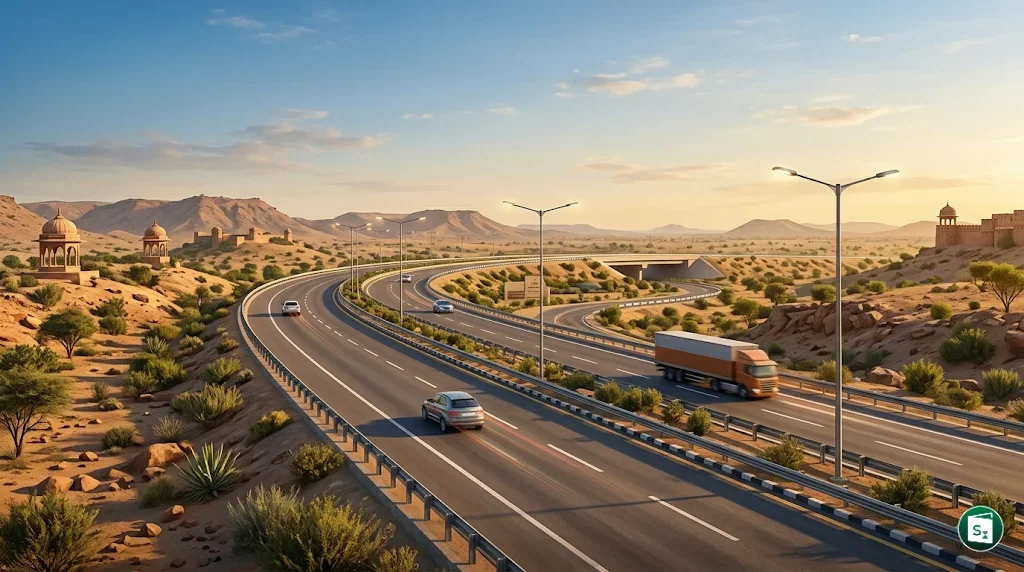
The World Bank has approved a $225 million (₹2,080 crore) loan to modernise and secure over 800 kilometres of state highways in Rajasthan. This project, funded through the International Bank for Reconstruction and Development (IBRD), introduces India’s first Step-Up Loan (SuL) to manage fiscal risks in infrastructure. The initiative aims to enhance road safety and climate resilience while transforming the state’s transport authority into a service-led institution.
Enhancing Rajasthan’s Road Infrastructure: Project Goals
The Rajasthan Highway Modernisation Project is a comprehensive plan to upgrade approximately 800 kilometres of selected highway corridors across the state. A primary objective is to increase the proportion of the state’s road network in good or fair condition from the current 40 percent to 70 percent. This infrastructure push focuses on making highways more efficient and reliable for the millions of people who depend on them daily.
Besides physical upgrades, the project places a heavy emphasis on climate resilience and road safety. By integrating digital traffic management systems and improving safety protocols, the initiative seeks to reduce road fatalities and ensure that the network can withstand extreme weather events. The investment will cover various types of road works, from surfacing and widening to the installation of modern drainage systems and safety barriers.
The “Step-Up Loan”: An Innovative Financial Tool
A standout feature of this financial package is the inclusion of India’s first Step-Up Loan (SuL). This innovative financing model is designed by the World Bank to ease the fiscal burden on state governments during the early stages of large-scale projects. In this structure, the initial repayment costs are kept low during the high-risk construction phase. As the project matures and begins generating economic returns or is better positioned for market refinancing, the pricing “steps up” or increases.
This flexibility allows the state of Rajasthan to manage its budget more effectively while developing critical infrastructure. Below is a summary of the project’s financial and technical parameters:
| Parameter | Details |
|---|---|
| Loan Amount | $225 million (₹2,080 crore) |
| Lending Institution | IBRD (World Bank Group) |
| Financing Model | Step-Up Loan (SuL) |
| Final Maturity | 35 years |
| Grace Period | 5 years |
| Highway Coverage | 800 kilometres |
Furthermore, the project aims to mobilize approximately $295 million in private capital via public-private partnerships (PPPs) and market borrowing, reducing the total reliance on public funds.
Reforming the Rajasthan State Highway Authority
The project goes beyond construction to include significant institutional reforms. A major goal is to transform the Rajasthan State Highway Authority (RSHA) into a modern, service-oriented agency. This shift involves moving from a traditional construction-focused mindset to a “Road as a Service” model. This approach prioritises the long-term maintenance, safety, and performance of the road network to ensure that the infrastructure remains functional and high-quality throughout its lifecycle.
To support this transformation, the project will help implement digital asset management systems and performance-based maintenance contracts. By strengthening the institutional capacity of the RSHA, the state government aims to create a more efficient and transparent system for managing public infrastructure. These reforms are expected to serve as a benchmark for other Indian states looking to modernise their own transport departments.
Driving Socio-Economic Growth through Connectivity
The modernisation of 800 kilometres of highways is expected to directly benefit more than 3 million people in Rajasthan. Improved road connectivity is a key driver for economic growth, particularly in sectors such as agriculture, mining, tourism, and industry. Better roads mean faster and cheaper transport for goods and services, which can help stimulate local businesses and create new job opportunities.
Tourism, which is a vital part of Rajasthan’s economy, stands to gain significantly from smoother and safer travel routes between major heritage sites and urban centres. Similarly, the movement of agricultural produce from farms to markets will become more efficient, reducing wastage and increasing farmer incomes. By linking remote regions to major economic hubs, the project aims to foster inclusive development and reduce regional disparities within the state.
Understanding the World Bank and IBRD
The World Bank Group is an international financial institution that provides loans and grants to the governments of low and middle-income countries for the purpose of pursuing capital projects. It was established in 1944 following the Bretton Woods Conference and is headquartered in Washington, D.C. The primary goal of the organization is to reduce global poverty and promote shared prosperity.
The International Bank for Reconstruction and Development (IBRD) is one of the five constituent institutions of the World Bank Group. It specifically lends to sovereign states and creditworthy low-income countries at market-reflective interest rates. Another key arm is the International Development Association (IDA), which provides concessional loans and grants to the world’s poorest nations. As of 2026, Ajay Banga serves as the President of the World Bank Group, overseeing its global operations and financial initiatives like the Step-Up Loan introduced in this project.
Key Takeaways
- The World Bank has approved a $225 million (₹2,080 crore) loan to modernise and maintain 800 kilometres of state highways across Rajasthan.
- This project introduces India’s first Step-Up Loan (SuL), which lowers initial repayment costs during the high-risk construction phase.
- The International Bank for Reconstruction and Development (IBRD) provides the funding with a 35-year maturity and a 5-year grace period.
- The Rajasthan State Highway Authority (RSHA) aims to transition into a service-oriented agency using the “Road as a Service” operational model.
- The infrastructure upgrade is expected to benefit more than 3 million people and improve connectivity for the agriculture, mining, and tourism sectors.
- The World Bank Group, headquartered in Washington, D.C., was established in 1944 following the Bretton Woods Conference.