Welcome to Scoreclever ⏳ Current Affairs 🌏

  • 👉 Detailed daily current affairs on website
  • 👉 Crisp current affairs on daily PDFs
  • 👉 Easy memorization and revision with app

News for 22-04-2026

  1. 1
  2. 2
  3. 3
  4. 4
  5. 5
  6. 6
  7. 7
  8. 8
  9. 9
  10. 10
  11. 11
  12. 12
  13. 13

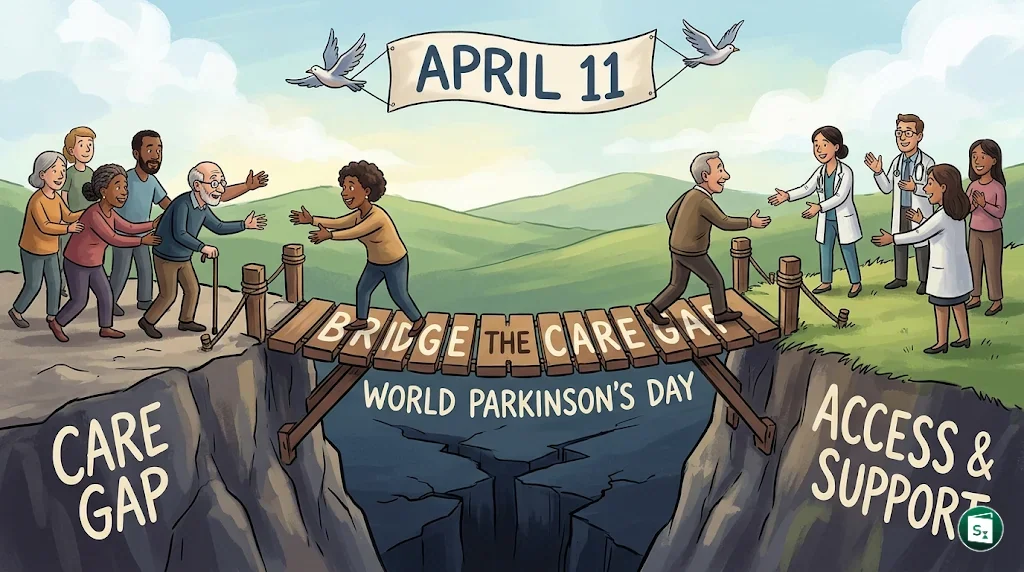
World Parkinson's Day 2026: Global Theme 'Bridge the Care Gap' Highlights Critical Care Disparities

SUMMARY

World Parkinson's Day 2026 was observed on April 11 with the theme 'Bridge the Care Gap,' focusing on improving access to specialized care and reducing disparities in Parkinson’s treatment.

Exam Oriented Concise Information

Important Banking

World Parkinson’s Day: Day - April 11; Theme 2026 - “Bridge the Care Gap”; Observed since - 1997; Commemorating - Birth anniversary of Dr James Parkinson

This information is solely enough for exam preparation. It is 5 times concise compared to other top current affairs sources that offers elaborative content, but outperforms them. The comprehensive details below are just for additional reference and context. Visit the performance page to know more about our content performance on recent exams.

World Parkinson’s Day 2026 was observed on April 11, serving as a global platform to address the rising challenges of Parkinson’s disease under the theme “Bridge the Care Gap.” The annual event focuses on reducing disparities in access to specialized care while commemorating the 271st birth anniversary of Dr James Parkinson, the British physician who first identified the condition. In India, the day highlighted a concerning increase in early-onset cases among the younger population, necessitating a shift toward multidisciplinary management strategies.

Bridging the Care Gap: The 2026 Global Directive

The theme “Bridge the Care Gap” reflects the systemic failures that often leave individuals diagnosed with Parkinson’s to manage their condition with minimal clinical guidance. This gap encompasses significant delays in diagnosis, restricted access to neurologists, and a shortage of specialized nurses trained in neurodegenerative care. The 2026 campaign advocates for equity in healthcare, ensuring that patients, regardless of their location or economic status, receive continuous and holistic support rather than episodic interventions.

In many regions, the burden of care coordination falls heavily on unpaid family members. The initiative emphasizes that healthcare systems must prioritize proactive information delivery, providing patients with clear pathways to support immediately after diagnosis. By strengthening the role of Parkinson’s-specific clinicians and integrating mental health services, the global community aims to transform care from a privilege into a fundamental right.

Historical Roots: Honoring Dr. James Parkinson’s Legacy

World Parkinson’s Day was first established on April 11, 1997, by the European Parkinson’s Disease Association (EPDA), which is now known as Parkinson’s Europe, in collaboration with the World Health Organization (WHO). The chosen date honors the birth of Dr James Parkinson, an English surgeon and apothecary born in 1755. In 1817, he published a seminal work titled An Essay on the Shaking Palsy, which provided the first detailed clinical account of the neurological syndrome. It was not until later in the 19th century that the French neurologist Jean-Martin Charcot named the condition after Parkinson to recognize his pioneering contribution.

The red tulip has become the universal symbol for Parkinson’s awareness, officially adopted at the 9th World Parkinson’s Day conference in 2005. The symbol originated from J.W.S. Van der Wereld, a Dutch horticulturist who lived with the disease and developed a special red and white tulip variety in 1980. Today, the flower represents hope and the ongoing search for a cure for millions affected worldwide.

India is facing a significant surge in Parkinson’s disease cases, with prevalence rates estimated between 15 and 43 per 100,000 people. Experts at the All India Institute of Medical Sciences (AIIMS), New Delhi, have noted that the country could soon host the second-largest population of Parkinson’s patients globally. A particularly alarming trend in the Indian context is the high incidence of early-onset Parkinson’s, affecting individuals between the ages of 22 and 49.

Statistics suggest that between 40 and 45 percent of cases in India are classified as young-onset. The average age of diagnosis in India is 51 years, which is nearly a decade earlier than the global average. This early arrival of the disease is attributed to several factors, including genetic predispositions, rising industrial pollutants, and environmental triggers such as heavy metals and pesticides. To address this, the King’s Parkinson’s Research Alliance India (PRAI) showcased modern multidisciplinary care models at their 2026 symposium, emphasizing that early detection and lifestyle modifications are vital for managing the condition’s long-term impact.

Global Strategic Framework: WHO’s 10-Year Vision

The World Health Organization (WHO) addresses Parkinson’s disease through a comprehensive global roadmap known as the Intersectoral Global Action Plan on Epilepsy and Other Neurological Disorders (IGAP) 2022-2031. This 10-year plan provides a framework for nations to strengthen governance, improve diagnostics, and expand access to treatment and care for neurological conditions. In support of this plan, the WHO brain health unit released a technical brief titled Parkinson Disease: A Public Health Approach to guide policymakers in integrating specialized care into national health systems.

Central to the WHO’s strategy are six major action steps designed to reduce global disparities. These include tracking the disease burden, boosting advocacy and awareness, promoting prevention and risk reduction, and enhancing support for caregivers. The plan emphasizes that low and middle-income countries must be supported in developing localized care pathways, as these regions often lack the specialized workforce required to manage the escalating number of cases.

Understanding the Condition: Science and Symptoms

Parkinson’s disease is a chronic and progressive neurodegenerative disorder that primarily affects motor functions. It occurs when nerve cells in a specific part of the brain called the substantia nigra begin to die or become impaired. These neurons are responsible for producing dopamine, a chemical messenger that sends signals to coordinate muscle movement. When dopamine levels decrease, it results in the classic physical symptoms associated with the condition.

The most common motor symptoms of Parkinson’s include tremors, bradykinesia (slowness of movement), muscle rigidity, and postural instability (impaired balance). However, many patients also experience non-motor symptoms such as sleep disturbances, mood changes, and gastrointestinal issues, which can often precede physical tremors by several years. While there is currently no cure, treatments such as levodopa-carbidopa medication and deep brain stimulation (DBS) surgery can effectively manage symptoms and improve the quality of life for many patients.

Key Takeaways

  • World Parkinson’s Day is observed annually on April 11 to commemorate the birth anniversary of Dr James Parkinson, who identified the disease in 1817.
  • The global theme for the year 2026 is “Bridge the Care Gap,” which focuses on reducing disparities in access to specialized neurological treatment and caregiver support.
  • The red tulip was officially adopted as the universal symbol for Parkinson’s awareness in 2005, originally developed by Dutch horticulturist J.W.S. Van der Wereld.
  • In India, between 40 and 45 percent of Parkinson’s cases are classified as early-onset, typically affecting individuals between 22 and 49 years of age.
  • The World Health Organization (WHO) addresses the condition through the Intersectoral Global Action Plan (IGAP) 2022–2031, which targets neurological disorders globally.
  • Parkinson’s disease is a progressive neurodegenerative disorder caused by the depletion of dopamine-producing neurons in the substantia nigra region of the brain.

Check your understanding

Attempt quiz on this news with three level of difficulty

World Parkinson's Day 2026: Global Theme 'Bridge the Care Gap' - Quiz

Test your knowledge on the global theme, history, and significance of World Parkinson's Day 2026.

2 Questions Passing: 50%

About Scoreclever

Your Complete Learning Ecosystem

Scoreclever helps you master Current Affairs, English Language, and General Awareness for Banking, SSC & other government exams. The Scoreclever app has innovative learning technique that make memorization and revision effortless.

Explore Scoreclever

CA League Leaderboard

8 days left in April
Profile photo of Vijay V

Vijay

157.8
2
Profile photo of Dhanush D

Dhanush

166.3
1
E

Elakiya

148.8
3
4
Profile photo of Gautham
Gautham
5
SS
Saariga Selvam
6
Profile photo of Devadharshini Senthil
Devadharshini Senthil
7
S
Sribala
8
S🌼
Spring 🌼
9
Profile photo of 𝗠𝘂𝗥𝗮𝗟𝗶 𝗩𝗶𝗝𝗮𝗬
𝗠𝘂𝗥𝗮𝗟𝗶 𝗩𝗶𝗝𝗮𝗬
10
RG
Ragavi G
11
H
Hariniii🦋
12
D
DD
13
Profile photo of Dhanush GS
Dhanush GS
14
Profile photo of Banker GD
Banker GD
15
L
LOL
16
GK
Gopi K.
17
Profile photo of Arun Mozhi
Arun Mozhi
18
Profile photo of Pradeepa
Pradeepa

Current Affairs 🌏 quiz are conducted on our telegram channel at 8 PM 🕗 everyday as a league 🏆. New League will start 🚀 every month. Marks obtained by the participants are added from day 1 until the end of the month 🗓️ and top 3 winners 🥇🥈🥉 will receive exciting rewards.

Join CA league

Memorize Current Affairs effortlessly with the Scoreclever App

The app has a new & unique learning technique that will
Predict when you will forget
Make you to revise accordingly
Testimonials

Loved by Aspirants

Reviews collected across various platforms

"The memorising technique in the Scoreclever automatically stores the news in my mind and it saves time."

S
Sarika
IBPS PO

"It is very helpful platform to study current affairs. It has memory technique which saves lots of time during preparartion."

C
Chidambaram
SBI PO

"Came across Editorial Vocabulary podcast video accidentally and really loved the idea. Its really useful for my preparation."

M
Minnie
SSC CGL

"Wonderful session. Thank you so much and really hats off to you for making current affairs and editorial an easy one."

A
Amit
SSC CPO

"This is one the best app for Current Affairs. The content is cut and short whichever is required and is easy to remember with flashcards."

H
Hari
IBPS PO

"Thx to daily quizzes. It played a big role in revisions. April 2024 - April 2025 I missed quizzes 3 or 4 days only. It's that interesting."

N
Naveen
UBI LBO

"Best app to learn current affairs in an effective way. I usually forgot current affairs easily and now I can easily remember everything."

L
Linu
RRB NTPC

"I studied current affairs only in Scoreclever and its really a time saver. Thanks Scoreclever team for all your efforts."

N
Nithya
RRB Clerk

"Just wow. Haven't seen anyone explaining editorials like this. Crystal clear explanations with word by word. Thanks so much."

S
Shyam
UPSC CAPF

"This app is very useful to the persons who find difficult to go through the bunch of PDFs, and spending lots of time for revision."

H
Hema
IBPS PO

"The memorising technique in the Scoreclever automatically stores the news in my mind and it saves time."

S
Sarika
IBPS PO

"It is very helpful platform to study current affairs. It has memory technique which saves lots of time during preparartion."

C
Chidambaram
SBI PO

"Came across Editorial Vocabulary podcast video accidentally and really loved the idea. Its really useful for my preparation."

M
Minnie
SSC CGL

"Wonderful session. Thank you so much and really hats off to you for making current affairs and editorial an easy one."

A
Amit
SSC CPO

"This is one the best app for Current Affairs. The content is cut and short whichever is required and is easy to remember with flashcards."

H
Hari
IBPS PO

"Thx to daily quizzes. It played a big role in revisions. April 2024 - April 2025 I missed quizzes 3 or 4 days only. It's that interesting."

N
Naveen
UBI LBO

"Best app to learn current affairs in an effective way. I usually forgot current affairs easily and now I can easily remember everything."

L
Linu
RRB NTPC

"I studied current affairs only in Scoreclever and its really a time saver. Thanks Scoreclever team for all your efforts."

N
Nithya
RRB Clerk

"Just wow. Haven't seen anyone explaining editorials like this. Crystal clear explanations with word by word. Thanks so much."

S
Shyam
UPSC CAPF

"This app is very useful to the persons who find difficult to go through the bunch of PDFs, and spending lots of time for revision."

H
Hema
IBPS PO

"The memorising technique in the Scoreclever automatically stores the news in my mind and it saves time."

S
Sarika
IBPS PO

"It is very helpful platform to study current affairs. It has memory technique which saves lots of time during preparartion."

C
Chidambaram
SBI PO

"Came across Editorial Vocabulary podcast video accidentally and really loved the idea. Its really useful for my preparation."

M
Minnie
SSC CGL

"Wonderful session. Thank you so much and really hats off to you for making current affairs and editorial an easy one."

A
Amit
SSC CPO

"This is one the best app for Current Affairs. The content is cut and short whichever is required and is easy to remember with flashcards."

H
Hari
IBPS PO

"Thx to daily quizzes. It played a big role in revisions. April 2024 - April 2025 I missed quizzes 3 or 4 days only. It's that interesting."

N
Naveen
UBI LBO

"Best app to learn current affairs in an effective way. I usually forgot current affairs easily and now I can easily remember everything."

L
Linu
RRB NTPC

"I studied current affairs only in Scoreclever and its really a time saver. Thanks Scoreclever team for all your efforts."

N
Nithya
RRB Clerk

"Just wow. Haven't seen anyone explaining editorials like this. Crystal clear explanations with word by word. Thanks so much."

S
Shyam
UPSC CAPF

"This app is very useful to the persons who find difficult to go through the bunch of PDFs, and spending lots of time for revision."

H
Hema
IBPS PO