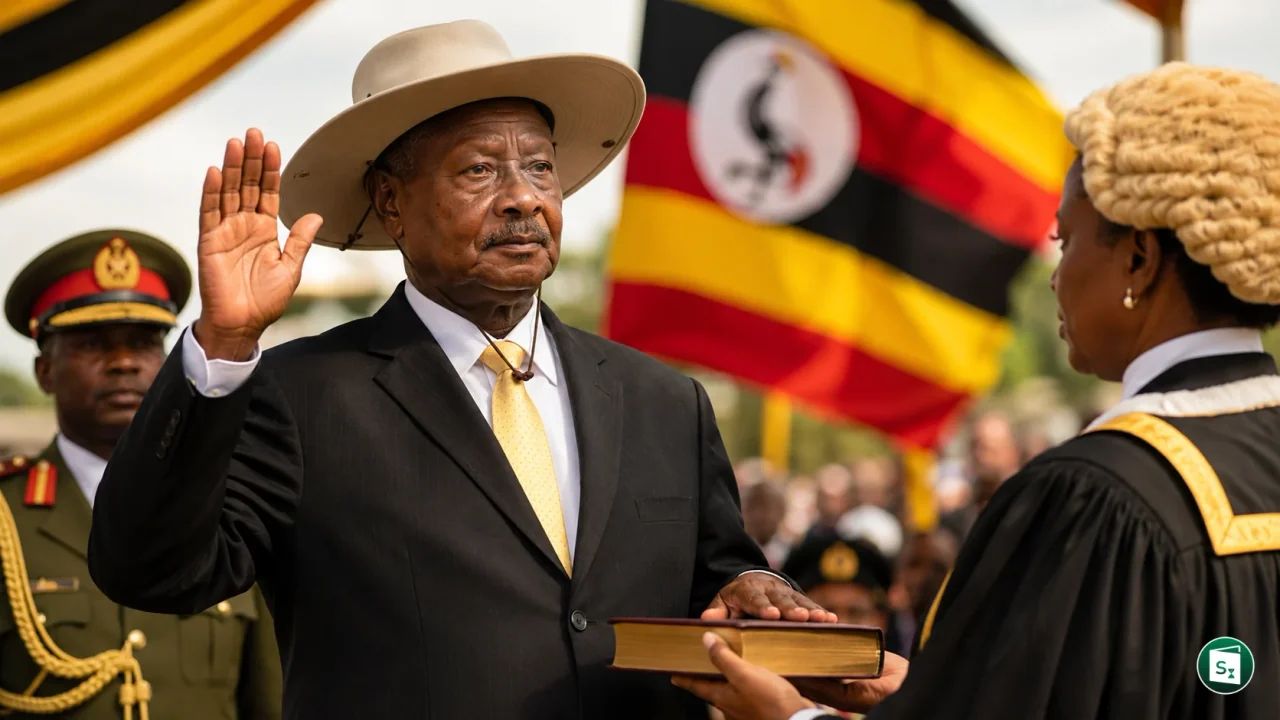
Ugandan President Yoweri Museveni was sworn in for a seventh consecutive five-year term on May 12, 2026, at the Kololo Ceremonial Grounds in Kampala. Museveni, representing the National Resistance Movement (NRM), secured this extension of his four-decade rule following a victory in the January 2026 general election. This inauguration solidifies his position as one of the longest-serving heads of state in Africa and continues to shape the geopolitical dynamics of East Africa.
The 2026 General Election and Swearing-In Ceremony
The general election in Uganda took place on January 15, 2026, amidst tight security and intense political contestation. The Electoral Commission declared Yoweri Museveni the winner, stating that he received 71.65% of the cast votes. His main challenger, former musician-turned-politician Robert Kyagulanyi, who is widely known as Bobi Wine and leads the National Unity Platform (NUP), finished second with 24.72% of the vote.
The election process drew criticism from various international observers and domestic opposition groups. Opposition leaders rejected the results, alleging widespread voter intimidation, ballot stuffing, and arbitrary arrests of their supporters. The government also implemented a nationwide internet shutdown during the voting and counting period, which authorities defended as a measure to maintain public order and prevent unrest.
Following the confirmation of the results, Museveni took the oath of office on May 12, 2026, for another five-year term that extends his presidency until 2031. The swearing-in ceremony at the Kololo Ceremonial Grounds in Kampala was attended by several African heads of state, foreign diplomats, and regional leaders.
Constitutional Amendments and Extended Tenure
Museveni’s ability to contest for a seventh presidential term was made possible through crucial changes to the Constitution of Uganda, which was originally promulgated in 1995. Under the original 1995 framework, the president was limited to two five-year terms. However, in 2005, the Ugandan Parliament passed a major constitutional amendment that abolished these term limits. This change allowed Museveni to run for a third term in 2006 and continue contesting subsequent elections.
Another major legal hurdle arose prior to the 2021 elections due to a constitutional age limit. The original constitution barred individuals older than 75 years from running for the presidency. In December 2017, Parliament passed another amendment that removed this age restriction. Born in September 1944, Museveni was 76 years old during the 2021 election and 81 years old during the 2026 election, making the 2017 amendment essential for his continued presidency.
Yoweri Museveni’s Rise and Political Journey
Yoweri Museveni came to power in January 1986 after leading a successful five-year guerrilla struggle known as the Ugandan Bush War. His insurgent group, the National Resistance Army (NRA), captured the capital city of Kampala and overthrew the military regime of Tito Okello. Upon taking office, Museveni formed the political wing of the movement, the National Resistance Movement (NRM), which has remained the dominant political party in Uganda since then.
His early administration brought relative stability, security, and economic recovery to a nation previously devastated by the tyrannical rule of Idi Amin and the subsequent civil strife under Milton Obote. Over his four decades in power, Museveni positioned himself as a key regional mediator and a vital security ally for Western nations in the Horn of Africa, particularly through Uganda’s participation in peacekeeping missions. However, in recent years, his administration has faced growing domestic and international criticism over the suppression of political dissent, press censorship, and the prolonged consolidation of executive power.
India-Uganda Bilateral and Economic Relations
India and Uganda share a deep historical and economic partnership that has expanded significantly under Museveni’s presidency. A key milestone in contemporary relations was the state visit of Prime Minister Narendra Modi to Uganda in July 2018, which marked the first visit by an Indian Prime Minister to the country in 21 years. During this visit, Modi addressed the Ugandan Parliament, becoming the first Indian leader to do so, and articulated India’s 10 Principles of Engagement with Africa, placing Uganda at the core of India’s development partnership on the continent.
To strengthen infrastructure and capacity building, India extended two crucial Lines of Credit to Uganda. These included USD 141 million for electricity transmission lines and substations, alongside USD 64 million for agriculture and dairy development. India also established a regional materials laboratory and donated medical equipment, including a Bhabhatron cancer therapy machine, and solar irrigation pumps to support Uganda’s developmental goals.
Trade Dynamics and Diaspora Impact
Economic engagement remains a key pillar of the bilateral relationship, with India consistently ranking as a top investor in Uganda. In the financial year 2023-24, the bilateral trade volume between the two nations exceeded USD 1.39 billion. India’s primary exports to Uganda include pharmaceutical products, industrial machinery, petroleum products, and automobiles, while Uganda exports gold, coffee, and agricultural pulses to India.
The Indian diaspora, which numbers between 30,000 and 35,000 individuals, acts as a strong cultural and economic link. Although they comprise less than one percent of the total population, they are major economic contributors, paying a substantial portion of Uganda’s tax revenues. This community has a complex history, having faced mass expulsion in 1972 under the military dictator Idi Amin, before returning in the 1980s and 1990s under the Museveni administration to resume their role in the country’s economic development.
Key Takeaways
- Yoweri Museveni of the National Resistance Movement (NRM) was sworn in for his seventh consecutive five-year term as President of Uganda on May 12, 2026.
- In the Ugandan general election held on January 15, 2026, Museveni won 71.65% of the vote, defeating opposition candidate Robert Kyagulanyi (popularly known as Bobi Wine) who received 24.72%.
- Under the Constitution of Uganda, which was established in 1995, presidential term limits were removed in 2005 and the maximum age limit of 75 years was removed in 2017.
- Museveni originally took power in January 1986 after leading the National Resistance Army (NRA) to victory in the Ugandan Bush War.
- During a landmark state visit in July 2018, Prime Minister Narendra Modi articulated India’s 10 Principles of Engagement with Africa during his address to the Parliament of Uganda.
- Bilateral trade between India and Uganda reached over USD 1.39 billion in the 2023-24 financial year, with India ranking as one of the largest investors in the East African country.