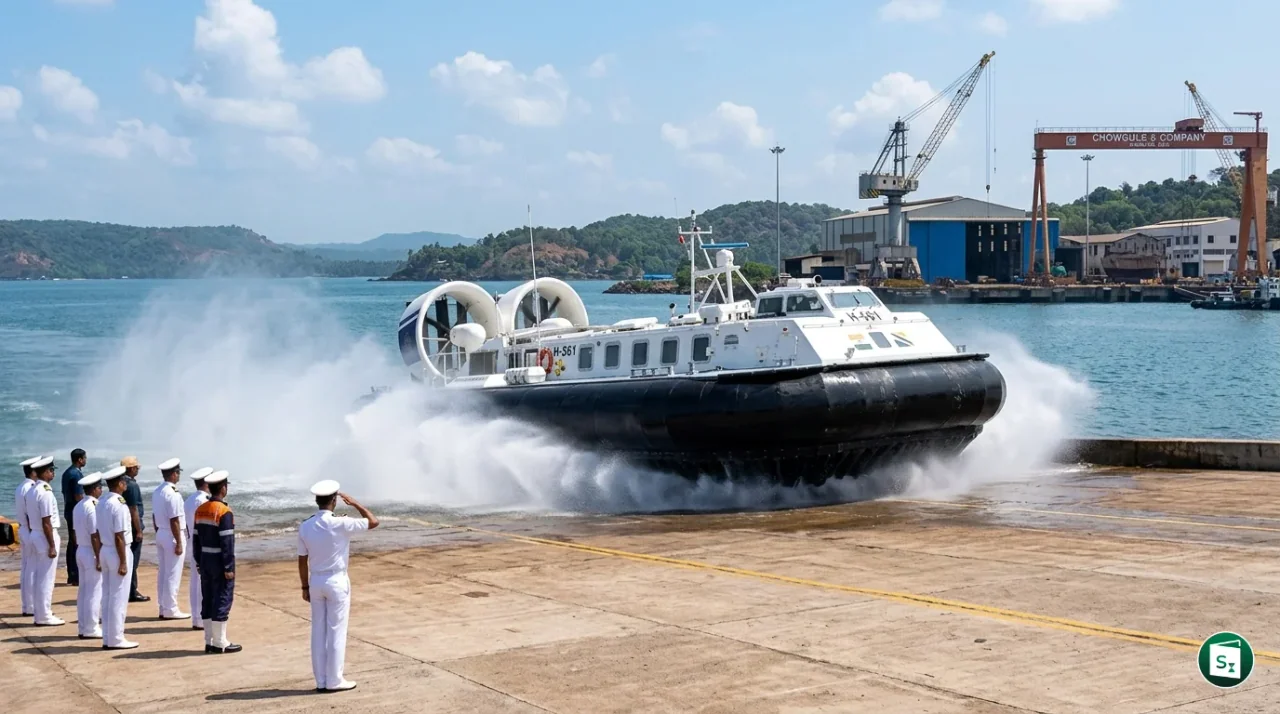
The Indian Coast Guard inducted its first indigenously built Air Cushion Vehicle, designated H-561, into service on 18 June 2026 at the Rassaim shipyard facility of Chowgule and Company Private Limited in Goa. The hovercraft, which can carry 42 personnel at speeds of up to 45 knots, will be deployed at Haldia in West Bengal to strengthen coastal surveillance and rapid response capabilities along India’s eastern seaboard. The induction marks a major milestone in India’s pursuit of self-reliance in maritime defence manufacturing under the Atmanirbhar Bharat initiative.
What Is an Air Cushion Vehicle?
An Air Cushion Vehicle, commonly known as a hovercraft, is an amphibious craft that rides on a cushion of pressurised air created by downward-facing fans or lift systems. This cushion of air is contained by a flexible skirt attached to the hull, which allows the vehicle to travel over water, mudflats, marshes, sandbanks, ice, and even low-support land surfaces that conventional vessels cannot navigate.
The fundamental principle behind an ACV is that it reduces hull contact with the surface, enabling it to operate at high speeds in extremely shallow waters. Unlike traditional boats that require a minimum depth, ACVs can transition seamlessly from water to land. This makes them ideal for littoral zone operations, where tidal variations, sandbars, and marshy terrain pose insurmountable challenges for standard patrol vessels.
ACVs were pioneered by British inventor Sir Christopher Cockerell in the 1950s. The H-561 has been built under a technology licence from Griffon Marine (formerly Griffon Hoverwork) of the United Kingdom, a company established in 1976 and headquartered in Southampton, with a global reputation as a leader in hovercraft design and manufacturing.
Key Features of H-561
The H-561 is constructed from marine-grade aluminium, which offers high strength, corrosion resistance, and reduced weight. It contains more than 50% indigenous content, a figure that reflects the growing capability of India’s ancillary defence manufacturing ecosystem, including MSMEs.
| Parameter | Specification |
|---|---|
| Personnel capacity | 42 personnel |
| Payload capacity | 8 tonnes |
| Maximum speed | 45 knots (contractual); achieved 52 knots in sea trials |
| Cruising speed | 35 knots |
| Operational endurance | 9 hours |
| Hull material | Marine-grade aluminium |
| Indigenous content | Over 50% |
| Technology partner | Griffon Marine (UK) |
The vessel demonstrated superior performance during sea trials, achieving a top speed of 52 knots, which is 4 knots higher than the Indian Coast Guard’s minimum contractual requirement of 48 knots. This performance margin provides the ICG with enhanced operational flexibility during high-speed interception and pursuit missions.
The Contract and Indigenisation Effort
The Ministry of Defence signed the contract for six Air Cushion Vehicles with Chowgule and Company Private Limited on 24 October 2024 at a total cost of ₹387.44 crore. The procurement was categorised under the Buy (Indian) category, which mandates indigenous manufacturing. As part of the deal, the shipyard will also provide maintenance support for a period of five years after delivery of each vessel.
The remaining five ACVs are scheduled for delivery at intervals of approximately three months each. This phased delivery plan ensures that Chowgule’s shipbuilding infrastructure can maintain quality standards while steadily building the ICG’s hovercraft fleet.
Chowgule and Company: A Century of Shipbuilding
Chowgule and Company is part of the Chowgule Group, a century-old Indian industrial conglomerate headquartered in Goa, with diversified interests in mining, iron ore pellets, shipbuilding, industrial salts, and education. Its shipbuilding division has been operational since 1951 and has constructed over 160 vessels for both domestic and international clients.
The company operates shipyards at Loutulim and Rassaim in Goa. It is recognised as the world’s largest supplier to the European dry cargo fleet and the only Indian shipyard to publish an ESG report. In a significant expansion of its capabilities, Chowgule also revived the Mangaluru Shipyard, a bankrupt facility that it made operational in just 18 months.
The H-561 project has boosted the technical expertise of India’s ancillary and MSME sectors, which supplied components accounting for more than half the vessel’s content. This aligns with the government’s broader push to build a comprehensive domestic defence supply chain rather than relying solely on final assembly of imported kits.
Strategic Importance for India’s Maritime Security
India has a coastline of approximately 7,500 kilometres and an Exclusive Economic Zone covering about 2.3 million square kilometres, making maritime security a critical national priority. The Indian Coast Guard is responsible for safeguarding these vast waters against threats including smuggling, illegal fishing, piracy, and infiltration, while also undertaking search and rescue and environmental protection missions.
The H-561 will be stationed at Haldia, West Bengal, a strategically important location near the Sundarbans delta and the India-Bangladesh maritime boundary. This region features intricate riverine networks, mangrove forests, mudflats, and shallow estuaries where conventional patrol vessels cannot operate effectively. The hovercraft’s ability to transition seamlessly between water and land gives the ICG a decisive advantage in these challenging terrains.
Key Operational Roles
The ACV will support the Indian Coast Guard across multiple mission profiles:
- Coastal surveillance and reconnaissance in shallow waters, creeks, and estuaries
- High-speed interception of suspicious vessels involved in smuggling or illegal fishing
- Search and rescue operations in all-weather, day-and-night conditions
- Humanitarian assistance and disaster relief, particularly during floods and cyclones that frequently affect West Bengal and the eastern coastline
- Law enforcement in riverine and deltaic regions inaccessible to standard patrol boats
The hovercraft’s 9-hour endurance and 8-tonne payload capacity allow it to carry sufficient fuel, supplies, and equipment for sustained patrols. Its ability to deploy directly onto beaches and riverbanks also makes it valuable for rapid insertion of personnel during special operations.
Indian Coast Guard: A 50-Year Journey
The year 2026 marks the 50th Raising Day (Golden Jubilee) of the Indian Coast Guard, with the theme “Surakshit Tat, Samridh Bharat” (Secure Coasts, Prosperous India). The force was originally conceived after the Nag Committee (1970) and the Rustamji Committee (1974) examined the growing problem of seaborne smuggling and recommended a dedicated maritime law enforcement agency.
An interim Coast Guard was established on 1 February 1977 with just seven ships transferred from the Indian Navy. The force was formally inaugurated on 19 August 1978 by then Prime Minister Morarji Desai following the enactment of the Coast Guard Act, 1978 by Parliament. The first Director General was Vice Admiral V. A. Kamath.
The Indian Coast Guard operates under the Ministry of Defence and is headquartered in New Delhi. Its motto, “Vayam Rakshamah” (We Protect), reflects its core mission. The current Director General is Paramesh Sivamani, the 26th DG of the ICG, who assumed office in October 2024.
Over five decades, the ICG has grown from a modest seven-ship force to a modern multi-mission organisation with over 150 surface platforms and 77 aircraft. It has five regional headquarters located at Gandhinagar, Mumbai, Chennai, Kolkata, and Port Blair, and operates through a network of district headquarters and Coast Guard stations along the coastline.
The ICG’s responsibilities extend well beyond coastal patrol. It serves as the National Maritime Search and Rescue Coordinating Authority (NMSARCA), chairs the Offshore Security Coordination Committee (OSCC), and acts as the Lead Intelligence Agency for coastal and sea borders. During hostilities, it operates under the operational control of the Indian Navy.
The Way Forward
The H-561 is the first of six ACVs that will join the Coast Guard fleet over the next year. Once all six are operational, the ICG’s hovercraft capabilities will see a significant expansion, particularly in the riverine and deltaic sectors of eastern India where conventional assets are least effective.
This induction comes at a time when India’s defence manufacturing sector is experiencing unprecedented growth. Defence production reached ₹1.54 lakh crore in FY 2024-25, while defence exports hit a record ₹38,424 crore in FY 2025-26, a 62.7% increase over the previous year. The government has set ambitious targets of ₹3 lakh crore in defence production and ₹50,000 crore in exports by 2029.
The successful execution of the H-561 project demonstrates that Indian shipyards can absorb advanced foreign technologies and deliver complex maritime platforms to global standards. This capability will be critical as India pursues its broader maritime modernisation goals, including the planned expansion of the ICG fleet to 200 surface platforms and 100 aircraft by 2030.
Key Takeaways
- The Indian Coast Guard inducted its first indigenously built Air Cushion Vehicle, H-561, on 18 June 2026 at Chowgule and Company’s shipyard in Goa.
- The ACV can carry 42 personnel and an 8-tonne payload at a maximum speed of 45 knots (achieved 52 knots in sea trials), with an endurance of 9 hours.
- The vessel is built from marine-grade aluminium and contains over 50% indigenous content under a technology licence from Griffon Marine (UK).
- The contract for six ACVs was signed between the Ministry of Defence and Chowgule and Company on 24 October 2024 for ₹387.44 crore under the Buy (Indian) category.
- The H-561 will be deployed at Haldia, West Bengal, to enhance the ICG’s capabilities in the riverine and deltaic regions of eastern India.
- The Indian Coast Guard was established on 1 February 1977 (formally inaugurated on 19 August 1978) under the Coast Guard Act, 1978, and operates under the Ministry of Defence with its headquarters in New Delhi.
- 2026 marks the 50th Raising Day of the Indian Coast Guard, with the theme “Surakshit Tat, Samridh Bharat” (Secure Coasts, Prosperous India).