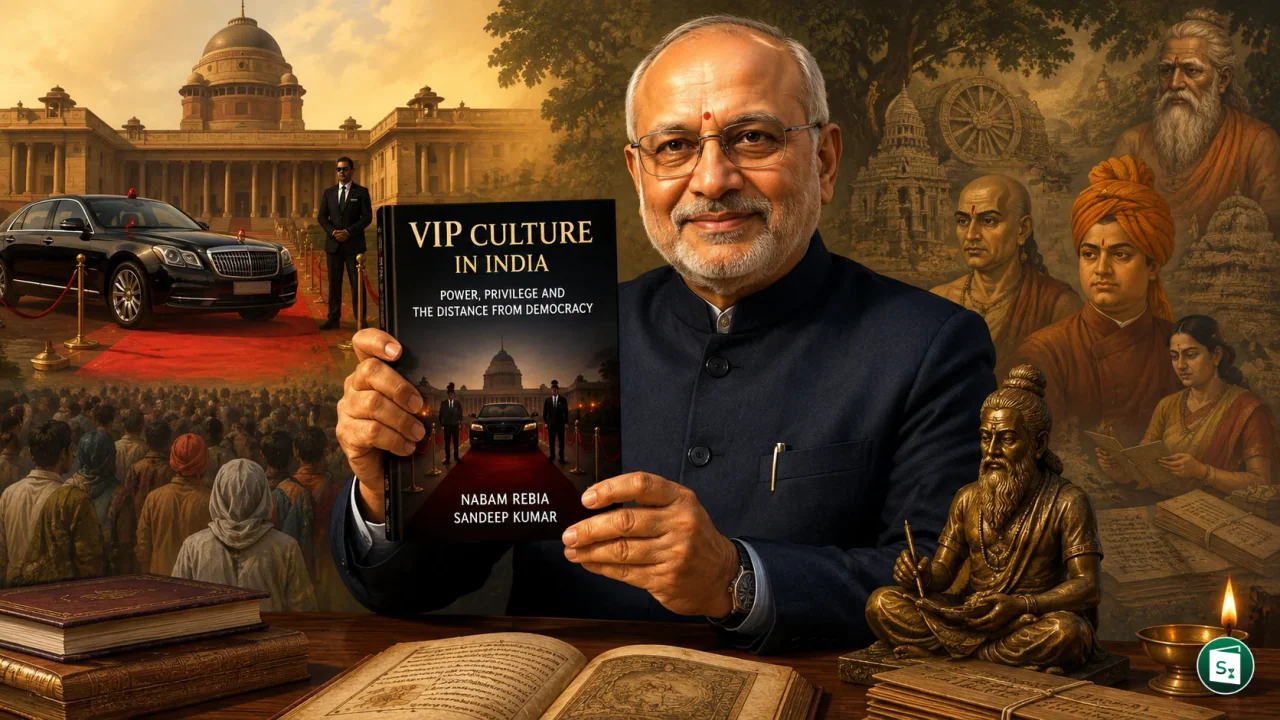
Vice President C.P. Radhakrishnan released the book “VIP Culture in India: Power, Privilege and the Distance from Democracy” at Uprashtrapati Bhavan in New Delhi on June 24, 2026. The book, authored by former Rajya Sabha member from Arunachal Pradesh Nabam Rebia and co-authored by Sandeep Kumar, critically examines how privilege and entitlement in public life create a distance between institutions of power and ordinary citizens. At the launch, Radhakrishnan emphasised that democracy thrives when public office is treated as a responsibility rather than a privilege.
About the Book
The book traces the evolution and persistence of VIP culture in India, exploring how systems of privilege, entitlement, and unequal access to public services erode democratic values. It presents a critical analysis of the relationship between power and public accountability while advocating a more citizen-centric and egalitarian democratic framework. The authors argue that when public authority becomes detached from the people it is meant to serve, the distance between the state and citizens widens, weakening democratic institutions.
A distinctive feature of the book is its grounding in India’s civilisational and intellectual traditions. The analysis draws from the Upanishads, the Ramcharitmanas, the teachings of Lord Buddha, and the Panchatantra, weaving ancient wisdom into contemporary debates on governance and ethics. The Vice President noted that these references enrich the book’s examination of leadership and public duty, making it both timely and rooted in Indian philosophical thought.
The Authors
Nabam Rebia
Nabam Rebia is a veteran politician from Arunachal Pradesh currently serving as a Rajya Sabha member, having been elected in June 2020 on a BJP ticket. He previously served as a Rajya Sabha member from 1996 to 2008 as a Congress party representative. Born on August 10, 1962 in the Papum Pare district, he holds an LL.B. degree from the Campus Law Centre at Delhi University (1986).
Rebia served as Speaker of the Arunachal Pradesh Legislative Assembly and was an MLA from the Doimukh constituency for two terms (2009-2019). He also held cabinet positions in the Pema Khandu government, handling portfolios including Urban Development and Law and Justice. His name is notably associated with the landmark Nabam Rebia v. Deputy Speaker Supreme Court judgment of 2016, which ruled that a Speaker facing a removal motion cannot adjudicate disqualification petitions under the Tenth Schedule (anti-defection law). The Vice President observed that the book reflects Rebia’s long experience as a parliamentarian, Speaker, minister, and public leader.
Sandeep Kumar
Sandeep Kumar is the co-author of the book. The Vice President acknowledged that Kumar’s contribution added academic value to the work and noted that his background as a mentor and writer has made the book accessible to a wider audience interested in governance and public policy.
Understanding VIP Culture in India
VIP culture refers to the system of privileges, special treatment, and entitlements granted to a select group of individuals holding public office or positions of power. Its common manifestations include reserved lanes, red beacon lights on vehicles, large motorcades, security-related traffic disruptions, and preferential access to public services and amenities. Critics argue that such practices create a visible hierarchy that contradicts the constitutional vision of equality.
The concept is often described as a colonial hangover, where the style of governance has not fully shifted from ruling subjects to serving citizens. Despite the formal end of British rule, certain administrative habits and symbols of superiority persisted within the bureaucracy and political class. This has created what scholars call an empathy deficit in governance, where the distance between those who govern and those who are governed widens over time.
The impact of VIP culture on democracy is significant. Visible privilege breeds public cynicism and weakens the legitimacy of institutions. A two-tier access to public services undermines the rule of law and the constitutional guarantee of equality before the law. Resources spent on security and logistics for VIP movement often divert public money from welfare and development. Administrative decision-making can also become biased toward influential actors rather than the public interest.
Key Messages from the Launch Event
Addressing the gathering at the book launch, Vice President Radhakrishnan said the Constitution envisions a society founded on justice, equality, liberty and fraternity. He stressed that democracy functions best when public office is treated as a responsibility rather than a privilege. The relationship between citizens and those entrusted with public authority, he noted, remains central to the health of any democracy.
Drawing from the teachings of the Tamil saint-poet Thiruvalluvar, Radhakrishnan said true leadership is defined by accessibility, compassion, and accountability. Leaders who remain approachable and treat citizens with respect earn lasting trust and admiration, he added.
The Vice President observed that the themes of the book align closely with Prime Minister Narendra Modi’s vision of public service. He cited the Prime Minister’s decision to abolish red beacon lights for dignitaries as a concrete step toward reducing symbols of privilege in public life. He also referred to a recent instance where the Prime Minister delayed his departure to avoid inconveniencing NEET candidates due to traffic restrictions, calling it an example of citizen-first governance.
Recalling the Prime Minister’s statement that “Every Indian is special. Every Indian is a VIP,” Radhakrishnan said public authority exists to serve citizens. He described service as the ultimate dharma and praised the book’s references to former Prime Minister Lal Bahadur Shastri and other leaders known for their simplicity and dedication to public service.
The event was attended by several prominent figures, including former Arunachal Pradesh Chief Minister Nabam Tuki, former Rajya Sabha member from Meghalaya W.R. Kharlukhi, Lok Sabha MP Tapir Gao, Rajya Sabha MP S. Phangnon Konyak, and the authors.
Why the Book Matters
The Vice President described the book as having the potential to become a milestone in the field of public policy, as it raises fundamental questions about privilege, accountability, and citizen-centric governance. He noted that the book would be of great help to officers, administrators, policymakers, public representatives, and students.
The book arrives at a time when debates around VIP culture have gained fresh urgency in India. The government has taken several measures in recent years to reduce visible symbols of privilege, including the abolition of the red beacon system in 2017 and the simplification of security protocols. At the same time, institutional mechanisms such as the Citizen’s Charter, the Right to Public Services Acts enacted by various states, and the Centralized Public Grievance Redress and Monitoring System (CPGRAMS) have sought to make governance more responsive and citizen friendly.
By examining VIP culture through the lens of India’s civilisational heritage, the book offers a unique perspective that goes beyond legal and administrative critiques. It situates the demand for egalitarian governance within the broader philosophical traditions of Indian thought, making the case that simplicity, humility, and public service are not modern imports but values deeply embedded in India’s intellectual history.
Key Takeaways
- Vice President C.P. Radhakrishnan released the book “VIP Culture in India: Power, Privilege and the Distance from Democracy” at Uprashtrapati Bhavan in New Delhi on June 24, 2026.
- The book is authored by former Rajya Sabha member Nabam Rebia and co-authored by Sandeep Kumar.
- The analysis draws from India’s civilisational heritage including the Upanishads, Ramcharitmanas, teachings of Lord Buddha, and the Panchatantra.
- Nabam Rebia served as Speaker of the Arunachal Pradesh Legislative Assembly and was associated with the landmark Nabam Rebia v. Deputy Speaker (2016) Supreme Court judgment on the Tenth Schedule (anti-defection law).
- The Vice President cited the abolition of red beacon lights for dignitaries and the simplicity of former Prime Minister Lal Bahadur Shastri as examples of citizen-centric leadership.
- The Rajya Sabha is the upper house of the Indian Parliament; Nabam Rebia represents the state of Arunachal Pradesh in it.