The 31st CII Partnership Summit 2026 was held on 12 and 13 November 2026 in Visakhapatnam, Andhra Pradesh. The Confederation of Indian Industry organised the summit with the Department for Promotion of Industry and Internal Trade and the Andhra Pradesh government. The meet produced investment proposals worth ₹9.89 lakh crore, a new India Oman UAE aviation panel and a ₹25,000 crore space city plan.
What Is the CII Partnership Summit?
The CII Partnership Summit is an annual global economic forum organised by the Confederation of Indian Industry since 1995. The Department for Promotion of Industry and Internal Trade supports the summit on behalf of the Ministry of Commerce and Industry. The host state government acts as a partner for venue, logistics and investment sessions.
The 31st edition carried extra weight because Visakhapatnam hosted the summit for the second year in a row. The 30th edition in November 2025 had drawn 30 ministers, about 3,000 delegates and representation from nearly 60 countries. The 2026 edition matched that scale with delegates from 59 countries, 15 foreign ministers, global chief executives, policymakers and heads of international bodies.
Union Commerce and Industry Minister Piyush Goyal served as summit chairman and Andhra Pradesh Chief Minister N Chandrababu Naidu served as co-chair. The inaugural session was attended by Union Home Minister Amit Shah, Civil Aviation Minister Kinjarapu Ram Mohan Naidu, Deputy Chief Minister Konidala Pawan Kalyan and IT Minister Nara Lokesh. Vice President C P Radhakrishnan joined the valedictory session. Foreign participants included UAE Minister of Economy and Tourism Abdulla bin Touq Al Marri, ministers from Singapore, Slovakia and Guatemala, and ambassadors of Japan and Russia.
What Is CII and What Is DPIIT?
The Confederation of Indian Industry (CII) is a non-government and not-for-profit industry association headquartered in New Delhi. CII works with industry, government and civil society on policy advice, competitiveness, skilling and business networking. CII is not a government body. It is led and managed by industry and is funded through membership and services.
CII traces its origin to 1895, when five engineering firms formed the Engineering and Iron Trades Association in Kolkata. The body became the Indian Engineering Association in 1912, the Association of Indian Engineering Industry in 1974, the Confederation of Engineering Industry in 1986 and the Confederation of Indian Industry in 1991. Today CII reports more than 9,700 direct members and over 3,65,000 indirect members through around 318 national and regional associations. For 2026 to 27, R Mukundan, Managing Director of Tata Chemicals, is President of CII and Chandrajit Banerjee is Director General.
The Department for Promotion of Industry and Internal Trade (DPIIT) is a department under the Ministry of Commerce and Industry. DPIIT frames industrial policy, promotes foreign direct investment, handles ease of doing business reforms and administers intellectual property rights. DPIIT also runs the Startup India initiative, which was launched on 16 January 2016 and recognises eligible startups for tax benefits, easier compliance and faster patent support.
31st Summit Theme and Six Discussion Tracks
The 31st summit met under the theme Navigating the New World Order: Trade, Technology, Trust and Thought Leadership. The theme points to supply chain shocks, technology competition and the search for stable partners. India presented itself as a fast growing, policy stable and technology capable economy that can link developed and developing markets.
The summit organised its debates around six tracks. The table below lists each track and its central question.
| Track | Central question discussed |
|---|---|
| Trade, Investment and Global Value Chains | How to build resilient supply chains and reach $2 trillion in merchandise and services exports |
| Trust, Geoeconomics and Global Cooperation | How transparent governance and rules based trade can attract long term capital |
| Technology, Innovation and Future Industry | How to grow research spending, protect ideas and scale defence, semiconductor and quantum systems |
| Talent, Skills and Global Mobility | How to train young workers for clean energy, health, mobility and advanced manufacturing |
| Transition to Clean Energy and Sustainable Growth | How to scale solar, green hydrogen, batteries and critical mineral supply |
| Transforming Agriculture, Food Security and Bioeconomy | How precision farming and climate smart methods can raise farm income |
The concept note linked the talks to hard data. World trade crossed $35 trillion in 2025. India recorded $825 billion in exports in 2024 to 25 and 7.7 percent GDP growth in 2025 to 26. Gross foreign direct investment inflows crossed $1.16 trillion between 2000 and March 2026. India also improved its rank in the Global Innovation Index to 38 in 2025 from 52 in 2019.
India Oman UAE Technical Committee for Airspace Coordination
Civil Aviation Minister Kinjarapu Ram Mohan Naidu met UAE Minister of Economy and Tourism Abdulla bin Touq Al Marri on the sidelines of the summit on 12 November 2026. The two ministers agreed to set up an India Oman UAE technical trilateral committee. The panel will address operational problems for flights and prepare coordinated solutions.
The decision responds to airspace stress in West Asia. Strikes involving the United States, Israel and Iran since February 2026, retaliatory drone and missile attacks and airspace closures forced Indian carriers to cancel or reroute services to cities such as Jeddah, Riyadh and Dammam. Longer routes around conflict zones raise fuel use, flight time and insurance cost.
The committee will bring technical officials from the three countries together. The ministers said the talks will feed into wider technical discussions between the Middle East and Asia Pacific regions of the International Civil Aviation Organization (ICAO) later in November. ICAO is a United Nations agency headquartered in Montreal, Canada that sets global rules for safe air navigation. The three country format matters because Gulf airspace links India with Europe and North America, so coordination on routes, safety and traffic flow directly affects Indian passengers and cargo.
Andhra Pradesh Announcements: 303 MoUs Worth ₹9.89 Lakh Crore
Chief Minister N Chandrababu Naidu announced 303 memoranda of understanding (MoUs) with proposed investments of ₹9.89 lakh crore. Of this total, 109 MoUs worth ₹9.02 lakh crore were signed during the 12 and 13 November summit in Visakhapatnam. The remaining 194 MoUs worth ₹86,522 crore were signed at regional investment meets held between 7 and 26 October 2026.
The state government expects the 303 projects to create about 3.48 lakh jobs, with more than two lakh jobs from the summit day signings. Large commitments include Reliance Industries at about ₹2.43 lakh crore and Kia India at ₹18,800 crore to add annual capacity of two lakh cars. Other investment areas include manufacturing, food processing, education, health, aviation and automobiles.
Naidu placed the summit total in a wider pipeline. Since June 2024, Andhra Pradesh has received 714 proposals worth ₹22.60 lakh crore. Total commitments since then have reached ₹32.49 lakh crore. Of the earlier proposals, 526 projects worth ₹17.10 lakh crore have received land and incentive approvals, while 303 projects worth ₹7.30 lakh crore are ready for construction.
To reassure investors about policy continuity, Naidu promised an Investment Protection Act with effect from 2024, a Speed of Doing Business law and an escrow mechanism to honour state commitments. He also said industrial approvals now need only 13 licences and are cleared within five days.
Renewable Energy Investments of ₹43,871 Crore
New and Renewable Energy Minister Pralhad Joshi said 17 MoUs and 3 government orders in renewable energy were exchanged at the summit. The commitments total ₹43,871 crore and are expected to generate about 4,700 jobs. Major names include Sours Infra, Texal CGS Green Ammonium, SunSure Energy and BLE Renewables.
Joshi linked the deals to national targets. Solar capacity has grown from 2.8 GW in 2014 to 175 GW at present. Non fossil sources now form about 55 percent of total installed power capacity. India aims for 500 GW of non fossil capacity by 2030. In Andhra Pradesh alone, 7.86 lakh households have rooftop solar connections. Across India, 66 lakh households have benefited under the PM Surya Ghar Muft Bijli Yojana, which aims to cover one crore homes. Joshi also flagged the coming phase of PM KUSUM, which will extend solar support from pumps to other farm equipment.
₹25,000 Crore Space City Plan Near Sriharikota
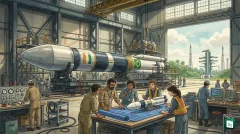
The Andhra Pradesh government plans a ₹25,000 crore space city across Sri Sathya Sai and Tirupati districts, about 40 to 60 km from the Satish Dhawan Space Centre at Sriharikota. The project flows from the Andhra Pradesh Space Policy 4.0 for 2025 to 30, which targets ₹25,000 crore in space investment over ten years, 5,000 direct jobs and 30,000 indirect jobs. The state has created a ₹100 crore SpaceTech Fund and will set up the Andhra Pradesh Space City Corporation to manage land, infrastructure and investor facilitation.
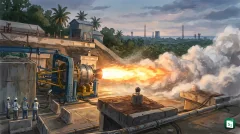
At the 2026 summit, the state signed space deals worth about ₹1,800 crore. Astrobase Space Technologies proposed ₹800 crore for a reusable rocket engine test facility at Thimmasamudram. Bellatrix Aerospace proposed ₹550 crore for satellites and propulsion at Lepakshi. Agnikul Cosmos proposed ₹510 crore for rockets and orbital data centre units. Hathor Rockets proposed ₹250 crore for liquid engines at Routhusuramala in Tirupati. An earlier anchor, Skyroot Aerospace, has been allotted 294.67 acres for a ₹400 crore unit. The cluster will combine engine building near Tirupati, testing at Thimmasamudram and propulsion work at Lepakshi, all within reach of Sriharikota and the Hyderabad Bengaluru corridor.
CII, FICCI and ASSOCHAM: How Industry Bodies Differ
Readers often confuse CII with two other national bodies. The Federation of Indian Chambers of Commerce and Industry (FICCI) was set up in 1927 and is the oldest apex chamber. The Associated Chambers of Commerce and Industry of India (ASSOCHAM) started work in 1920 and brings together more than 400 chambers and trade associations.
All three are non-government and not-for-profit bodies that speak for business, join government committees and lead delegations. CII grew from engineering industry roots and is known for policy work, quality, competitiveness and skilling centres. FICCI draws members from across the corporate sector and runs more than 100 sector committees. ASSOCHAM has a large base of small firms and regional chambers. The key point for recall is simple. CII was founded in 1895, ASSOCHAM in 1920 and FICCI in 1927, and none of them is a government body.
Key Takeaways
- The 31st CII Partnership Summit 2026 was held on 12 and 13 November 2026 in Visakhapatnam under the theme Navigating the New World Order.
- The summit is organised by the Confederation of Indian Industry, founded in 1895 and headquartered in New Delhi, with the Department for Promotion of Industry and Internal Trade under the Ministry of Commerce and Industry.
- India, Oman and the UAE agreed to set up an India Oman UAE technical trilateral committee to manage West Asia airspace and flight operation challenges.
- Andhra Pradesh announced 303 MoUs worth ₹9.89 lakh crore, including 109 MoUs worth ₹9.02 lakh crore signed at the summit with about 3.48 lakh expected jobs.
- The summit saw 17 MoUs and 3 government orders worth ₹43,871 crore in renewable energy and a ₹25,000 crore space city plan across Sri Sathya Sai and Tirupati districts near Sriharikota.