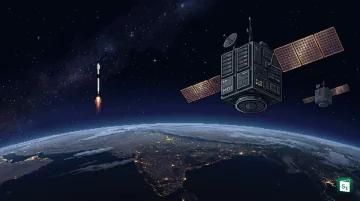
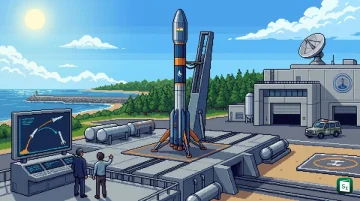
Skyroot Aerospace Pvt Ltd has signed a contract with the US-based Reflect Orbital for two dedicated satellite launches. The launches will use the Vikram family of rockets to support the development of on-demand sunlight at night.
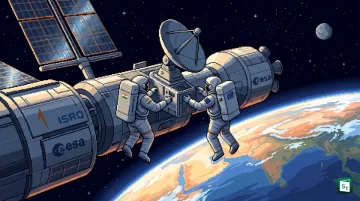
ISRO has successfully completed a series of Crew Module (CM) and Service Module (SM) separation tests at the Vikram Sarabhai Space Centre (VSSC) in Thiruvananthapuram.
The tests validated the design adequacy of the separation systems ahead of the first uncrewed mission “Gaganyaan-1 (G1)” which is scheduled to carry the Vyommitra half-humanoid.
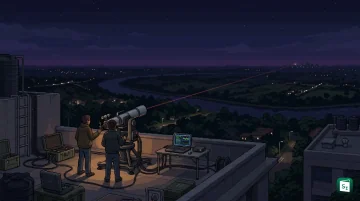
QNu Labs, in collaboration with the Bhaskaracharya National Institute for Space Applications and Geo-informatics (BISAG-N) and the IIT Gandhinagar, has successfully demonstrated the first free-space Quantum Key Distribution (QKD) link of India. The link is established over a distance of 5.56 km.
The demonstration utilized a Pointing, Acquisition and Tracking (PAT) system to maintain stable communication, achieving a Quantum Bit Error Rate (QBER) of less than 5%. It is to be noted that secure encryption keys were generated at a rate of 230 to 260 bits per second (bps) and were integrated with the Vedic Kavach platform.
Francis Louis Halzen, an 82-year-old Belgian-American particle physicist, has been conferred the 2026 Nobel Prize in Physics by the Royal Swedish Academy of Sciences.
The award, carrying a prize value of 12 million Swedish kronor (SEK), recognizes his contributions to the IceCube Neutrino Observatory (IceCube) and the discovery of high-energy neutrinos from astrophysical sources. It is to be noted that the discovery is based on a concept proposed in 1988, which involved the utilization of Antarctic ice as a massive neutrino detector.
Hyderabad-based TakeMe2Space is set to launch the first networked orbital data centre mission of India in late 2028. The mission will be launched aboard the Falcon 9 rocket of SpaceX.
It is to be noted that the organization has signed a launch service agreement with RIDE! Space, a France-based space technology firm specializing in launch mission management. The company plans to establish a constellation of 6 satellites over the following years to facilitate its orbital data operations.
The Technology Development Board (TDB) has signed an agreement with the Chennai-based Agnikul Cosmos Pvt Ltd to facilitate the development of the ‘Agnibaan’ Reusable Launch Vehicle (RLV).
The project involves a financial commitment of ₹200 crore, which will be provided through Optionally Convertible Debentures (OCD) under the Research Development and Innovation (RDI) Fund.
The National Institute of Technology (NIT) Srinagar has become the first NIT in India to establish a dedicated campus-based astronomical observatory named the NIT Srinagar Observatory for Astronomy and Astrophysics (NSOAA).
The facility is equipped with a 14-inch Celestron C14 EdgeHD aplanatic Schmidt-Cassegrain telescope. It was inaugurated to promote observational astronomy, astrophysics research, student training, and public outreach.
Assam CM Himanta Biswa Sarma has laid the foundation stone for the Indian Space Research Organisation (ISRO) Telemetry, Tracking and Command Network (ISTRAC) Advanced Radar Research Facility (IARRF) at Chandrapur in Kamrup Metropolitan district, Assam.
The facility is being developed under the Network for Space Object Tracking and Analysis (NETRA) programme. The initial system at the site will be a cloud-research radar, which is scheduled to be commissioned and become operational by February 2027.
The Technology Development Board (TDB) has signed an agreement with Bengaluru-based GalaxEye Space Solutions Pvt Ltd to provide financial support of ₹63.84 crore under the Research Development and Innovation (RDI) Fund. The financial assistance will be extended through Optionally Convertible Debentures (OCD).
The project, with a total approved cost of ₹247.69 crore, aims to develop a multisensor satellite capable of high-resolution (less than 0.5 m) OptoSAR imaging. The initiative seeks to transition the imaging technology from Technology Readiness Level (TRL)-6 to TRL-9.
The Indian Space Promotion and Authorization Centre (IN-SPACe) has approved an agreement for the development of the first indigenous and fully commercial Earth Observation (EO) constellation of India under the Public Private Partnership (PPP) model.
The agreement is signed with a private consortium, Allied Orbits Pvt Ltd, which is led by PixxelSpace India Pvt Ltd and includes Dhruva Space Pvt Ltd, PierSight Space Pvt Ltd, and Satsure Analytics India Pvt Ltd.
The consortium will be responsible for the design, construction, ownership, and operation of the 12-satellite constellation. It is to be noted that the consortium will invest over ₹1,200 crore for the project, which is expected to be developed and operationalized by 2029.
Skyroot Aerospace Pvt Ltd has signed a Multi-Launch Agreement (MLA) with HEX20 for 3 dedicated Vikram-series missions.
The launches will support the Earth Observation constellation, in-orbit payload demonstration missions, and rideshare capacity for third-party spacecraft of the latter.
Astrobase Space Technologies Pvt Ltd has unveiled “EVEREST”, the first privately developed 800 kilonewton (kN) Full-Flow Staged Combustion (FFSC) rocket engine of India, in Bengaluru. The engine is specifically designed for reusable medium-lift launch vehicles and advanced orbital missions.
It is to be noted that Astrobase completed sub-scale and turbopump tests during 2025 and 2026, with plans to produce around 20 engines and conduct full-scale hot-fire testing in 2026.
The Indian National Space Promotion and Authorisation Centre (IN-SPACe) has released guidelines titled "Norms, Guidelines and Procedures for Implementation of Indian Space Policy-2023 in respect of Authorisation for Undertaking Planned Re-entry of Space Objects".
Under these guidelines, entities of India must obtain approval from IN-SPACe for the planned re-entry of space objects. Foreign entities intending to perform re-entry must apply through an entity incorporated in India. Entities are required to maintain a casualty risk of less than 1 in 10,000 and must submit trajectory and risk assessments for approval.
The Vikram Sarabhai Space Centre (VSSC), a unit of the ISRO, has signed an MoU with the Council of Scientific and Industrial Research-Indian Institute of Chemical Technology (CSIR-IICT) to jointly develop indigenous technology for next-generation, environmentally sustainable blowing agents.
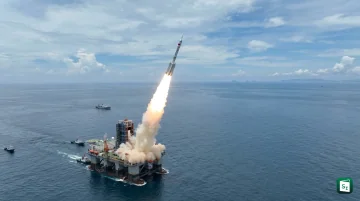
The Chinese aerospace company, Orienspace, has successfully launched its 'Gravity-1 Y4' carrier rocket from a sea-based platform in the East China Sea. The mission successfully deployed 9 satellites into their intended orbits.
It is to be noted that this was the 3rd flight of the rocket and its 1st long-range sea launch.
The Human Space Flight Centre (HSFC) of the ISRO has signed an Implementing Agreement (IA) with the Thiruvananthapuram-based Sree Chitra Tirunal Institute for Medical Sciences and Technology (SCTIMST) for collaboration in space medicine and Bioastronautics research and training.
Under this partnership, both institutions have launched India's first indigenous 2-year Postdoctoral Fellowship programme in Bioastronautics.