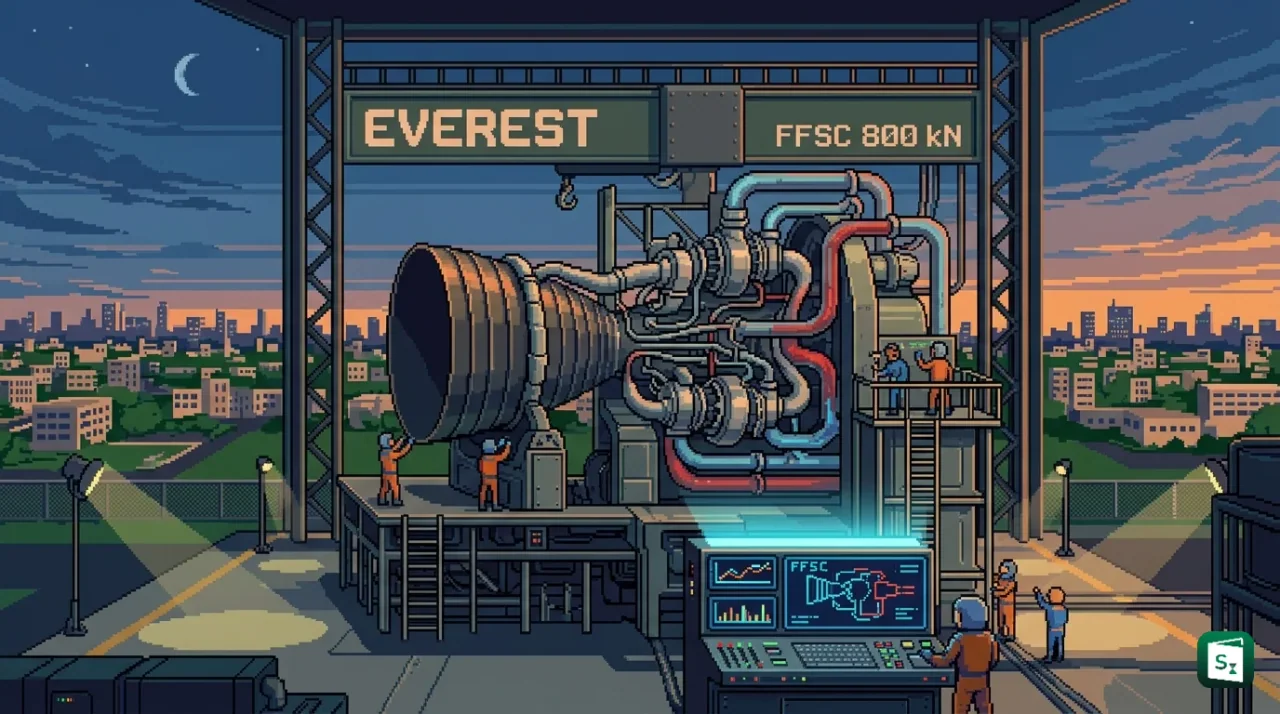
Bengaluru-based space startup Astrobase Space Technologies Pvt Ltd has unveiled EVEREST, India’s first privately developed 800 kilonewton (kN) Full-Flow Staged Combustion (FFSC) rocket engine. The 80-tonne-class engine, designed and manufactured entirely in India, is built for reusable medium-lift launch vehicles and advanced orbital missions. With this achievement, India joins the United States, Russia and China as the fourth country to develop an FFSC engine, a technology that only a handful of organisations globally have mastered.
Who Is Astrobase Space Technologies?
Astrobase Space Technologies was founded in 2024 by entrepreneur Neeraj Khandelwal, a co-founder of the cryptocurrency exchange CoinDCX, and Devakumar Thammisetty, a former ISRO propulsion engineer with more than 13 years of experience in cryogenic propulsion and reusable launch systems. The company is headquartered in Bengaluru, Karnataka.
The startup has built a vertically integrated ecosystem that covers the entire chain from design and manufacturing to testing and launch operations. Its 46,000 square foot assembly and integration facility in Bengaluru houses India’s largest industrial metal 3D printer, which manufactures the engine’s intricate core components. The printer was delivered in March 2026 after being transported in pieces on four trucks.
Astrobase also operates a 21.5-acre propulsion test facility near Anantapur in Andhra Pradesh, the first privately owned high-thrust test stand in India, rated to handle thrust levels up to 200 tonnes. The company raised roughly $10.6 million in its first funding round, led by venture capital firm Banyan.
What Is a Full-Flow Staged Combustion Engine?
To understand why EVEREST matters, it helps to know how a rocket engine works. A liquid rocket engine pushes fuel and an oxidiser into a combustion chamber, where they burn to produce hot exhaust gas that rushes out through a nozzle to create thrust. The fuel and oxidiser are pumped into the chamber at very high pressure by turbopumps, which need power to spin.
In a conventional engine, a small portion of the propellant is burned in a separate chamber called a gas generator to drive the turbopumps. In a staged combustion engine, this hot gas is instead produced by a preburner, and the exhaust is injected back into the main combustion chamber, so that no propellant is wasted.
A Full-Flow Staged Combustion (FFSC) engine goes one step further. Both the fuel and the oxidiser are separately passed through their own preburners, where each is partially burned. The resulting hot gases drive two independent turbopumps before both streams, one fuel-rich and one oxidiser-rich, enter the main combustion chamber together. Because every drop of propellant passes through a turbine and is used for combustion, the engine can run at very high chamber pressure with great efficiency.
Analogy · Two Taps, Full Flow Expand analogy
Think of a conventional rocket as a kitchen that runs one small burner to spin a blender, wasting some gas in the process. An FFSC engine uses both taps to feed the blender through two dedicated spouts, so every bit of fuel and oxygen is fully used before it finally meets in the mixing bowl. Nothing is wasted, and the whole system runs faster and hotter.
This design gives FFSC engines several advantages. It delivers higher combustion efficiency and thrust for the same propellant, allows very high chamber pressure, and reduces stress on the turbopumps because each turbine handles only its own propellant. It is also better suited to reuse, since a single engine can be throttled over a wide range for controlled landings. The trade-off is enormous engineering complexity, because the preburners run at extreme temperatures and pressures, and the materials must survive flows of hot, reactive gases.
EVEREST at a Glance
EVEREST is a methalox engine, meaning it burns liquid oxygen (LOX) as the oxidiser and liquid methane as the fuel. Methane is favoured for reusable rockets because it burns cleaner than kerosene, leaving little soot that would otherwise force heavy maintenance between flights. It can also be produced relatively easily, including from renewable sources, which makes it a candidate fuel for future Mars missions.
| Parameter | EVEREST |
|---|---|
| Engine cycle | Full-Flow Staged Combustion (FFSC) |
| Propellants | Liquid oxygen and liquid methane (methalox) |
| Thrust | 800 kN (80-tonne class) |
| Specific impulse | Around 340 seconds |
| Throttle range | 50 per cent to 110 per cent |
| Reusability | Designed to fly multiple times |
| Manufacturer | Astrobase Space Technologies |
The engine is designed to deliver about 800 kN of thrust in vacuum, roughly the force needed to lift 80 tonnes. It offers a specific impulse of around 340 seconds, a measure of how efficiently the engine converts propellant into thrust, and a throttle range of 50 to 110 per cent, which is essential for landing a returning rocket stage precisely. More than 70 per cent of EVEREST is designed and manufactured domestically at Astrobase’s Bengaluru facilities.
The Journey So Far and What Comes Next
The EVEREST programme has moved fast since the company’s founding in 2024. A sub-scale version of the engine was successfully hot-fired in September 2025, followed by high-speed turbopump trials in January 2026, with results the company described as ahead of prediction. All engine components were manufactured by June 2026, culminating in the integration of the full-scale engine. The engine was then publicly unveiled in August 2026.
The next and most critical milestone is the full-scale hot-fire test, in which the complete engine, with both preburners, both turbopumps and the main combustion chamber running together, will be fired at Astrobase’s test facility in Anantapur. The company plans to build and test around 20 engines before its first orbital flight, which is targeted for December 2028.
Astrobase plans to scale up to producing up to 50 engines per year, with the goal of hot-firing roughly one high-thrust engine every week once facilities are fully operational. The company’s Phase 1 target is to enable about 100 tonnes of launch capacity per year, which could sustain a low Earth orbit fleet of roughly 500 to 700 satellites, scaling to more than 1,000 tonnes annually in Phase 2. It ultimately aims for rapid, on-demand launches within 15 days, a capability it calls launch-on-demand.
Government Support and the Policy Backdrop
EVEREST is not being built in isolation. The development sits inside a wider push, begun with the space sector reforms of 2020, to open India’s space programme to private enterprise. The reforms created the Indian National Space Promotion and Authorisation Centre (IN-SPACe), an autonomous body under the Department of Space that promotes and regulates private space activity. They were later consolidated by the Indian Space Policy, 2023, which formally opened end-to-end space activities, from building rockets to launching satellites, to Non-Government Entities (NGEs).
Under this framework, IN-SPACe launched the Technology Adoption Fund (TAF) in February 2025, a ₹500 crore fund to help startups and companies commercialise early-stage space technologies. It supports up to 60 per cent of project costs, capped at ₹25 crore per project, and is tied to defined technical milestones. In June 2026, Astrobase was named one of the first three beneficiaries of the TAF, selected from 43 applicants, for the indigenous development of its 800 kN LOX-methane engine. The two other recipients were SatSure Analytics India and TM2SPACE Technologies.
The public unveiling of EVEREST was attended by senior figures from the space ecosystem, including Rajeev Jyoti, Distinguished Scientist and Director of the Technical Directorate at IN-SPACe, who was the chief guest, Group Captain Shubhanshu Shukla, the Indian Air Force astronaut who flew India’s first mission to the International Space Station in 2025, and Lieutenant General A. K. Bhatt (retd), Director General of the Indian Space Association.
Why EVEREST Matters for India
A Rare Global Technology
Full-flow staged combustion is considered one of the most demanding propulsion technologies in rocketry. Until now, only a small number of engines have been tested on stands: the Soviet Union’s RD-270 in the 1960s, which never flew, the United States’ Integrated Powerhead Demonstrator in the mid-2000s, and SpaceX’s Raptor, which powers the Starship programme and remains the only FFSC engine ever flown in orbit. China has also pursued the technology through its YF-215 engine. With EVEREST, Astrobase becomes the first Indian entity, and only the fourth country, to build a fully integrated FFSC engine.
Strength for the Private Space Ecosystem
India’s space economy is estimated at around $8.4 billion, roughly two per cent of the global market, and the government projects it can grow four to five times over the next decade to about $40 to $45 billion. The number of space startups has surged from a handful before the reforms to nearly 400. EVEREST moves the private sector beyond small satellite launch systems into high-thrust propulsion, the technology that underpins reusable orbital-class rockets, which is where the cost reduction and launch volume of the future will come from.
Reusability and Cheaper Access to Space
A reusable first stage dramatically cuts the cost of putting satellites in orbit, because the most expensive hardware is flown, landed and flown again. EVEREST’s clean-burning methalox design and wide throttle range make it well suited to this role. Astrobase intends to cluster multiple EVEREST engines on a medium-lift rocket that will carry satellites to low Earth orbit and return its first stage for reuse. A domestic supply of such engines reduces dependence on foreign launch capacity and strengthens India’s position in the global commercial launch market.
An Indigenous Manufacturing Backbone
EVEREST represents the foundation of an industrial capability rather than a one-off prototype. The use of large-scale metal 3D printing allows rapid iteration and cheaper production of intricate engine components, cutting both time and cost per engine. Astrobase’s vertically integrated model, from engine design through testing to launch, keeps critical design authority, manufacturing knowledge and mission configuration under Indian control.
Challenges Ahead
Despite the rapid progress, EVEREST remains at an early stage. The unveiling marks a design and integration milestone, but the engine has not yet been fired in full scale. The full-scale hot-fire test in Anantapur is the moment that will decide whether the concept works as designed. The engine must then survive a long qualification campaign, including repeated firings, endurance tests and flight-readiness reviews, before it can be trusted with a mission.
The production target of 20 engines before first flight is itself a demanding industrial challenge, since each engine must be manufactured, tested and certified. The December 2028 first-flight target depends on the full-scale tests going well, and any technical failure could push the schedule back. The company has also not publicly disclosed its first customer, and commercial demand for its launch services will need to materialise as planned.
Key Takeaways
- EVEREST is India’s first privately developed 800 kN Full-Flow Staged Combustion (FFSC) engine, an 80-tonne-class methalox engine burning liquid oxygen and liquid methane.
- The engine offers around 340 seconds of specific impulse and a throttle range of 50 to 110 per cent, making it suitable for reusable rocket landings.
- A sub-scale hot-fire test was completed in September 2025, followed by turbopump trials in January 2026; the full-scale engine was integrated by June 2026.
- Full-scale hot-fire testing will take place at Astrobase’s 21.5-acre test facility near Anantapur, Andhra Pradesh, with plans to build and test about 20 engines before a first orbital flight targeted for December 2028.
- Astrobase is a beneficiary of IN-SPACe’s Technology Adoption Fund, a ₹500 crore fund supporting up to 60 per cent of project costs, capped at ₹25 crore per project.
- SpaceX’s Raptor remains the only FFSC engine ever flown in orbit; with EVEREST, India became the fourth country, after the United States, Russia and China, to develop such an engine.