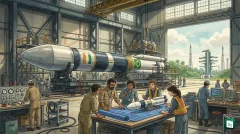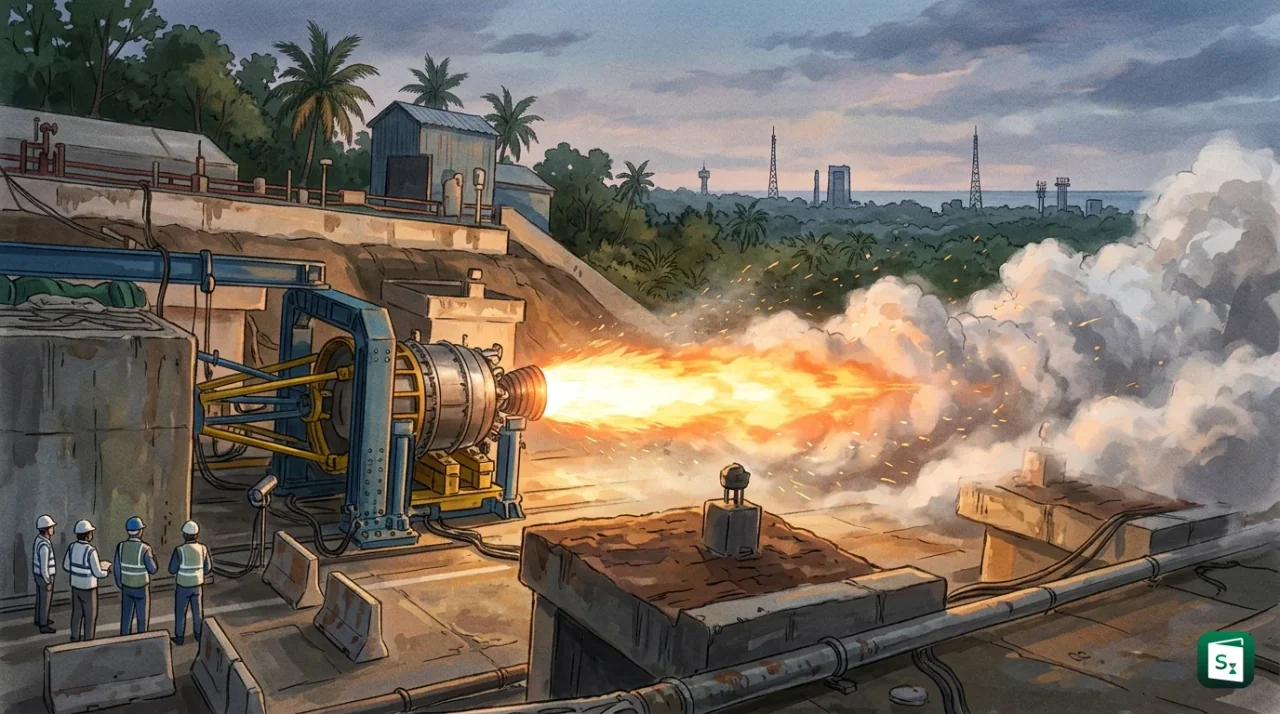
The Indian Space Research Organisation (ISRO) successfully carried out the ground static test of the upgraded PSLV third stage (PS3) solid motor on 12 November 2026 at the Static Test Facility in the Satish Dhawan Space Centre, Sriharikota. The test validated a strengthened PS3 configuration with an improved nozzle design and redundant sealing systems. ISRO made these changes after operational anomalies in the third stage caused the failure of the PSLV-C61 and PSLV-C62 missions.
What Is the PSLV and How Does It Work?
PSLV stands for Polar Satellite Launch Vehicle. It is the third generation launch vehicle of India and is often called the workhorse of ISRO because of its long record of reliable flights for national needs and foreign customers. ISRO was formed on 15 August 1969 and is headquartered in Bengaluru. It operates under the Department of Space.
The PSLV made its first flight on 20 September 1993. Since then it has completed more than 60 flights. It launched landmark missions such as Chandrayaan-1 in 2008, the Mars Orbiter Mission (Mangalyaan) in 2013, Aditya-L1, and a record flight that carried 104 satellites in 2017.
The PSLV is an expendable launch vehicle. Expendable means no part of the rocket is reused after launch. It is about 44 metres tall with a lift off mass of about 320 tonnes in its heaviest XL version. It has four stages that fire one after another. Solid and liquid propulsion stages are placed alternately to combine high thrust at lift off with precise control in upper stages.
| Stage | Motor or Engine | Propellant Type |
|---|---|---|
| First stage (PS1) | S139 solid motor plus strap on motors | Solid HTPB based propellant, about 138 tonnes |
| Second stage (PS2) | Vikas liquid engine | Liquid UDMH fuel with nitrogen tetroxide oxidiser, about 42 tonnes |
| Third stage (PS3) | S7 solid motor | Solid HTPB based propellant, about 7.6 tonnes |
| Fourth stage (PS4) | Twin liquid engines | Liquid MMH fuel with mixed oxides of nitrogen oxidiser, up to 2.5 tonnes |
The first stage provides the massive thrust needed for lift off. The second stage ignites at high altitude and steers the rocket after the thick part of the atmosphere. The third stage gives a rapid push in near vacuum to build orbital speed. The fourth stage then places each satellite precisely into its intended orbit.
The PSLV has four variants based on the number of strap on motors attached to the first stage. PSLV-CA uses no strap ons, PSLV-DL uses two, PSLV-QL uses four, and PSLV-XL uses six. Payload capacity rises with more strap ons. The XL version can place about 1,750 kg into a 600 km Sun Synchronous Polar Orbit. Sun synchronous orbit means the satellite passes over any point on Earth at the same local solar time, which is useful for Earth observation.
What Changed in the Upgraded PS3 Third Stage?
The PS3 is the third and penultimate stage of the PSLV. It is a solid rocket motor that burns hydroxyl-terminated polybutadiene (HTPB) fuel. HTPB is a rubber like solid fuel mixed with oxidiser and aluminium powder. It delivers a maximum thrust of about 240 kN and burns for about 127 seconds. The motor case is made of light Kevlar polyamide fibre. It uses a submerged nozzle with a flexible bearing seal that can tilt by about 2 degrees to steer the rocket in pitch and yaw.
ISRO said the PS3 configuration was reviewed in full after the two failures. The review covered design margins, raw material acceptance criteria, assembly procedures, and quality checks used so far. Design margin means the extra safety buffer kept above the expected load.
The upgraded motor includes four clear changes. First, the configuration has been strengthened and the nozzle design has been improved to increase design margins. The nozzle is the narrow outlet through which hot gas escapes to produce thrust. A small defect or erosion here can cause a sharp fall in chamber pressure.
Second, the mechanical interfaces have been strengthened with redundancy in the sealing systems. Redundant sealing means two independent seals protect the same joint, so one failure does not cause a gas leak.
Third, ISRO has updated the procedures for acceptance of raw materials, assembly, and quality checks. This includes stricter checks on materials such as nozzle throat inserts and insulation liners.
Fourth, ISRO has introduced updated Non-Destructive Tests (NDT) during integration and transportation. NDT methods check for cracks or voids inside the motor without cutting or damaging it.
ISRO has verified the adequacy of the new design margins. The new version of the PS3 solid motor was realised and test fired successfully at the Static Test Facility in SDSC SHAR. A static test means the motor is fixed to the ground and fired while sensors record pressure, thrust, temperature, and vibration.
Why Did PSLV-C61 and PSLV-C62 Fail?
The PSLV had only three full failures before 2025. The two back to back anomalies in 2025 and 2026 therefore drew close attention because both involved the same PS3 stage.
The PSLV-C61 mission lifted off on 18 May 2025 at 5.59 am from the First Launch Pad at Sriharikota. It was the 101st launch attempt from Sriharikota and the 63rd flight of the PSLV. It used the PSLV-XL version to carry the EOS-09 Earth observation satellite. EOS-09 weighed about 1,696 kg and carried a C band Synthetic Aperture Radar for all weather imaging. It was meant for a Sun synchronous orbit at about 525 km altitude.
The first and second stages performed normally. About 203 seconds into flight, during the PS3 burn, telemetry showed a fall in chamber pressure in the motor case. The motor started normally but lost thrust midway. The satellite could not reach orbit and fell into the Indian Ocean. ISRO formed a Failure Analysis Committee to examine manufacturing records, propellant behaviour, and test protocols.
The PSLV-C62 mission lifted off on 12 January 2026 at 10.18 am from the same launch pad. It was the 64th flight of the PSLV and used the PSLV-DL version with two strap on motors. It was the ninth dedicated commercial mission of NewSpace India Limited (NSIL), the commercial arm of the Department of Space. The main payload was EOS-N1, also called Anvesha, along with 15 co passenger satellites from Indian and foreign customers. One co passenger was the Kestrel Initial Technology Demonstrator (KID), a small re entry prototype from Spain.
In this flight the vehicle performed as expected through most of the PS3 burn. Close to the end of the third stage, controllers saw higher disturbance in roll rates followed by a deviation in the flight path. The satellites could not be placed in the intended orbit. ISRO Chairman V. Narayanan said the data was under detailed analysis.
Both cases point to the critical role of the third stage. At that height the rocket flies almost horizontally at about 26,000 to 28,000 km per hour. It must gain speed quickly to avoid being pulled back by gravity. Any loss of chamber pressure reduces thrust and the vehicle loses the velocity needed to stay on its path.
How Is PSLV Different From GSLV?
PSLV means Polar Satellite Launch Vehicle. GSLV means Geosynchronous Satellite Launch Vehicle. Both are built and operated by ISRO, but they serve different orbits and use different upper stages.
| Feature | PSLV | GSLV |
|---|---|---|
| Number of stages | Four stages | Three stages plus four liquid strap ons |
| Propulsion order | Solid, liquid, solid, liquid | Solid, liquid, cryogenic |
| Upper stage fuel | Earth storable liquids in PS4 | Cryogenic liquid hydrogen and liquid oxygen in upper stage |
| Height and mass | About 44 metres, about 320 tonnes in XL form | About 51.7 metres, about 420 tonnes |
| Payload to low orbit | About 1,750 kg to 600 km Sun synchronous orbit | About 8,000 kg to low Earth orbit in Mk III form |
| Payload to high orbit | About 1,425 kg to sub geosynchronous transfer orbit | About 2,250 to 4,000 kg to Geosynchronous Transfer Orbit |
| Main use | Earth observation, navigation, small satellites, interplanetary probes | Communication satellites that must stay over the equator |
A cryogenic engine uses fuels stored below minus 150 degrees Celsius. Liquid hydrogen gives very high exhaust speed, so it is efficient for pushing heavy satellites to high orbits. It is also complex to store and handle. The PSLV avoids cryogenics and uses storable liquids in its top stage, which suits lighter payloads and precise orbit placement.
Why the Static Test Matters for Future Launches
The static test took place at the Static Test Facility in the Satish Dhawan Space Centre (SDSC) SHAR at Sriharikota in Nellore district of Andhra Pradesh. The centre was set up in 1969 and renamed in 2002 in memory of former ISRO chairman Satish Dhawan. It became operational with a sounding rocket flight on 9 October 1971. It has two launch pads for PSLV and GSLV flights and plants for processing solid propellants and testing solid motors.
Sriharikota is a spindle shaped island between Pulicat Lake and the Bay of Bengal. Its location on the east coast near the equator helps eastward launches gain extra velocity from Earth rotation. An open sea corridor to the east provides a safe zone for spent stages to fall.
ISRO has said that further tests are planned after detailed analysis and review of the test data from 12 November 2026. A successful return to flight will restore confidence in the PSLV for government Earth observation missions and for NSIL commercial contracts. NSIL books foreign and domestic small satellites on PSLV flights, so a pause affects launch schedules and revenues.
The test also protects the production chain. PSLV motors and structures are built with Indian industry. Clear identification of nozzle, sealing, and quality issues helps industry correct material selection and process controls before the next flight model is cleared.
Key Takeaways
- ISRO carried out the ground static test of the upgraded PS3 solid motor on 12 November 2026 at SDSC SHAR in Sriharikota.
- The upgraded PS3 has a strengthened structure, an improved nozzle design, and redundant sealing systems.
- The changes followed third stage anomalies in the PSLV-C61/EOS-09 mission of May 2025 and the PSLV-C62/EOS-N1 mission of January 2026.
- PSLV stands for Polar Satellite Launch Vehicle, a four stage rocket about 44 metres tall that can place about 1,750 kg into a 600 km Sun synchronous orbit.
- ISRO was formed on 15 August 1969 and is headquartered in Bengaluru, while launches take place from Sriharikota in Andhra Pradesh.