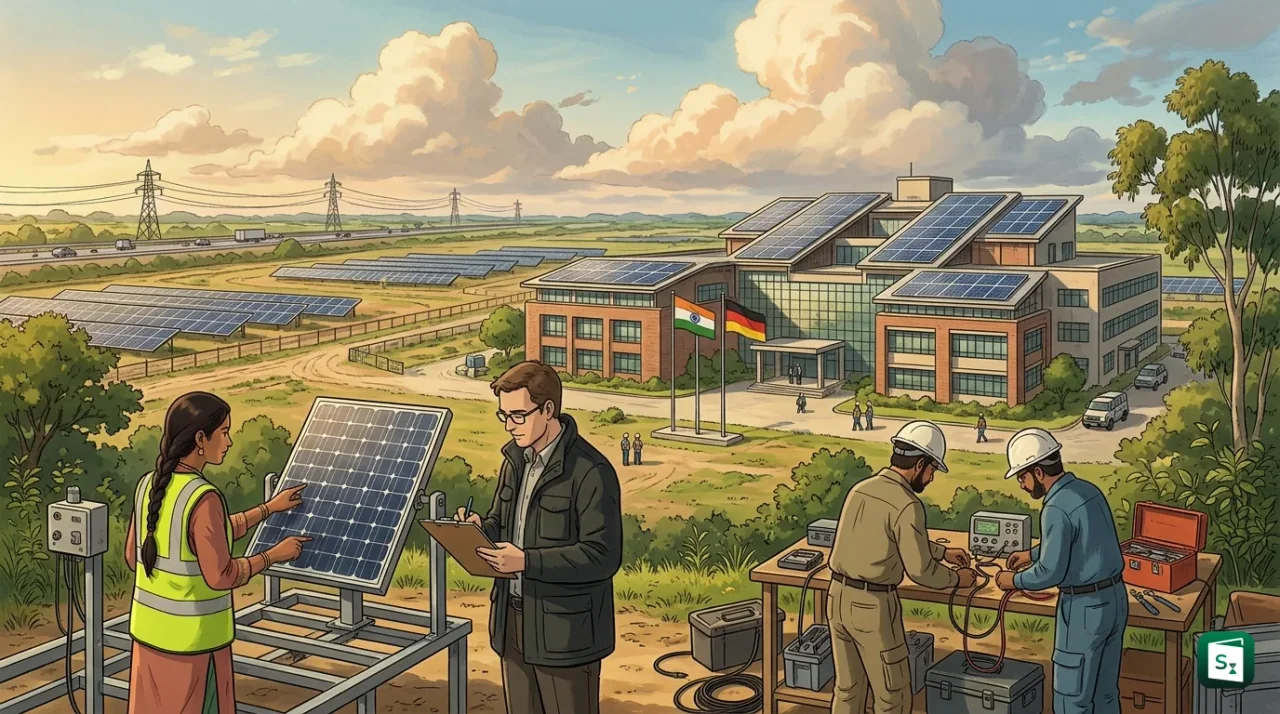
Integrated Batteries India Pvt Ltd, which operates as IB Solar, has signed a Memorandum of Understanding with three German organisations to establish India’s first Centre of Excellence for solar technology. The agreement was signed at the Bharat Renewable Energy Summit and Expo 2026 in New Delhi, organised by the Ministry of New and Renewable Energy. The proposed centre will come up in the Yamuna Expressway Industrial Development Authority region in Uttar Pradesh and will focus on research, technology development and skill building.
What Is the IB Solar Agreement with German Firms?
The IB Solar agreement is a Memorandum of Understanding for technology cooperation to create India’s first dedicated Centre of Excellence for solar technology. The pact brings together IB Solar with three German partners, RENA Technologies GmbH, centrotherm international AG and ISC Konstanz, to link industrial production with photovoltaic research. The centre is planned in the YEIDA region of Greater Noida in Uttar Pradesh.
The MoU was signed at the Bharat Renewable Energy Summit and Expo 2026. The summit was held from 2 to 5 November 2026 at Bharat Mandapam in New Delhi. The Ministry of New and Renewable Energy (MNRE), the central ministry that frames India’s renewable energy policy, organised the event. The 2026 edition combined three events for the first time, the Bharat Renewable Energy Summit, the 9th Session of the International Solar Alliance Assembly and the 4th International Conference on Green Hydrogen, under the theme Invest, Innovate, Inspire.
A Memorandum of Understanding is a written understanding that records the intent of parties to work together. It is not a final commercial contract. Detailed supply terms, funding and project timelines are fixed through later agreements.
In this case, a parallel understanding also covers a proposed 2 GW TOPCon solar cell manufacturing line at IB Solar’s facility, with German origin equipment and process support. TOPCon stands for Tunnel Oxide Passivated Contact, a high efficiency solar cell design that has now replaced older PERC cells as the leading global technology. PERC stands for Passivated Emitter and Rear Contact, the previous mainstream cell design.
The collaboration has received facilitation support from three organisations. These are the National Solar Energy Federation of India (NSEFI), India’s industry body for solar companies, the German Solar Association (BSW), the industry body for about 1,000 solar and storage companies in Germany, and GIZ, which stands for Deutsche Gesellschaft für Internationale Zusammenarbeit, Germany’s agency for international development cooperation.
Who Are the Partners Behind the Solar Centre of Excellence?
IB Solar leads the Indian side of the pact. The German side brings equipment makers and a research institute with deep experience in cell production.
| Partner | Base and Background | Role in the Pact |
|---|---|---|
| IB Solar | Division of Integrated Batteries India Pvt Ltd, which was incorporated in 2003 and traces its energy business to 1992. The corporate office is at Sector 63, Noida. The company operates a fully automated module plant in Greater Noida with about 1.5 GW capacity | Host and Indian manufacturing partner. It will provide land and manufacturing base in YEIDA and adopt new processes into domestic production |
| RENA Technologies GmbH | Founded in 1993 and based at Gutenbach in Germany’s Black Forest. It is a global leader in wet chemical equipment for solar, semiconductor and glass industries, with more than 3,350 systems installed and about 900 employees worldwide | Supply of German origin wet processing equipment and process know how for high efficiency cells |
| centrotherm international AG | Based at Blaubeuren in Germany with origins in 1976. It specialises in thermal production systems and coating technology for photovoltaics and semiconductors, with more than 700 employees | Lead of the proposed production consortium. It will coordinate installation, commissioning, process integration and ramp up |
| ISC Konstanz | Founded in 2005 at Konstanz in Germany. ISC stands for International Solar Energy Research Center Konstanz. It is a photovoltaic research institute focused on silicon solar cells and technology transfer | Research partner. It will support joint research, process development and transfer of laboratory results to factory production |
IB Solar manufactures high efficiency N TOPCon and Mono PERC modules, lithium iron phosphate battery packs and turnkey solar solutions. The company holds BIS certification, meets IEC standards and is enlisted under the Approved List of Models and Manufacturers (ALMM), the MNRE list that certifies solar models eligible for government projects. IB Solar has received land in Sector 33 of YEIDA, close to the upcoming Noida International Airport at Jewar. The company plans a 2 GW solar cell unit and an integrated 3 GWh Battery Energy Storage System unit there, with commercial operations targeted by December 2027.
The choice of German partners is significant. RENA and centrotherm earlier worked with ISC Konstanz to ramp up a 2.9 GW TOPCon cell factory for EMMVEE in Bengaluru, which reached conversion efficiencies up to 25.4 percent.
Conversion efficiency measures how much sunlight a cell converts into electricity. Higher efficiency means more power from the same panel area. That experience shows how equipment suppliers and a research institute can jointly shorten the learning period for a new factory.
Where Will the Centre Come Up and What Is YEIDA?
The Centre of Excellence will come up in the YEIDA region in Greater Noida in western Uttar Pradesh, close to the Noida International Airport at Jewar on the Yamuna Expressway.
What Is YEIDA?
YEIDA stands for the Yamuna Expressway Industrial Development Authority. It is a government development authority of Uttar Pradesh that plans and develops industry, housing and institutions along the Yamuna Expressway. It covers notified areas in Gautam Buddh Nagar, Bulandshahr, Aligarh, Hathras, Mathura and Agra districts.
YEIDA was constituted on 24 April 2001 under the Uttar Pradesh Industrial Area Development Act, 1976. It was earlier called the Taj Expressway Industrial Development Authority. Its headquarters is at Sector Omega I in Greater Noida. The authority implements the Yamuna Expressway project, acquires land, prepares master plans and allots industrial, residential and institutional plots.
The Yamuna Expressway is a 165 km long, six lane access controlled expressway connecting Greater Noida with Agra. It can be expanded to eight lanes. The YEIDA notified area covers about 2,689 sq km and is being developed in two phases.
Phase 1 covers parts of Gautam Buddh Nagar and Bulandshahr with a Master Plan 2041. Phase 2 covers parts of Aligarh, Mathura, Hathras and Agra with a Master Plan 2031. The authority is developing about 25,000 hectares along the expressway.
The region hosts nationally important projects. These include the Noida International Airport at Jewar, which is being developed as a major aviation hub, the Buddh International Circuit, a proposed Film City, and planned Medical City, IT City and Sports City clusters. The area connects to the Eastern Peripheral Expressway, the Dedicated Freight Corridors and the Delhi Mumbai Industrial Corridor influence zone.
For solar manufacturing, the location offers large industrial plots, expressway logistics and proximity to Delhi and Noida’s supplier base. IB Solar’s Factory 2 is already located at Plot 121, Sector 33 in the YEIDA area.
What Will the Centre of Excellence Do for Solar Manufacturing in India?
The centre will bring research closer to the factory floor. It will help India move from only assembling modules to developing cell technology at home.
What Is a Centre of Excellence in India?
A Centre of Excellence is a dedicated facility where industry, researchers and trainers work together on applied research, testing of new processes and training of specialised staff. Such centres develop standards, run pilot lines and turn laboratory results into factory ready manufacturing practices.
The proposed solar Centre of Excellence will perform four main functions.
First, it will support applied research and process innovation. Solar cell manufacturing involves four broad stages, making polysilicon, shaping wafers, processing wafers into cells and assembling cells into modules. India has strong module capacity but depends on imported machines and know how for cells.
New TOPCon lines in India take about 12 months for process optimisation, against 7 to 8 months for older PERC lines. The centre will work on process settings, material use and efficiency gains to shorten this learning period.
Second, it will develop and test advanced technologies. The focus includes mainstream TOPCon, which now accounts for more than 70 percent of global production, and next stage options such as heterojunction (HJT), back contact cells and tandem perovskite cells.
Heterojunction cells combine crystalline silicon with thin layers to raise efficiency. Tandem cells stack two light absorbing layers to capture more of the solar spectrum. The centre will test such options for Indian factory conditions, where heat, dust and grid needs differ from European labs.
Third, it will connect research with industrial application. Laboratory efficiency means little until it works at high speed on a production line with stable yield. Yield measures the share of defect free cells in total output. The centre will run pilot scale trials, share equipment data and refine production recipes before full scale use.
Fourth, it will build skills. Cell plants need process engineers who can troubleshoot tools, set process windows and control material use. Indian manufacturers report a shortage of such engineers and depend on foreign experts for new lines. The centre will offer technical training and knowledge exchange between German specialists and Indian engineers, similar to models used in solar skilling centres in Tamil Nadu and Hyderabad.
Why Domestic Solar Cell Manufacturing Matters for India
India installs far more solar power than it can supply with home made cells. The YEIDA centre directly addresses this gap between deployment strength and technology depth.
What Is the India Solar Mission?
The India Solar Mission began as the Jawaharlal Nehru National Solar Mission, launched in January 2010 under the National Action Plan on Climate Change. It started with a target of 20 GW of grid connected solar by 2022, which was raised to 100 GW in 2015.
India crossed that 100 GW milestone on 31 January 2025, when installed solar capacity reached 100.33 GW. Solar now provides about 45 percent of India’s renewable capacity. The current national goals are 280 GW of solar by 2030 and 500 GW of non fossil capacity by 2030.
Progress in modules hides weakness in cells. As of early 2026, India has about 173 GW to 219 GW of enlisted module capacity under ALMM List 1, but only about 30 GW to 32 GW of cell capacity. This means nearly 80 percent of module lines still depend on imported cells, mainly from China. Cell imports rose from about $1.85 billion to about $3 billion even as module imports fell sharply, showing that dependence has moved up the value chain.
| Stage of Solar Value Chain | India’s Position | Implication |
|---|---|---|
| Polysilicon and wafers | Almost no domestic capacity, about 2 GW wafer capacity by 2026 | Full dependence on imports for base material |
| Solar cells | About 31 GW capacity, with 53 percent PERC and 32.2 percent TOPCon, rest thin film and others | Technology lock in to older PERC while the world has shifted to TOPCon |
| Solar modules | More than 170 GW enlisted capacity | Surplus module capacity faces cell shortage and price pressure |
| Solar parks and deployment | 140.60 GW installed solar by February 2026, with annual additions above 23 GW | Large demand needs secure domestic supply to meet the 500 GW goal |
Three structural problems make the centre relevant.
First, cost and scale. Indian cell making is nearly 40 percent costlier than Chinese production. Capital costs are more than double because Indian plants average about 2 GW while Chinese plants reach tens of GW and gain scale benefits faster.
Second, weak research depth. Indian manufacturers spend up to 0.1 percent of revenue on research, against up to 2 percent by leading Chinese firms. Public solar research funding since 2014 has been about $13 million, far below levels in the United States and Japan, with limited industry participation.
Third, technology transition risk. TOPCon replaced PERC globally between 2023 and 2025. Commercial TOPCon modules now reach 23 percent efficiency against about 21.7 percent for PERC. Future shifts to heterojunction and tandem designs will need pilot lines and skilled process engineers. Without domestic research, Indian firms will repeat the cycle of buying each new generation from abroad.
Large solar parks show why secure supply matters. The Bhadla Solar Park in Rajasthan, with 2,245 MW, is India’s largest and among the world’s largest. The Pavagada Solar Park in Karnataka, with 2,050 MW, is India’s second largest. Both were built under the scheme for solar parks and ultra mega projects launched in 2014. Meeting the next phase of 37 GW average annual additions will need cells that are efficient, affordable and available on time.
How the Pact Fits into India Germany Technology Partnership
The IB Solar pact is part of a wider phase of India Germany clean energy cooperation that was visible at the 2026 summit.
Germany was one of the country partners at the Bharat Renewable Energy Summit, along with Australia, Denmark, France, the Netherlands, Norway, Sweden, the United Kingdom and the European Union. The German country session and a closing roundtable jointly organised by NSEFI and BSW produced several Memorandums of Understanding and Letters of Intent between German research bodies and Indian manufacturers. The IB Solar Centre of Excellence was among the main outcomes.
The partnership model reflects complementary strengths. Germany pioneered photovoltaic research and holds process expertise in precision equipment. India offers scale, a fast growing market and a policy push for domestic manufacturing through the Production Linked Incentive scheme for high efficiency modules, with an outlay of ₹19,500 crore, domestic content rules and the ALMM framework.
ALMM List 1 covers modules. ALMM List 2 will cover cells and will require government projects to use enlisted domestic cells, which increases the commercial value of local cell technology.
For India, the gain is technology development inside the country rather than only capacity addition. If the YEIDA centre succeeds, process recipes, test data and trained engineers will remain in the domestic ecosystem and support other manufacturers. For German firms, the gain is early entry into a market that plans to add about 250 GW of solar between 2026 and 2030 and to expand cell capacity toward 170 GW by 2030. Equipment orders, service contracts and joint intellectual work can follow successful pilot results.
The next steps will show whether intent converts into output. The partners will need to finalise funding, with the possibility of Indian government support for the research centre, define land and laboratory scope in YEIDA, and sign definitive supply terms for the 2 GW TOPCon line. Clear milestones on efficiency, yield and skill numbers will decide the real impact of the first solar technology Centre of Excellence.
Key Takeaways
- IB Solar signed an MoU with RENA Technologies, centrotherm and ISC Konstanz at the Bharat Renewable Energy Summit in November 2026 to set up India’s first solar technology Centre of Excellence.
- The proposed Centre of Excellence will come up in the YEIDA region of Greater Noida in Uttar Pradesh, which was established on 24 April 2001 under the UP Industrial Area Development Act, 1976.
- The centre will focus on applied research, TOPCon process development and skill building to cut the 12 month optimisation time for new cell lines in India.
- India has about 170 GW of module capacity but only about 31 GW of cell capacity, with nearly 80 percent dependence on imported cells for module lines.
- The pact supports India’s goals of 280 GW solar by 2030 and 500 GW non fossil capacity by 2030, with backing from MNRE, NSEFI, BSW and GIZ.