
The National Payments Corporation of India (NPCI) notified the UPI Vyapaar Saksham Scheme on 11 November 2026 to expand UPI acceptance among small merchants. The scheme will operate for three years from the date the UPI Merchant Discount Rate (MDR) is implemented. It will use a share of MDR collections to pay banks for deploying QR codes and soundboxes and for growing low value merchant transactions in smaller cities and remote regions.
What Is UPI and What Is MDR?
Unified Payments Interface (UPI) is an instant payment system developed by the National Payments Corporation of India (NPCI). NPCI is an umbrella organisation for retail payments in India. It was incorporated in December 2008 under the Payment and Settlement Systems Act, 2007 as an initiative of the Reserve Bank of India (RBI) and the Indian Banks Association (IBA). NPCI is registered as a not for profit company under Section 8 of the Companies Act, 2013 and is headquartered in Mumbai.
UPI was built over the Immediate Payment Service (IMPS) infrastructure. Its pilot was launched on 11 April 2016 and full operations began in August 2016 with 21 banks. UPI lets a user link multiple bank accounts in one mobile app and send or receive money at any time, including weekends and holidays. A payment needs only a UPI ID, which is also called a Virtual Payment Address (VPA), a mobile number or a QR code, plus a UPI PIN for confirmation.
How UPI works is simple. The payer enters the payee UPI ID or scans the QR code and approves the amount with a UPI PIN. The payer app sends the request through its payment service provider to the NPCI switch. The NPCI switch checks the addresses and arranges a debit from the payer bank and a credit to the payee bank in real time.
Merchant Discount Rate (MDR) means the fee a merchant pays for accepting a digital payment. The merchant pays it to its own bank, which is called the acquiring bank. That amount is then shared among ecosystem players, including the issuing bank, the acquiring bank, the payer payment service provider and the UPI app provider. The fee meets system costs such as technology, settlement, fraud control and customer support. Since January 2020, bank account based UPI payments for merchants operated under a zero MDR framework. NPCI has now introduced a limited MDR on higher value merchant payments, while person to person transfers remain free.
What Is the UPI Vyapaar Saksham Scheme?
The UPI Vyapaar Saksham Scheme is an NPCI programme for all UPI members to expand acceptance infrastructure among small merchants. NPCI issued the circular on 11 November 2026. The scheme will run for three years from the date UPI MDR is implemented. That start date has not yet been separately notified.
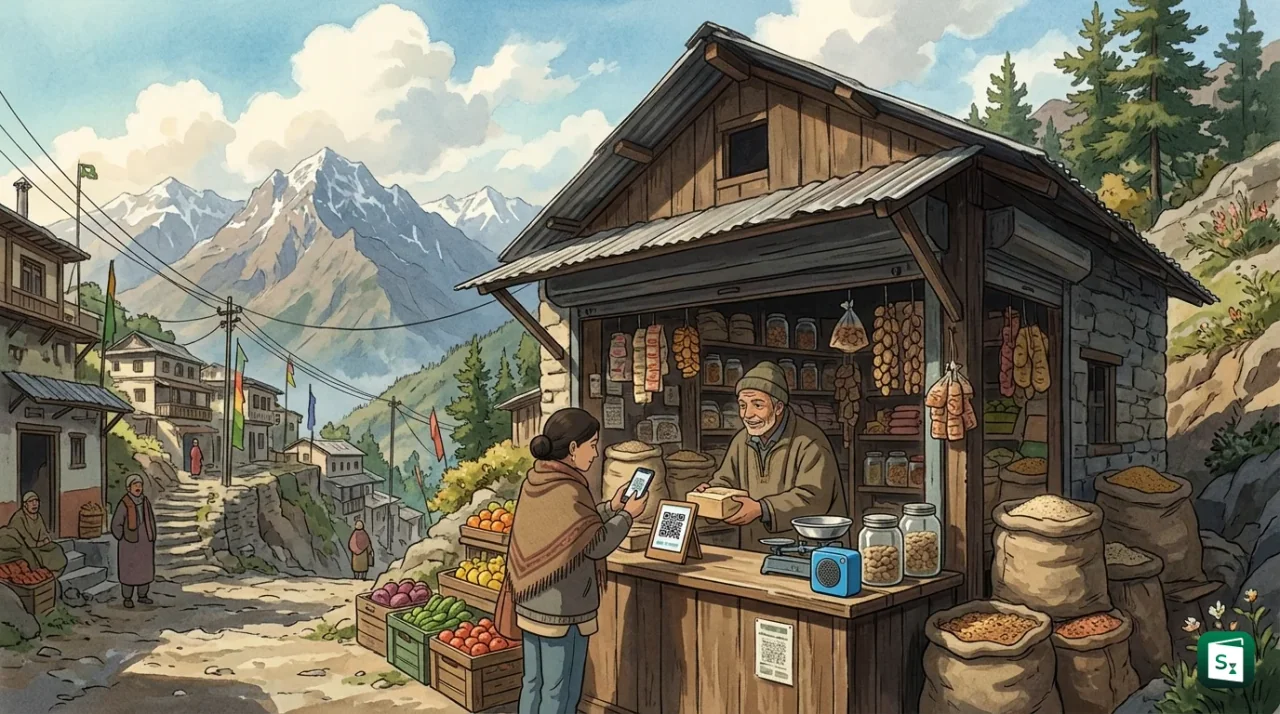
The scheme pays acquiring banks and payment providers, not merchants directly, for two tasks. The first task is installing physical QR codes and soundboxes at new small merchant outlets. A soundbox is a small audio device kept at the shop counter which announces receipt of a payment. The second task is keeping those merchants active and growing their UPI transaction volumes.
NPCI has set clear annual targets for the scheme. The targets include 6 to 10 million new physical QR codes per year and 0.5 to 1 million new soundboxes per year. For existing small merchants, NPCI expects 30 percent to 50 percent annual growth in transaction volumes.
Only eligible transactions earn incentives under the scheme. Eligible transactions are successfully settled UPI payments of up to ₹2,000 at qualifying small merchants. Refunds, cancelled payments and reversed payments do not count. NPCI has barred artificial splitting of a larger payment into smaller parts to stay below the ₹2,000 limit.
Who Qualifies as a Small Merchant and Which Areas Are Covered?
A small merchant under the scheme means a business with annual turnover of up to ₹40 lakh in the previous financial year. NPCI divides them into two groups. New small merchants are those onboarded to UPI during the scheme period. Existing small merchants are those onboarded before the scheme started.
The geographic focus is on areas with low acceptance infrastructure:
- Tier-III to Tier-VI centres
- North Eastern states
- Jammu and Kashmir and Ladakh
- Merchants in Tier-I and Tier-II centres qualify only if they are covered under notified central government schemes
The notified schemes named by NPCI are the Pradhan Mantri Street Vendor AtmaNirbhar Nidhi (PM SVANidhi) and PM Vishwakarma. PM SVANidhi was launched in June 2020 by the Ministry of Housing and Urban Affairs to give collateral free working capital loans to street vendors. PM Vishwakarma was launched on 17 September 2023 by the Ministry of Micro, Small and Medium Enterprises to support artisans and craftspeople in 18 traditional trades with skill training, toolkit help, credit and digital incentives.
To earn the hardware incentive, a new merchant must show active use. The merchant must complete at least 25 eligible transactions in any two months of a quarter with a minimum transaction value of ₹5,000 per month. The QR code or soundbox must not have received an incentive under this scheme or any other subsidy scheme, including support from institutions such as NABARD.
How Are the Three Incentive Components Structured?
The fund is divided into three fixed parts. Money cannot be moved from one component to another. The structure is as follows:
| Component | Share of Fund | What It Pays For |
|---|---|---|
| Component A: New merchant onboarding | 30 percent | ₹300 per physical QR code and ₹750 per soundbox at new small merchants |
| Component B: Transaction growth | 50 percent | 0.03 percent of aggregate eligible transaction value on 5 percent quarter on quarter growth, plus 50 percent extra in targeted geographies |
| Component C: Incremental growth in targeted geographies | 20 percent | 0.20 percent of incremental eligible value over the previous quarter, paid over and above Component B |
Component A for QR codes and soundboxes
Component A supports physical acceptance points. Acquiring banks receive ₹300 for each QR code and ₹750 for each soundbox installed at a new eligible outlet. The payment is made only after the merchant meets the usage test of 25 transactions in two months and ₹5,000 monthly value. NPCI gives an illustration. A bank deploying 1,000 QR codes and 200 soundboxes for qualifying new merchants would earn ₹4.5 lakh.
Component B for sustained growth
Component B is the largest part and rewards higher volumes. Acquiring banks must show at least 5 percent growth in eligible transaction volumes over the previous quarter. Banks then receive 0.03 percent of the total value of eligible transactions. Stores in targeted geographies earn an additional 50 percent, which takes the effective rate to 0.045 percent there. A bank with ₹50 crore of eligible transactions in a quarter would earn ₹1.5 lakh as base incentive.
Component C for remote markets
Component C focuses only on incremental business in targeted geographies. Acquiring banks receive 0.20 percent of the extra eligible value added over the previous quarter. This amount is paid in addition to the Component B incentive. NPCI illustrates that ₹10 crore of incremental value in these areas would fetch ₹2 lakh under Component C.
How the Scheme Is Funded and Settled
The scheme has no separate budget grant. NPCI will create the pool from MDR collections. Each issuing bank, acquiring bank, payer payment service provider and UPI app provider will contribute 5 percent of its MDR share to the fund. The total size of the pool will therefore depend on how much MDR is actually collected after implementation.
MDR from two ineligible groups is excluded from contribution. The first group is industry programmes defined in earlier NPCI circulars, such as railways, telecom, insurance and fuel. The second group is capital market transactions such as mutual funds, securities and brokers.
NPCI has laid down strict settlement rules:
- Incentives are calculated and settled quarterly. NPCI completes settlement within 30 days of claim submission.
- Claims of acquiring banks must be certified by both internal and external auditors.
- If claims in a component exceed its allocation, NPCI will pay on a pro rata basis. Unused money is carried forward within the same component.
- All incentive amounts are exclusive of taxes.
- Fraudulent claims will lead to disqualification and adjustment of incentives. NPCI will also review the impact of the scheme every six months.
How UPI Charges Above 2000 Work and Who Remains Exempt
UPI remains free for ordinary users. NPCI and the Finance Ministry state that most daily UPI use remains free. Person to person transfers remain free for any amount. Person to merchant payments up to ₹2,000 also remain free. These two groups cover about 96 percent of merchant transactions by volume.
The UPI MDR applies only to specified person to merchant transactions above ₹2,000. The standard rate is 0.4 percent, with a cap of ₹300 per transaction for payments of ₹75,000 and above. The merchant bears the charge and cannot pass it to the buyer. Banks have been advised to ensure that merchants do not add the fee to customer bills. UPI app providers cannot impose platform fees linked to MDR.
The framework has concessional rates for special categories:
- Essential and thin margin sectors such as railways, telecom, insurance, fuel and agricultural inputs pay a flat ₹5 per transaction above ₹2,000.
- Capital market payments for mutual funds, securities, stockbrokers and dealers pay 0.02 percent, capped at ₹300.
- Small vendors under the Person to Person Merchant (P2PM) category enjoy zero MDR. These vendors receive up to ₹1 lakh per month through UPI QR directly into their own bank accounts. If inflows exceed ₹1 lakh for three months in a row, the bank moves the account to the regular merchant category.
The comparison below shows why NPCI presents UPI as the cheapest option for shops. For a ₹10,000 merchant payment, UPI MDR would be ₹40, while a debit card at 0.9 percent would cost ₹90 and a credit card at 2 percent would cost ₹200.
| Payment Mode | Indicative MDR | Cost on ₹10,000 Payment |
|---|---|---|
| UPI above ₹2,000 | 0.4 percent, capped at ₹300 | ₹40 |
| Debit card | Up to 0.90 percent | About ₹90 |
| Credit card | 1.5 percent to 2.5 percent | About ₹150 to ₹250 |
UPI was to levy MDR from 15 October 2026. The UPI and Services Steering Committee headed by NPCI deferred the rollout on 13 October 2026 to avoid extra load during the festival season. NPCI said MDR would be implemented immediately post Diwali on a date to be notified separately. Daily transaction limits set by banks and NPCI, generally ₹1 lakh to ₹5 lakh depending on category, are security controls. They are not charging thresholds.
Key Takeaways
- NPCI notified the UPI Vyapaar Saksham Scheme on 11 November 2026 for three years from the date UPI MDR is implemented.
- The scheme covers small merchants with turnover up to ₹40 lakh in Tier-III to Tier-VI centres, the Northeast, Jammu and Kashmir and Ladakh.
- Component A provides ₹300 per QR code and ₹750 per soundbox to acquiring banks for new merchant onboarding.
- Component B pays 0.03 percent on eligible transaction value with 5 percent quarterly growth, while Component C pays 0.20 percent on incremental value in targeted geographies.
- Standard UPI MDR is 0.4 percent on merchant payments above ₹2,000, capped at ₹300, while P2PM vendors receiving up to ₹1 lakh per month retain zero MDR.