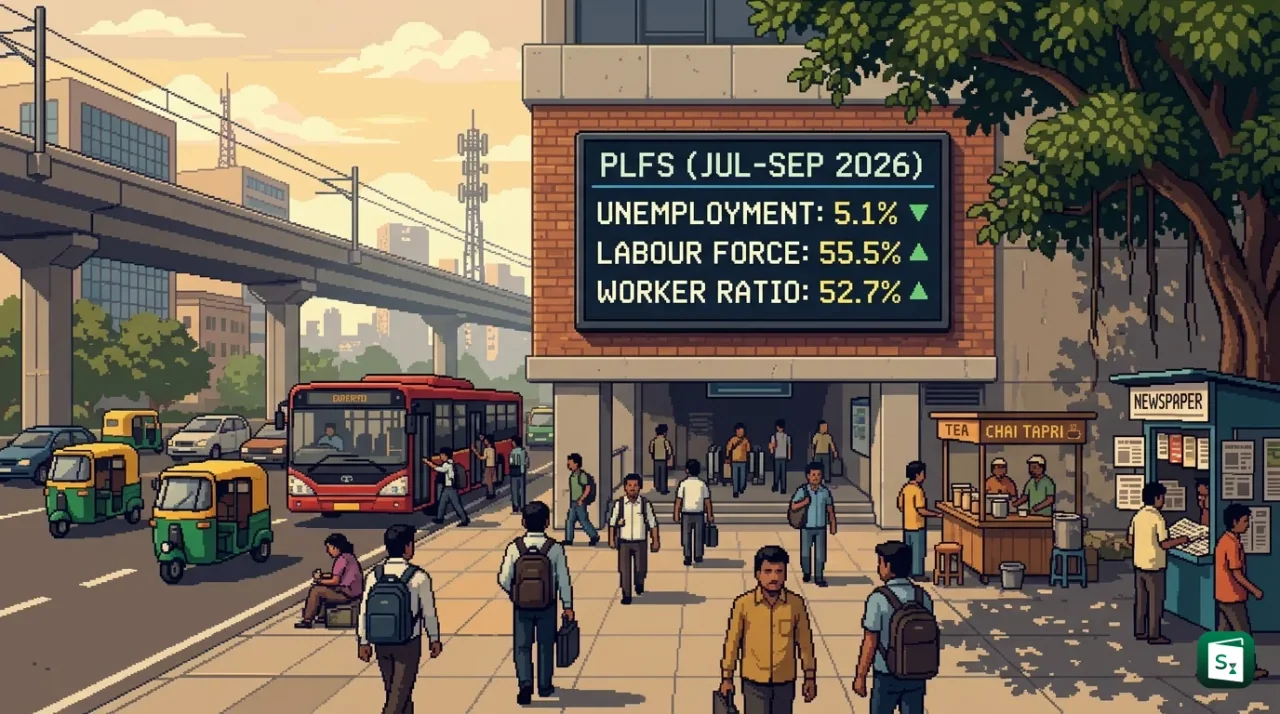
The National Statistics Office released the Periodic Labour Force Survey Quarterly Bulletin for July-September 2026 on 10 November 2026. The unemployment rate for persons aged 15 years and above fell to 5.1 percent from 5.4 percent in April-June 2026, while labour force participation rose to 55.5 percent. The recovery was led by rural areas, where seasonal farm work pushed more people into employment.
What Is the Periodic Labour Force Survey?
The Periodic Labour Force Survey (PLFS) is India’s main official source of data on jobs, unemployment and labour force participation. The National Statistics Office (NSO) conducts the survey under the Ministry of Statistics and Programme Implementation (MOSPI). The Ministry, based in New Delhi, was formed on 15 October 1999 by merging the Department of Statistics and the Department of Programme Implementation.
The PLFS was launched in 2017. In its first design, it gave employment estimates every three months for urban areas only, and once a year for both rural and urban areas. From January 2025, the NSO revamped the design to give high frequency estimates. The revamped survey produces monthly estimates at the all India level and quarterly estimates for both rural and urban areas.
The July-September 2026 bulletin is the sixth quarterly bulletin in the new series, which began with the April-June 2025 bulletin. The quarterly estimates are based on the Current Weekly Status (CWS) approach, which records activity in the seven days before the survey date. A person who worked for at least one hour on any day in that week is counted as employed. A person who did not work but sought work or was available for work is counted as unemployed. The bulletin also gives annual estimates on the basis of Usual Status (ps+ss), which uses a 365 day reference period. For July-September 2026, the NSO surveyed 5,55,593 persons across rural and urban India.
Unemployment Rate Falls to 5.1 Percent in July-September 2026
The Unemployment Rate (UR) is the share of the labour force that is without work but seeking or available for work. It is calculated on the labour force, not on the total population. A fall in this rate means a larger share of job seekers found work.
The overall UR for persons aged 15 years and above fell to 5.1 percent in July-September 2026 from 5.4 percent in April-June 2026. The fall came mainly from rural areas. Rural unemployment declined to 4.3 percent from 4.8 percent in the previous quarter. Urban unemployment remained broadly stable at 6.8 percent against 6.7 percent in the previous quarter.
On a year on year basis, rural unemployment was almost unchanged at 4.3 percent against 4.4 percent in July-September 2025. Rural male unemployment eased to 4.4 percent from 4.7 percent a year ago. In urban areas, male unemployment improved to 6.1 percent from 6.2 percent, while female unemployment improved to 8.8 percent from 9.0 percent over the same period.
| Area | July-September 2026 | April-June 2026 |
|---|---|---|
| All India | 5.1 percent | 5.4 percent |
| Rural | 4.3 percent | 4.8 percent |
| Urban | 6.8 percent | 6.7 percent |
Labour Force Participation Rate Rises to 55.5 Percent
The Labour Force Participation Rate (LFPR) is the share of the population that is either working or seeking and available for work. A higher rate means more people are engaged in economic activity.
The overall LFPR for persons aged 15 years and above rose to 55.5 percent in July-September 2026 from 54.6 percent in April-June 2026. Rural participation rose to 58.1 percent from 56.9 percent, while urban participation edged up to 50.4 percent from 50.2 percent. The overall female LFPR increased to 34.7 percent from 33.2 percent in the previous quarter, showing stronger entry of women into the labour force.
Compared with July-September 2025, overall LFPR rose by 0.4 percentage points from 55.1 percent to 55.5 percent. Rural LFPR rose by 0.9 percentage points from 57.2 percent to 58.1 percent during the same period, while urban LFPR declined marginally by 0.3 percentage points.
| Area | July-September 2026 | April-June 2026 |
|---|---|---|
| All India | 55.5 percent | 54.6 percent |
| Rural | 58.1 percent | 56.9 percent |
| Urban | 50.4 percent | 50.2 percent |
Worker Population Ratio Improves to 52.7 Percent
The Worker Population Ratio (WPR) is the share of the total population that is employed. In the weekly measure, a person who worked for at least one hour on any day in the seven days before the survey is counted as a worker.
The overall WPR for persons aged 15 years and above rose to 52.7 percent in July-September 2026 from 51.7 percent in the previous quarter. Rural WPR rose to 55.6 percent from 54.2 percent, an increase of 1.4 percentage points. Urban WPR remained largely stable at 46.9 percent against 46.8 percent.
Male WPR increased to 73.4 percent from 73.0 percent, while female WPR rose more sharply to 32.8 percent from 31.3 percent. Compared with July-September 2025, overall WPR was up by 0.5 percentage points and rural WPR was up by 0.9 percentage points. The bulletin estimates an average of 57.9 crore persons aged 15 years and above in employment during the quarter, including 40.5 crore men and 17.4 crore women.
How Rural Jobs Shifted Toward Agriculture and Self-Employment
The bulletin shows a clear seasonal shift in the type of work available. In rural areas, the share of self employed workers rose to 62.7 percent from 61.4 percent in the previous quarter. In urban areas, the share of regular wage and salaried workers rose to 49.6 percent from 49.3 percent. Regular wage work offers fixed pay at fixed intervals, while self employment includes own farm work, small shops and household enterprises where income varies with output and prices.
Casual labour declined in both areas. In rural areas, its share fell to 21.7 percent from 22.5 percent. In urban areas, it fell to 10.7 percent from 11.1 percent. Over the year, casual work also declined, from 22.2 percent to 21.7 percent in rural areas and from 10.9 percent to 10.7 percent in urban areas.
Industry data explains the shift. In rural areas, the share of workers in agriculture rose to 56.7 percent from 52.9 percent, a rise of 3.8 percentage points. The July to September period coincides with kharif sowing and related farm operations, which increases demand for labour on fields. The share of rural workers in the secondary sector, which includes manufacturing, construction, and mining and quarrying, fell to 21.9 percent from 24.4 percent. The tertiary sector, which covers services such as trade, transport and education, eased to 21.4 percent from 22.7 percent. Compared with a year ago, the rural secondary share rose from 21.0 percent to 21.9 percent, while the tertiary share stayed stable. In urban areas, where services dominate, secondary and tertiary shares remained broadly stable.
How the Revamped Survey Tracks Jobs Every Quarter
Until December 2024, the PLFS published quarterly results for urban areas only. Twenty five such bulletins were released from December 2018 to December 2024. The bulletin for April-June 2025 was the first to cover both rural and urban areas, and the July-September 2026 bulletin is the sixth in this expanded series.
Under the revamped design, each selected household is visited four times in four straight months. The first visit uses a detailed schedule and the next three visits track changes. This rotation keeps half of the sample common between two quarters, which makes quarter on quarter comparison more reliable. The bulletin also gives state level estimates for selected states and, in this edition, estimates of the total number of workers.
Monthly bulletins give all India figures every month, while quarterly bulletins give detailed rural and urban breakups. Annual reports give both weekly and yearly status estimates. This layered system helps policymakers track seasonal swings, such as the monsoon rise in farm work, separately from long term trends in regular jobs and female participation.
Key Takeaways
- The PLFS Quarterly Bulletin for July-September 2026 was released on 10 November 2026 by the National Statistics Office under MOSPI.
- The overall unemployment rate for persons aged 15 years and above fell to 5.1 percent from 5.4 percent, with rural unemployment at 4.3 percent and urban unemployment at 6.8 percent.
- The overall labour force participation rate rose to 55.5 percent and the overall worker population ratio rose to 52.7 percent in the quarter.
- The rural share of workers in agriculture rose to 56.7 percent from 52.9 percent, while rural self-employment rose to 62.7 percent.
- The PLFS was launched in 2017 and revamped in January 2025 to provide monthly and quarterly estimates for rural and urban areas under Current Weekly Status.