

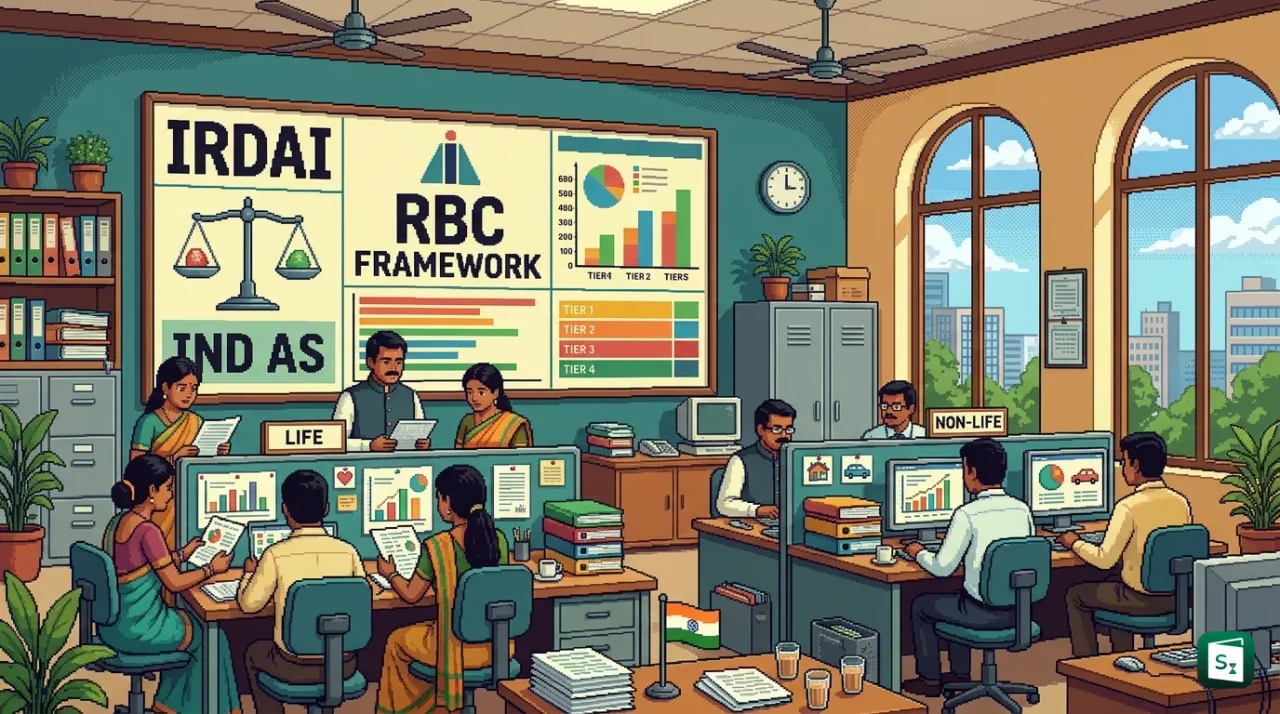
The Insurance Regulatory and Development Authority of India (IRDAI) set up two working groups on 10 November 2026 to frame a Risk Based Capital (RBC) framework for life and non life insurers. The 13 member life group is convened by Jamuna Choudhary and the 12 member non life group by Parmeshwar Shelke. The framework will use Indian Accounting Standards (Ind AS) accounts as the base so that capital reflects actual risk.
What Is Risk Based Capital and How Is It Different From Solvency Margin?
Risk Based Capital (RBC) is a method where the capital an insurer must hold depends on the actual risks it carries. These risks include insurance risk such as higher than expected claims, market risk such as fall in investment value, credit risk such as default by a borrower or reinsurer, and operational risk such as system failure. IRDAI will measure these risks on an economic balance sheet where assets are valued at fair value and liabilities are valued at discounted present value of future cash flows.
India now follows a factor based solvency system. This system was adapted from the European Solvency I rules introduced in 1979. It applies fixed factors to simple measures. For life business, one factor applies to mathematical reserves as a proxy for market risk and another applies to sum at risk as a proxy for insurance risk. For non life business, factors apply to premiums and claims. The method does not directly capture asset risk or diversification benefit.
| Feature | Factor Based Solvency (Current) | Risk Based Capital (Proposed) |
|---|---|---|
| Capital link | Fixed factors on premiums, reserves and sum at risk | Capital charges based on measured risk profile |
| Asset risk | Not directly captured, controlled through investment limits | Explicit charge based on asset class and credit rating |
| Reinsurance credit | Limited recognition | Fuller recognition with counterparty default charge |
| Valuation | Regulatory book values with limited discounting | Market consistent economic balance sheet |
| Diversification | No benefit for diversified portfolio | Lower total charge where risks offset each other |
What Is Solvency Ratio in Insurance?
The solvency ratio in insurance is the ratio of available solvency margin to required solvency margin, expressed as a percentage. IRDAI requires every life, general and health insurer to maintain a control level of 150% under Section 64VA of the Insurance Act, 1938. A ratio below 150% signals stress and triggers a restoration plan.
In simple terms, the ratio shows whether the insurer holds enough extra funds beyond its expected liabilities. IRDAI monitors the ratio every quarter through regulatory filings. Listed insurers also disclose it with results, which is why terms like solvency ratio of LIC appear often in public discussion.
What Is Solvency Margin in Insurance?
The solvency margin in insurance is the extra buffer an insurer holds over its policy liabilities to protect policyholders if experience turns worse than expected. Available solvency margin is the excess of assets over liabilities in the regulatory balance sheet. Required solvency margin is the minimum buffer IRDAI prescribes through factors.
For example, if required margin is ₹100 crore, a 150% ratio means the insurer must hold at least ₹150 crore as available margin. The Insurance Regulatory and Development Authority of India (IRDAI) was set up in 1999 under the IRDAI Act, 1999 as a statutory regulator under the Ministry of Finance. IRDAI is headquartered in Hyderabad and regulates solvency, investments, products and policyholder protection.
Why IRDAI Wants Ind AS Accounts as the Base for RBC
IRDAI has decided that Indian Accounting Standards (Ind AS) statements will form the starting point and basis for RBC. Where prudential safety needs a different treatment, IRDAI will allow clearly defined, transparent and evidence based adjustments. The goal is a single set of data, models and assumptions that serves both accounting and solvency needs to the maximum extent.
IRDAI says two separate bases would raise costs for insurers. Companies would run two valuation systems, reconcile differences and face scope for inconsistent results. Since both Ind AS and RBC rest on the same building blocks of current estimates of future cash flows, discounting to present value and an explicit allowance for risk, convergence reduces duplication.
The convergence follows strict guardrails. It will not dilute the prudential purpose of RBC, which is protection of policyholders at a defined confidence level. It will also not distort the objective of Ind AS, which is faithful representation of financial position. The resulting RBC framework must be transparent, comparable across insurers, resistant to arbitrage, proportionate and workable within a realistic transition path.
The timing is linked to accounting reform. The Ministry of Corporate Affairs notified Ind AS 117 on insurance contracts on 12 August 2024 and Ind AS 109 on financial instruments earlier. Ind AS 117 is substantially converged with IFRS 17, which the International Accounting Standards Board issued in 2017 and which took effect globally on 1 January 2023, replacing the interim IFRS 4. After industry gap assessments and proforma statements, IRDAI notified the IRDAI (Actuarial, Finance and Investment Functions of Insurers) (Amendment) Regulations, 2026 on 30 March 2026 and asked insurers to prepare Ind AS statements from 1 April 2026, with parallel Indian GAAP filings and independent validation in the first year.
Who Is on the Two Working Groups for Life and Non Life Insurance?
IRDAI issued the constitution order through Office Order No. IRDAI/RBC/ORD/MISC/150/11/2026 dated 10 November 2026. The order creates two separate groups because life and non life businesses carry very different risk profiles and contract lengths.
The 13 member Life Insurance Working Group is convened by Jamuna Choudhary, Deputy General Manager for RBC at IRDAI. The 12 member Non Life Insurance Working Group is convened by Parmeshwar Shelke, Deputy General Manager for RBC at IRDAI. Each group brings together chief financial officers or appointed actuaries from industry, a reinsurer, the actuarial profession and IRDAI.
| Life Group Representation | Non Life Group Representation |
|---|---|
| LIC of India, SBI Life, HDFC Life, ICICI Prudential Life, Bajaj Life, Tata AIA, Kotak Life, Bandhan Life, Aditya Birla Life | New India Assurance, ICICI Lombard, Bajaj General, SBI General, Tata AIG, Niva Bupa, IndusInd General, Kiwi General |
| Munich Re as reinsurer | Swiss Re as reinsurer |
| Institute of Actuaries of India through its Ind AS joint expert group member | Institute of Actuaries of India through its Ind AS joint expert group member |
| IRDAI officials for Ind AS and RBC functions | IRDAI officials for Ind AS and RBC functions |
IRDAI has directed the two groups to work in close coordination. Matters common to both life and non life business will be discussed in joint sittings so that a single consistent position emerges. Meetings can be physical, virtual or hybrid with a quorum of at least 50% of members. The groups may invite outside experts where needed. All deliberations, data, drafts and documents will remain strictly confidential.
What the Working Groups Must Deliver Within One Month
IRDAI has asked both groups to complete all deliverables within one month from 10 November 2026. The order starts the drafting and consultation process. It does not by itself bring the RBC regime into force.
The main output will be an exposure draft of RBC regulations for public consultation. The draft will use Ind AS balance sheets as the base for the RBC balance sheet and will cover:
- Definitions, applicability and commencement
- Valuation of assets and liabilities starting from Ind AS carrying values, with a full list of permitted and mandatory adjustments
- Determination of Available Capital, including its classification into tiers and eligibility limits
- Determination of Required Capital, including risk modules, calibration standard, aggregation and diversification benefit
- Treatment of key items derived from Ind AS statements such as debt securities and Expected Credit Loss (ECL), grouping, initial recognition, contract boundary, property valuation, discounting, Contractual Service Margin (CSM), risk adjustment for non financial risk, loss component, insurance acquisition cash flows and reinsurance contracts held
- Solvency ratio, supervisory intervention levels and ladder of action under Section 64VA of the Insurance Act, 1938
- Governance, actuarial and board responsibilities, use of internal or entity specific approaches, validation and audit
- Reporting, public disclosure and data submission
- Transitional provisions and phased implementation path
- Consequential changes to other IRDAI regulations
The groups will also prepare an approach paper that tests alternatives. It will include sensitivity of available capital, required capital and solvency ratio to each key choice, acceptable ranges for confidence levels and cost of capital rates, materiality thresholds, construction of the risk free yield curve and extrapolation beyond the last liquid point, flooring of negative liabilities or CSM, alignment of the RBC risk margin with the Ind AS risk adjustment, and need for an illiquidity premium.
A third output will be a draft reporting template for RBC data. It will capture the RBC balance sheet, the Ind AS to RBC reconciliation, available and required capital by module, sensitivities, assumptions and qualitative information. The groups will also recommend how to adopt the converged approach for actuarial valuation under Sections 13 and 49 of the Insurance Act, 1938, assess stress factors and additional data needs, and examine treatment of foreign business under home and host rules. Every recommendation must be backed by data, quantified impact and sensitivity testing.
This work builds on two Quantitative Impact Studies. IRDAI ran the first study in August 2023 and the second in August 2025 to test capital charges against Indian risk experience. For comparison, the European Union rolled out its Solvency II regime after five such studies.
How Ind AS 117 Insurance Contracts Will Shape the New Framework
Ind AS 117 on insurance contracts provides the accounting logic that RBC will borrow. The standard measures groups of contracts on current explicit estimates and has three models. The General Measurement Model, also called the Building Block Model, applies to most long term contracts. The Premium Allocation Approach suits short duration contracts such as one year motor or health covers. The Variable Fee Approach applies to participating contracts where policyholders share returns.
Three concepts from Ind AS 117 will directly feed into capital calculation. Fulfilment cash flows are probability weighted estimates of future premiums, claims, benefits and expenses, discounted for time value of money. Risk adjustment for non financial risk is the compensation an insurer needs for bearing uncertainty around mortality, morbidity or claims. Contractual Service Margin (CSM) is the unearned profit the insurer expects to earn for providing future coverage. CSM ensures no profit is booked on day one. It is released over the coverage period as service is delivered. If a group is loss making, the loss is recognised at once through a loss component.
Ind AS 117 also requires separate accounting for insurance contracts issued and reinsurance contracts held. Gross liabilities and reinsurance recoveries cannot be netted. Insurance service result and insurance finance income or expense must be shown separately, so underwriting performance is distinct from market movements. Ind AS 109 on financial instruments governs classification, measurement and impairment of investments through the Expected Credit Loss (ECL) model. IRDAI also proposes to align the risk free rate used for discounting under Ind AS with the rate used under RBC to keep both frameworks consistent.
The impact will differ by segment. For life insurers, treatment of long term guarantees, annuity promises, mortality assumptions and investment linked portfolios will be central. For general and health insurers, underwriting volatility, health cost inflation, motor liability, catastrophe exposure and dependence on reinsurance will drive the charge. Insurers with diversified books and strong asset liability management are likely to show lower net risk. Insurers with concentrated or higher risk portfolios may face higher required capital once final calibration is fixed.
Key Takeaways
- IRDAI constituted 13 member life and 12 member non life working groups on 10 November 2026 through Order No. IRDAI/RBC/ORD/MISC/150/11/2026 to frame the Risk Based Capital framework.
- The life group is convened by Jamuna Choudhary and the non life group by Parmeshwar Shelke, with members from LIC, private insurers, reinsurers and the Institute of Actuaries of India.
- India now requires a 150% solvency control level under Section 64VA of the Insurance Act, 1938, while RBC will link required capital to insurance, market, credit and operational risks on a market consistent balance sheet.
- Ind AS financial statements from 1 April 2026 will be the base for RBC, with Ind AS 117 notified on 12 August 2024 and converged with IFRS 17 effective from 1 January 2023.
- The groups must submit an exposure draft, approach paper and reporting template within one month, and IRDAI, set up in 1999 under the IRDAI Act, 1999 and headquartered in Hyderabad, will then seek public consultation.