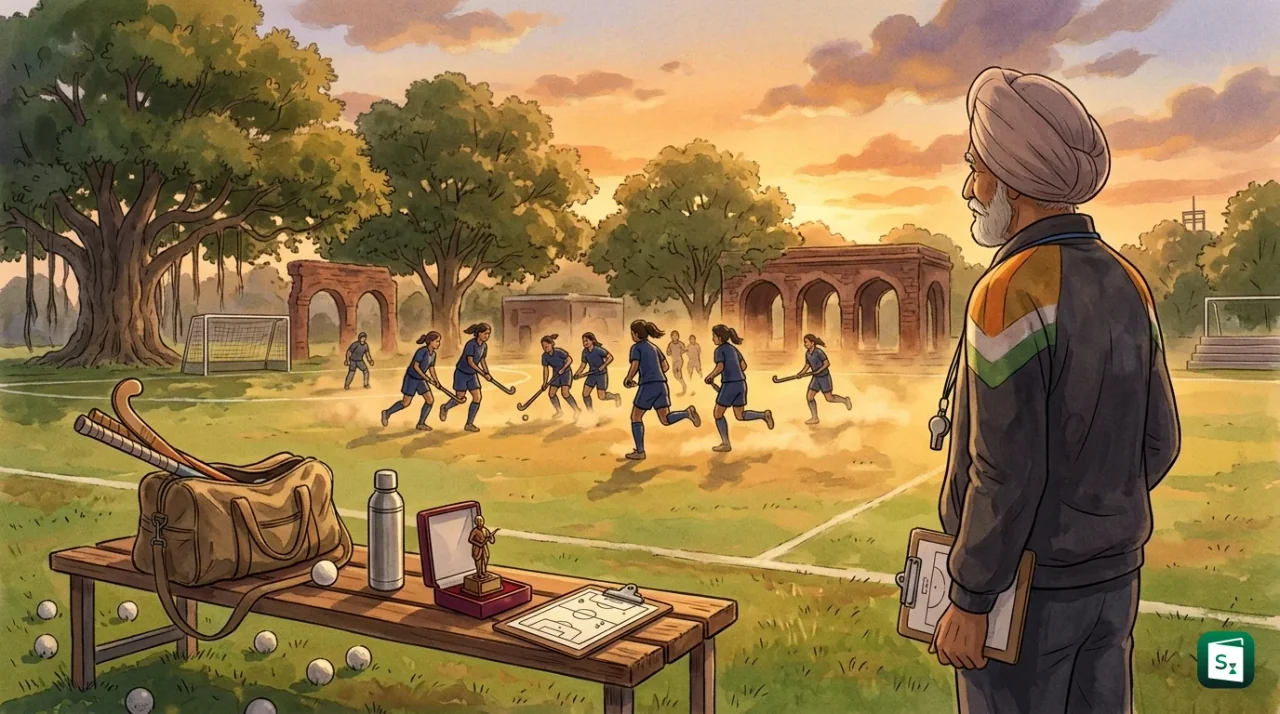
Gurdial Singh Bhangu, former chief coach of the Indian women’s hockey team, passed away at the age of 86 in Surrey, Canada. Hockey India confirmed his death on 7 November 2026 and recalled his lasting contribution to Indian hockey. Bhangu guided India to the historic gold at the 2002 Commonwealth Games in Manchester and became the first hockey coach to receive the Dronacharya Award in 2000.
Who Was Gurdial Singh Bhangu?
Gurdial Singh Bhangu was an Indian hockey coach best known as the chief coach of the Indian women’s team that won gold at the 2002 Commonwealth Games. He was born on 3 October 1941 in Lyallpur in undivided India, a city now known as Faisalabad in Pakistan. His family later settled in Ambala in present day Haryana, where he grew up and played hockey at the university level.
Bhangu did not play for the senior national team. He chose coaching as his career and joined the National Institute of Sports (NIS) in Patiala in 1965. The institute, set up on 7 May 1961 and later renamed the Netaji Subhas National Institute of Sports, is the academic wing of the Sports Authority of India and is regarded as Asia’s largest sports training institute. At Patiala, Bhangu trained under hockey great Dhyan Chand and under Balkishan Singh, a member of India’s 1956 Olympic gold winning team and coach of the 1980 Moscow Olympics gold winning men’s team.
From Nigeria to the Charge of the Indian Women’s Team
Bhangu gained early international experience in Africa. He served as chief coach of the Nigerian women’s hockey team from 1972 to 1976. During this period he helped Nigeria qualify for its first ever Women’s Hockey World Cup in 1976.
He took charge as chief coach of the Indian women’s team in 1998. The appointment came after India had finished 12th at the 1998 Women’s Hockey World Cup in Utrecht in the Netherlands. The result had exposed gaps in fitness, structure and match temperament.
The turnaround was quick. Within months, the Pritam Siwach led Indian team won the silver medal at the 1998 Asian Games in Bangkok. India lost the final but the medal restored belief in the squad. It also gave Bhangu time to build a young group for the next major target, the 2002 Commonwealth Games in Manchester.
How India Won the 2002 Commonwealth Games Gold in Manchester
The 2002 Commonwealth Games triumph remains India’s only gold medal in women’s hockey at the Games. India entered the Manchester event as an underdog. The team had limited funds, little media attention and higher ranked opponents in its path.
India beat South Africa 4-3 in the semifinal playoff to reach the final. The win gave the young side momentum before the title clash with the host nation. The final was played on 3 August 2002 at Belle Vue in Manchester.
The Dramatic Final Against England
India took a 2-0 lead in the first half through goals from Mamta Kharab and Sita Gussain. England fought back through captain Sarah Blanks and Jane Smith to level the score at 2-2 by full time. The match then moved to extra time under the golden goal rule, where the first team to score wins the match.
India earned a penalty corner in the closing seconds of the first half of extra time. Mamta Kharab pushed the ball in after a save off Sita Gussain’s strike to make the score 3-2. The umpire first disallowed the goal as the hooter had sounded. After consultation between the officials, the goal was allowed because a penalty corner remains live until a goal is scored or the ball leaves the striking circle. England lodged a protest but later withdrew it, and India were confirmed as champions.
| Event in the Final | Detail |
|---|---|
| Venue and date | Belle Vue, Manchester, 3 August 2002 |
| Teams | India against England |
| Score in normal time | 2-2 |
| Final score | India won 3-2 by golden goal in extra time |
| Indian scorers | Mamta Kharab (2 goals) and Sita Gussain (1 goal) |
| Winning goal | Mamta Kharab from a penalty corner in extra time |
Coaches and Players Behind the Triumph
Bhangu was the chief coach of the gold winning squad. Mir Ranjan Negi, a former India men’s goalkeeper, served as the goalkeeping coach. Negi worked closely with goalkeeper Helen Mary, while forwards such as Mamta Kharab and Pritam Siwach led the attack.
The Manchester story later reached a wider audience through the 2007 Hindi film Chak De India. The film, directed by Shimit Amin and starring Shah Rukh Khan as coach Kabir Khan, was inspired by the Indian women’s 2002 Commonwealth Games win. Screenwriter Jaideep Sahni developed the script after reading about the victory. Negi and then coach Maharaj Krishan Kaushik helped train the cast, and Negi’s own journey from the 1982 Asian Games final loss to Pakistan to redemption as a coach added to the public interest around the film. The film itself was fiction, but it drew national attention to women’s hockey.
What Is the Dronacharya Award and Why Was Bhangu Honoured?
The Dronacharya Award is India’s highest sports honour for coaches. It is given by the Ministry of Youth Affairs and Sports to coaches who have trained athletes or teams to achieve outstanding results at international events such as the Olympics, World Championships, Commonwealth Games and Asian Games. The award is named after Guru Drona, the teacher of Arjuna in the Mahabharata.
The award was instituted in 1985. The first winners in 1985 were wrestling coach Bhalchandra Bhaskar Bhagwat, boxing coach Om Prakash Bhardwaj and athletics coach O. M. Nambiar, the mentor of sprinter P. T. Usha. Winners receive a bronze statue of Drona, a certificate, ceremonial dress and a cash prize. The prize was ₹2.5 lakh in 2000. It is now ₹10 lakh for the Regular category and ₹15 lakh for the Lifetime category. Ordinarily not more than five awards are given in a year, with two set aside for lifetime contribution over 20 years or more.
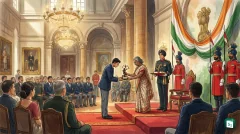
Bhangu received the Dronacharya Award for the year 2000 along with S. M. Arif for badminton, Hansa Sharma for weightlifting, Phadke Gopal Purushottam for kho kho and Bhupender Dhawan for powerlifting. He was the first hockey coach to receive the honour. The award recognised his work in rebuilding the women’s team after the 1998 World Cup and guiding it to the 1998 Asian Games silver.
| Year | Hockey Coach Honoured | Note |
|---|---|---|
| 2000 | Gurdial Singh Bhangu | First hockey coach to receive the award |
| 2002 | M. K. Kaushik | Former India player and women’s team coach |
| 2003 | Rajinder Singh | Coach linked to junior and senior teams |
| 2009 | Baldev Singh | Long serving national coach |
| 2010 | A. K. Bansal | Former national coach |
Bhangu later moved to Surrey in Canada, where he lived with his family. He passed away there on 6 November 2026. Hockey India paid tribute to him on 7 November 2026 and said his contribution to Indian hockey would always be remembered.
Key Takeaways
- Gurdial Singh Bhangu, former chief coach of the Indian women’s hockey team, passed away at 86 in Surrey, Canada in November 2026.
- Bhangu guided India to gold at the 2002 Commonwealth Games in Manchester with a 3-2 golden goal win over England.
- He took charge of the Indian women’s team in 1998 and led India to silver at the 1998 Bangkok Asian Games.
- Bhangu was the first hockey coach to receive the Dronacharya Award in 2000.
- The Dronacharya Award, instituted in 1985, is India’s highest honour for coaches and is given by the Ministry of Youth Affairs and Sports.