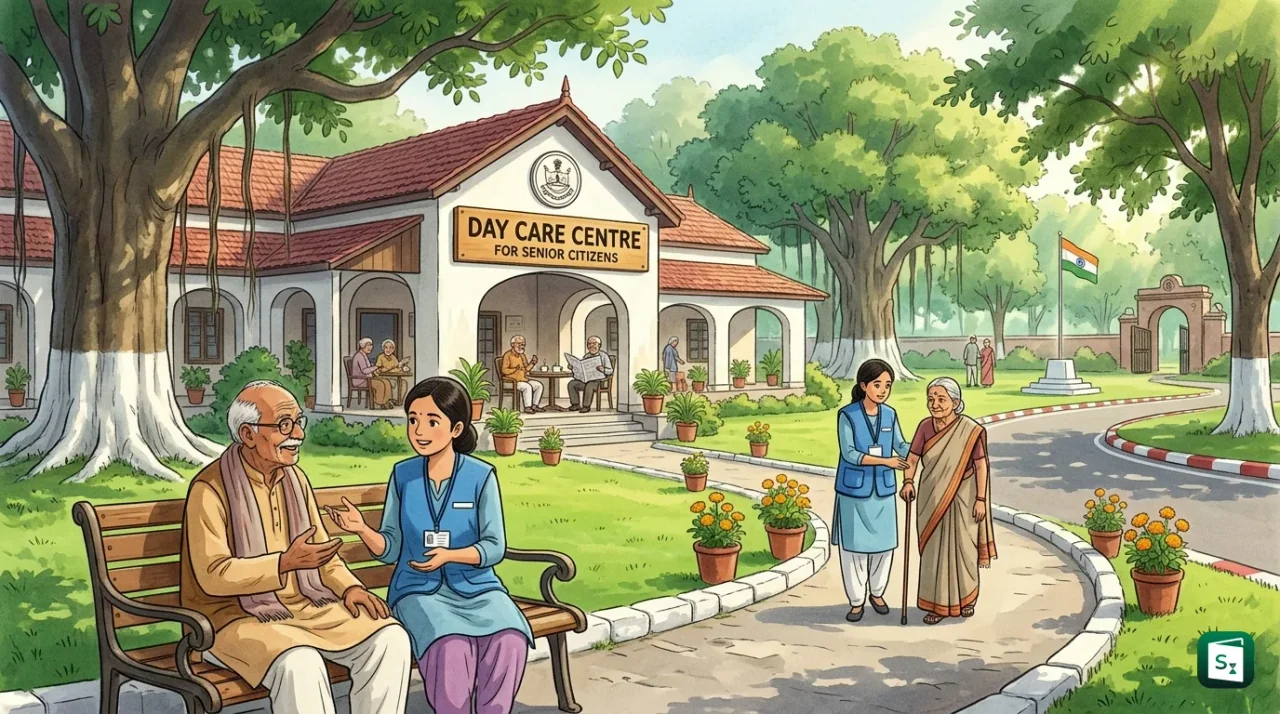
The Directorate General of Defence Estates and the Department of Social Justice and Empowerment signed a Memorandum of Understanding in New Delhi on 16 November 2026 to strengthen welfare services for senior citizens living in cantonment areas. The MoU was exchanged in the presence of Defence Minister Rajnath Singh and Social Justice and Empowerment Minister Virendra Kumar. It provides for new day care centres and senior citizen homes and training of youth as geriatric caregivers under the Atal Vayo Abhyuday Yojana.
What Is the Defence-Social Justice MoU for Cantonment Senior Citizens?
The Defence-Social Justice MoU is a five year cooperation pact between the Directorate General of Defence Estates (DGDE) and the Department of Social Justice and Empowerment to extend elderly welfare schemes to cantonment towns. A Memorandum of Understanding is a formal written agreement in which two organisations record shared goals and responsibilities before starting joint work. This MoU places cantonment boards under the Atal Vayo Abhyuday Yojana for the first time on this scale.
The MoU was formally exchanged by Kajal Singh, Director in the Social Justice Ministry, and Mane Amitkumar B., Deputy Director General in DGDE. Defence Secretary Rajesh Kumar Singh, Social Justice Secretary Sudhansh Pant and Director General of Defence Estates Shobha Gupta were present. A Joint Working Group with officers from both ministries will coordinate, implement and monitor the work. The pact will remain valid for five years and can be renewed.
The initiative is described as a Whole of Government effort. It combines the civic network of cantonment boards with the funds, guidelines and technical support of the Social Justice Ministry. It also coincides with the centenary of the Defence Estates Organisation, which traces its origin to the creation of a permanent Cantonment Department in 1926.
Where Will New Day Care Centres and Senior Citizen Homes Come Up?
The MoU covers both existing facilities and new facilities. Some cantonment boards already run day care centres and senior citizen homes from their own budgets, which depend largely on grants from the Defence Ministry. The Social Justice Ministry will now give financial support for their operation and upkeep under the Atal Vayo Abhyuday Yojana. Eight other cantonments have been identified for new centres.
| Status | Cantonments | Facility Type |
|---|---|---|
| Existing centres to be strengthened | Ambala (Haryana), Deolali (Maharashtra), Jabalpur (Madhya Pradesh), Ranikhet and Lansdowne (Uttarakhand) | Day Care Centres |
| Existing homes to be augmented | Ayodhya and Lucknow (Uttar Pradesh) | Senior Citizen Homes |
| New centres identified by DGDE | Barrackpore (West Bengal), Belgaum (Karnataka), Jhansi (Uttar Pradesh), Khadki and Pune (Maharashtra), Secunderabad (Telangana), St. Thomas Mount (Tamil Nadu), Delhi | Day Care Centres or Senior Citizen Homes |
New senior citizen homes will have residential capacity of 25 or 50 beds wherever feasible. Existing centres in five cantonments and homes in two cantonments will be expanded in consultation with the Social Justice Ministry based on availability of funds. The list keeps a balance between large urban cantonments such as Delhi, Secunderabad and Pune and hill cantonments such as Ranikhet and Lansdowne where access to elder care is limited.
How Will DGDE and the Social Justice Ministry Share Work?
The Directorate General of Defence Estates and the cantonment boards will provide land, buildings and basic civic services. This includes suitable premises for centres and homes along with electricity, water supply and sanitation. The boards will manage day to day civic administration through their chief executive officers.
The Ministry of Social Justice and Empowerment will provide money, standards and knowhow. It will extend grants under the Atal Vayo Abhyuday Yojana, share training modules for caregivers and give technical guidance on running homes and day care centres. Officials said awareness camps will inform residents about welfare schemes and local public representatives and community groups will be involved to build participation.
Defence Minister Rajnath Singh asked for regular social audits of the centres and homes. A social audit is an independent review of service quality with feedback from residents and families. The Joint Working Group will use these findings to fix gaps in care, staffing and infrastructure.
What Is Atal Vayo Abhyuday Yojana?
The Atal Vayo Abhyuday Yojana (AVYAY) is the central umbrella scheme for senior citizen welfare. The Department of Social Justice and Empowerment launched it in April 2021 by restructuring the earlier National Action Plan for Senior Citizens. A senior citizen under Indian law means an Indian citizen aged 60 years or more. The scheme aims to help such citizens live healthy, active and dignified lives with shelter, food, health care and recreation.
AVYAY has seven components. Each fills a different gap in elder care.
| Component | What It Does |
|---|---|
| Integrated Programme for Senior Citizens (IPSrC) | Gives grants to voluntary organisations to run senior citizen homes and continuous care homes with free shelter, food and medical care |
| State Action Plan for Senior Citizens (SAPSrC) | Supports states and union territories to run awareness drives, cataract operations and local projects |
| Rashtriya Vayoshri Yojana (RVY) | Provides free assisted living devices such as wheelchairs, hearing aids and spectacles to seniors with monthly income up to ₹15,000. Launched on 1 April 2017 and run through ALIMCO |
| Elderline | National toll free helpline 14567, launched on 1 October 2021, for information, emotional support and grievance redress. It has received more than 29 lakh calls |
| Seniorcare Ageing Growth Engine (SAGE) | Backs startups that build products for the elderly, with government equity capped at 49 percent |
| Training of Geriatric Caregivers | Trains youth as professional elder caregivers. More than 35,480 persons were trained between 2023-24 and 2025-26 |
| Other initiatives | Includes productive engagement portals such as SCOPE and research on ageing |
Between 2023-24 and 2025-26, more than 10,00,456 persons benefited under AVYAY. The legal backing for much of this work comes from the Maintenance and Welfare of Parents and Senior Citizens Act, 2007. The Act requires children and heirs to maintain parents who cannot support themselves, provides for maintenance tribunals and mandates old age homes and medical facilities in every district.
What Is a Cantonment and What Is a Cantonment Board?
A cantonment is a notified area where a part of the armed forces is quartered along with civilian population living nearby for support and services. A cantonment area in India is declared by the central government by gazette notification. Urban governance of cantonments falls under Entry 3 of the Union List in the Seventh Schedule of the Constitution.
A cantonment board is the urban local body that governs a cantonment. Cantonment boards are set up under the Cantonments Act, 2006, which replaced the Cantonments Act, 1924. There are 61 cantonment boards across 19 states and union territories. The first cantonment was set up at Barrackpore in 1765, followed by Danapore in the same year.
A board is chaired by the Station Commander as ex officio president. An officer of the Indian Defence Estates Service (IDES) serves as chief executive officer and member secretary. The board has elected civilians and nominated military members in equal balance. Cantonments are grouped into four categories based on population.
Cantonments differ from military stations and garrisons. A military station is meant only for troops and is created by executive order. A cantonment houses both troops and civilians and has a statutory municipality. The DGDE, headquartered at Delhi Cantonment, oversees the system through six Principal Directorates and 39 Defence Estates Offices. The Defence Ministry holds about 17.57 lakh acres of land, of which about 1.6 lakh acres lie inside cantonments. Citizen services such as birth certificates, tax payment and hospital bookings are offered online through the eChhawani portal.
Why Geriatric Caregiver Training and Vayo SAATHI Matter
Geriatric caregiving means organised medical and daily living support for old people. India needs more trained caregivers as the share of people above 60 rises. The MoU will train youth living in and around 12 cantonments to fill this gap and also create jobs for them. The 12 locations are Barrackpore, Belgaum, Jhansi, Deolali, Khadki and Pune, Secunderabad, St. Thomas Mount, Ambala, Delhi, Ferozepur and Jalandhar.
Training will be given through training partners of the Social Justice Ministry. Young trainees will learn elder health care, nutrition, mobility support and respectful communication. Raksha Mantri Rajnath Singh said the wisdom of elders will support the goal of Viksit Bharat by 2047. Social Justice Minister Virendra Kumar said dignified and active ageing is a national commitment.
The effort links to the Vayo Samman Rashtriya Abhiyan, a national intergenerational bonding campaign launched on 4 November 2026 under AVYAY. The campaign follows the 5C model of Connect, Converse, Co-create, Contribute and Continue. Its volunteer arm is Vayo SAATHI, which stands for Support, Awareness, Assistance, Training, Health and Inclusion. Citizens aged 18 years or more can register on the SCW SAMAVESH portal or the JEEVAN mobile application and receive a certificate. Students in cantonment board schools will take a pledge to respect elders and join joint activities with senior citizens.
Key Takeaways
- The DGDE and the Department of Social Justice and Empowerment signed an MoU in New Delhi on 16 November 2026 to extend elderly welfare to cantonment areas.
- Eight cantonments including Barrackpore, Belgaum, Jhansi, Khadki, Pune, Secunderabad, St. Thomas Mount and Delhi were identified for new day care centres.
- Existing day care centres in five cantonments and senior citizen homes in Ayodhya and Lucknow will be strengthened with funds under AVYAY.
- Youth in 12 cantonments including Ferozepur and Jalandhar will be trained as geriatric caregivers, with monitoring by a Joint Working Group over the five year MoU period.
- Cantonment boards, now numbering 61 under the Cantonments Act, 2006, are urban local bodies headed by the Station Commander with an IDES officer as chief executive officer.