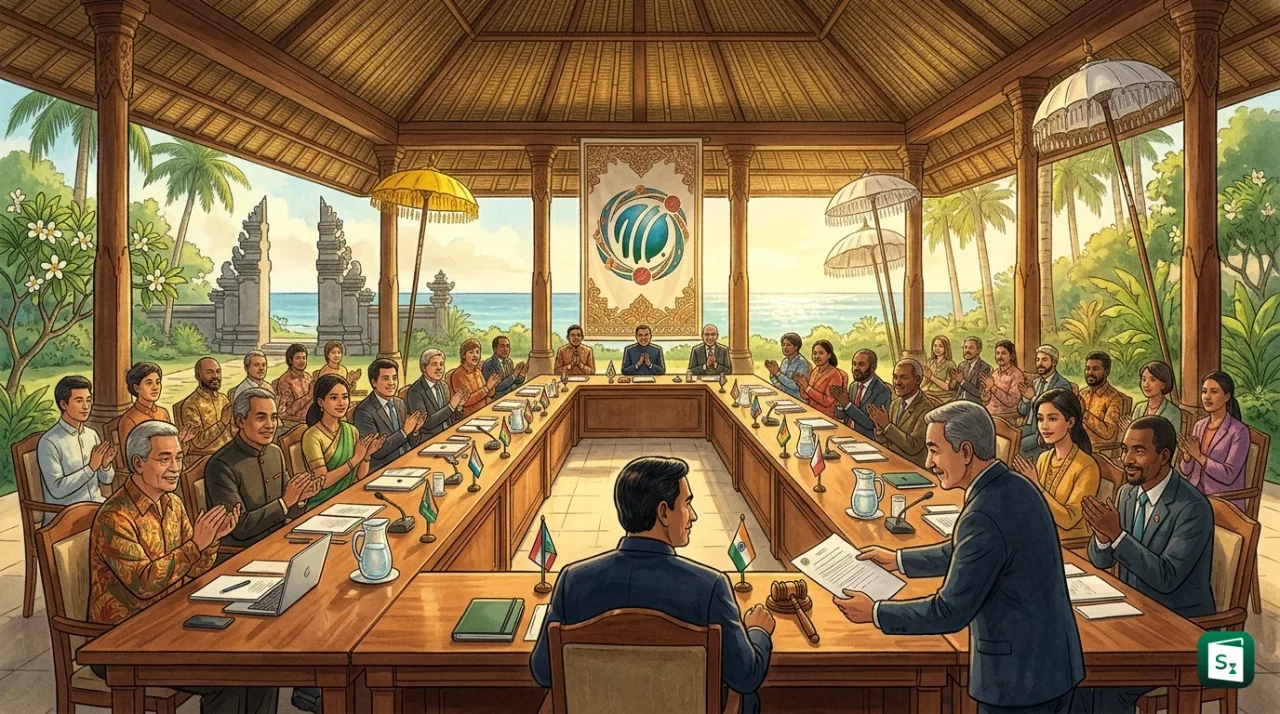
The International Cricket Council Board in Bali has reappointed Jay Shah unopposed as ICC Chairman for a second consecutive 2-year term. Shah, who first took charge on 1 December 2024 after succeeding New Zealand’s Greg Barclay, will now continue in the post till 2028. His extended tenure gives cricket continuity as it heads into the 2027 ODI World Cup and a return to the Olympic Games at Los Angeles 2028.
What Is the ICC in Cricket?
The International Cricket Council (ICC) is the global governing body for cricket. It organises world events, sets playing conditions, manages international rankings, and controls anti-corruption work. The ICC has 111 member nations in 2026.
The ICC was founded on 15 June 1909 at Lord’s in London as the Imperial Cricket Conference. Australia, England and South Africa were the founding members. The body was renamed the International Cricket Conference in 1965. It took its present name, the International Cricket Council, in 1989.
The ICC operated from London for nearly a century. In August 2005, the ICC shifted its headquarters to Dubai in the United Arab Emirates. The move brought the body closer to South Asia, which drives most of cricket’s commercial revenue. The ICC is legally registered in the British Virgin Islands.
Of the 111 members, 12 are Full Members with voting rights and the right to play Test matches. India, Australia, England, Pakistan, New Zealand, West Indies, South Africa, Sri Lanka, Zimbabwe, Bangladesh, Ireland and Afghanistan form this group. The remaining 99 are Associate Members, who can play T20 Internationals and, if they perform well, One Day Internationals.
The day to day work is led by Chief Executive Officer Sanjog Gupta, who took charge on 7 July 2025. The Board is headed by Chairman Jay Shah. Zimbabwe’s Tavengwa Mukuhlani serves as Deputy Chairman.
How the ICC Chairman Is Elected?
The ICC Chairman is chosen by the ICC Board through nomination and, if needed, a secret ballot. Only a present or past ICC director can contest. Each director can nominate one candidate. If only one valid candidate is nominated by the deadline, that person is declared elected unopposed with no vote.
The ICC Board has 16 voting members. These include 12 Full Member directors, 3 Associate Member directors and 1 independent woman director. The Chairman presides over the Board but does not represent any national board. The Chief Executive Officer sits on the Board without a vote.
When there is more than one candidate, the ballot is secret. The ICC’s independent Audit Committee Chairman oversees the process. A candidate needs a simple majority of 9 votes out of 16 to win. This rule replaced the earlier two-thirds requirement of 11 votes.
Jay Shah’s case followed the unopposed route in both 2024 and 2026. In August 2024, outgoing Chairman Greg Barclay decided against a third term. Shah was the sole nominee and took charge on 1 December 2024. In November 2026, ICC directors proposed his name at the Board and Committee meetings in Bali. No other candidate was nominated, so the Board confirmed his reappointment without a ballot.
Who Is Jay Shah?
Jay Amitbhai Shah is an Indian cricket administrator and the current Chairman of the ICC. He was born on 22 September 1988 in Ahmedabad, Gujarat. He is 38 years old in November 2026. He is the son of India’s Home Minister Amit Shah and Sonal Shah.
Shah holds a Bachelor of Technology (B.Tech) degree from Nirma University in Ahmedabad. He began cricket administration in 2009 with the Central Board of Cricket in Ahmedabad. In 2013, he became joint secretary of the Gujarat Cricket Association (GCA). During this period, he oversaw the building of the world’s largest cricket stadium at Motera in Ahmedabad, now called the Narendra Modi Stadium with a capacity of about 132,000.
Shah joined the Board of Control for Cricket in India (BCCI) finance and marketing committees in 2015. In October 2019, he became the youngest ever honorary secretary of the BCCI. He was re-elected in October 2022. His BCCI term saw the record Indian Premier League (IPL) media rights deal of ₹48,390 crore for five years, the launch of the Women’s Premier League (WPL), the new Centre of Excellence in Bengaluru and the Test Cricket Incentive Scheme.
In January 2021, Shah became president of the Asian Cricket Council (ACC), the youngest to hold that post. He was given an extension in January 2024 and served till December 2024. He also chaired the ICC’s Finance and Commercial Affairs Committee. On 27 August 2024, the ICC elected him unopposed as Chairman. He assumed office on 1 December 2024 as the youngest ICC Chairman and the fifth Indian to lead world cricket.
How Long Is the ICC Chairman Tenure?
The ICC Chairman serves a term of 2 years. The term can be renewed, with a total limit of 6 years. This means a Chairman can serve a maximum of three terms of two years each.
The ICC Board in October 2024 recommended a change to two terms of three years each. The six-year overall limit would stay the same. The proposal was aimed at giving more stability to the Chairman and the independent director. Members were asked to approve the change. The reappointment announced in Bali in November 2026 is described by the ICC as a second consecutive 2-year term, which will run till 2028.
In practice, Chairmen often serve four years. Greg Barclay of New Zealand served from 24 November 2020 to 30 November 2024, completing two terms. Shashank Manohar served from November 2015 to June 2020. Shah’s first term ran from December 2024 to November 2026. His second term covers December 2026 to November 2028.
ICC Chairman List and Indians Who Have Led World Cricket
The post of ICC Chairman was created in 2014 as the head of the Board of Directors. Before that, the top post was the ICC President. The post of President was abolished in 2016. Since then, the Chairman is the principal head of the ICC, while the Chief Executive Officer handles daily management.
| ICC Chairman | Country | Tenure |
|---|---|---|
| N. Srinivasan | India | 26 June 2014 to 9 November 2015 |
| Shashank Manohar | India | 22 November 2015 to 30 June 2020 |
| Greg Barclay | New Zealand | 24 November 2020 to 30 November 2024 |
| Jay Shah | India | 1 December 2024 to present |
Two Indians also served as ICC President before the Chairman became the top post. Jagmohan Dalmiya was President from 1997 to 2000. He was the first Indian to lead the ICC. Sharad Pawar was President from 2010 to 2012, a period that included the 2011 ODI World Cup in India, Sri Lanka and Bangladesh.
The Chairman and the Chief Executive Officer have different roles. The Chairman leads the Board, sets strategy and represents the ICC at the global level. The Chief Executive Officer runs operations, events and commercial work, and reports to the Board. The current CEO is Sanjog Gupta, former sports head at JioStar, who took charge in July 2025. He is the seventh ICC Chief Executive.
What the Second Term Will Decide for Cricket
The ICC Board said the reappointment ensures continuity at a defining moment for the sport. The Board listed four priorities. These are global expansion, growth in fandom, commercial development and strengthening the foundations of the game.
Two major events fall inside Shah’s second term. The ICC Men’s ODI World Cup 2027 will be held in Southern Africa. Cricket will then return to the Olympic Games at Los Angeles 2028. Cricket featured at the Olympics only once before, at Paris 1900. Its return after 128 years is expected to bring new audiences, new funding and new teams.
The Board also reaffirmed three long term goals. The first is faster growth of the women’s game, building on the WPL model and expanded ICC women’s events. The second is more chances for Associate Members through development pathways and participation routes. The third is protection of the integrity of international cricket and creation of stable commercial income to support members.
The Bali meetings also discussed the global events calendar till 2035. Future ICC tournaments are largely placed in the second half of the year. This creates a clear window from March to May for domestic leagues such as the IPL. The balance between national leagues and international cricket will be a key test of Shah’s second term.
Key Takeaways
- The ICC Board in Bali on 16 November 2026 reappointed Jay Shah unopposed as ICC Chairman for a second term.
- Jay Shah first took charge on 1 December 2024 after succeeding Greg Barclay and will now continue till 2028.
- The ICC Chairman serves a 2-year term with a maximum limit of 6 years and needs 9 of 16 votes when an election is contested.
- The International Cricket Council, founded in 1909, is headquartered in Dubai since 2005 and has 111 members.
- Shah’s second term covers the 2027 ODI World Cup in Southern Africa and cricket’s Olympic return at Los Angeles 2028.