

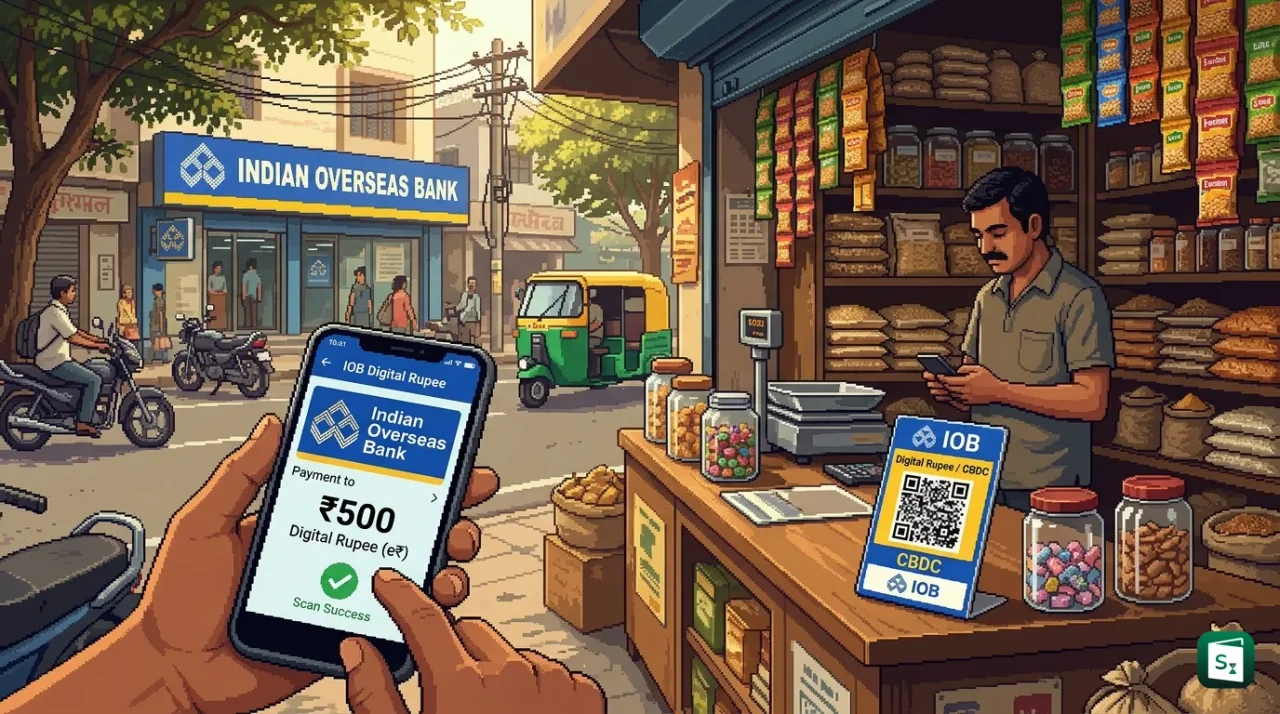
Indian Overseas Bank launched its IOB Digital Rupee mobile application on 9 November 2026 in Chennai. The app lets customers hold Central Bank Digital Currency in a phone wallet and pay other persons and merchants. The move widens the retail e-rupee pilot and links it with UPI acceptance and programmable benefits for government transfers.
What Is CBDC and What Is the Digital Rupee?
The Central Bank Digital Currency (CBDC) is digital money issued directly by a central bank. In India it is called the Digital Rupee or e-rupee and the Reserve Bank of India (RBI) issues it.
The Digital Rupee is the digital form of the physical rupee. One e-rupee equals one rupee in cash. It is legal tender across India under Section 26 of the Reserve Bank of India Act, 1934. It is a direct liability of the RBI and carries the guarantee of the Central Government. Citizens can use it to pay and to store value, just like notes and coins.
The RBI creates e-rupee tokens and passes them electronically to banks. Banks then load them into customer wallets. This is called a two tier model. The retail pilot uses a token based design with some components based on blockchain technology. The system records ownership of each token to prevent duplication.
For ease of use, e-rupee is issued in the same denominations as cash, such as ₹1, ₹5, ₹10, ₹20, ₹50, ₹100, ₹200, ₹500 and paise values up to two decimal places. Like cash, balances in an e-rupee wallet earn no interest. Holders can convert e-rupee into bank deposits and bank money into e-rupee at any time. There are no charges for using e-rupee or for holding a wallet.
What IOB Launched on 9 November 2026
Indian Overseas Bank (IOB) announced the IOB Digital Rupee application on 9 November 2026. The bank presented it as a secure mobile wallet for holding Digital Rupee and for instant payments.
The app supports Person to Person (P2P) transfers between e-rupee wallets and Person to Merchant (P2M) payments to shops and business outlets. Payments to merchants can use QR codes shown at the outlet. IOB said the design focuses on security, ease of use and wider access.
A central feature is UPI interoperability. Users of the IOB Digital Rupee wallet can scan existing UPI QR codes for payments, while merchants do not need a separate CBDC QR. This link lets e-rupee reach the large network of stores that already accept Unified Payments Interface (UPI), the instant payment system operated by the National Payments Corporation of India (NPCI).
IOB is a public sector bank headquartered at Anna Salai in Chennai. The bank was founded on 10 February 1937 by M. Ct. M. Chidambaram Chettyar to support foreign exchange and overseas banking. It was one of the 14 major banks nationalised in 1969. Its Managing Director and Chief Executive Officer is Ajay Kumar Srivastava, who said the launch is part of the digital transformation of the bank.
How the E Rupee Wallet Works
The e-rupee wallet is a phone based wallet that stores Digital Rupee like a purse stores notes. The RBI states that 19 banks and some non bank providers now offer such wallets as part of the retail pilot. Wallets work on both Android and iOS phones and operate 24 hours a day, seven days a week.
The RBI creates e-rupee and issues it to banks. Banks credit the wallets of customers from their linked savings accounts. For general users, a savings account link helps with onboarding and avoids a fresh KYC check. For beneficiaries of programmable government schemes, onboarding through mobile or Aadhaar authentication is possible without a savings account.
Safety rests on a strong cyber security framework. If a phone is lost, the e-rupee remains safe and the wallet can be recovered on a new device with the same phone number and SIM. Users can raise disputes through the wallet app or customer care. The RBI confirms that e-rupee wallets carry no minimum balance need and no usage fee.
Inside the wallet, e-rupee appears in familiar denominations. If a buyer has only a ₹20 token but must pay ₹15, the wallet credits ₹15 to the merchant and keeps ₹5 as balance. Payments between two e-rupee wallets at a CBDC QR settle instantly between the wallets. Payments from an e-rupee app to a UPI QR follow UPI settlement timelines. Work is also under way on offline use for areas with weak or no internet, to keep digital cash usable like physical cash.
Digital Rupee Vs UPI: How the Two Differ
The Digital Rupee is money itself. UPI is a way to move money between bank accounts. This distinction answers the most common questions on safety, legal status and technology.
The Digital Rupee is RBI money and a direct claim on the central bank. UPI transfers are claims on commercial banks that are settled between accounts. The Digital Rupee is legal tender. A UPI instruction is not separate money. The Digital Rupee can be held apart from a bank account as a store of value in a wallet. UPI always debits and credits bank accounts.
The Digital Rupee is not a cryptocurrency. Cryptocurrencies are privately issued and have no sovereign guarantee or stable value. The Digital Rupee is sovereign money issued by the RBI, fixed at par with the rupee, and guaranteed by the Central Government. The retail pilot uses some blockchain based components, but value comes from RBI backing, not from mining or market trading.
| Aspect | Digital Rupee | UPI |
|---|---|---|
| What it is | Digital form of the rupee, a currency token | Instant payment rail to move bank money |
| Issued by | RBI | Transfer system operated by NPCI with banks |
| Legal status | Legal tender under RBI Act | Payment instruction, not separate money |
| Where value sits | In e-rupee wallet, outside bank account until redeemed | In savings or current account |
| Settlement between e-rupee wallets | Instant wallet to wallet settlement | Bank to bank settlement through UPI |
| Interest | No interest, like cash | Account balance rules of the bank apply |
| Safety basis | RBI guarantee plus wallet security | Bank systems plus UPI PIN and KYC |
In practice the two systems now work together. An IOB Digital Rupee user can pay at a CBDC QR with wallet to wallet settlement. The same user can also pay at a UPI QR from the e-rupee app, in which case UPI timelines apply and the merchant can receive funds without a separate CBDC onboarding.
What Is Programmable CBDC and Why It Matters for Benefits
Programmable CBDC lets the issuer set conditions on how money in a wallet can be used. The RBI allows programming on expiry date, geo location, merchant category code and merchant payment address. The sponsor, which can be a government department or a company, fixes the rule. The wallet then permits payment only when the rule is met.
The IOB Digital Rupee app includes this function. IOB said it can support purpose specific release of grants and benefits through CBDC. The bank added that it is in talks with government departments to act as a sponsor bank for such disbursement programmes. In a sponsor model, the government releases funds as programmable tokens and the sponsor bank routes them to beneficiary wallets for spending at approved outlets.
For welfare delivery, the model points toward smarter Direct Benefit Transfer (DBT). A food subsidy token can be limited to empanelled grain shops. A farm input benefit can be limited to fertiliser outlets. A time limit can return unspent funds automatically. Geo fencing can show whether a benefit meant for one area is used elsewhere. Each transaction leaves a real time trail, which helps audit and reduces diversion compared with unrestricted cash or account transfers.
India has already tested this path. Programmable food subsidy transfers under the Pradhan Mantri Garib Kalyan Anna Yojana (PMGKAY) were piloted in Puducherry and Gujarat and were extended to Chandigarh and Dadra and Nagar Haveli in August 2026. Under that model, beneficiaries receive subsidy as CBDC tokens in a wallet and redeem them at approved merchants instead of receiving only a bank credit. The RBI also cites corporate uses, such as limiting staff travel funds to approved travel merchants and dates.
Retail Vs Wholesale CBDC: How India Reached This Stage
The RBI defines CBDC as legal tender issued by the central bank in digital form. The Union Budget for 2022-23 announced the Digital Rupee from that financial year. A gazette notification on 30 March 2022 amended the RBI Act to give the Digital Rupee legal tender status. The RBI then chose a phased pilot route before any final launch decision.
The Wholesale CBDC (e-rupee W) pilot started on 1 November 2022 for settlement of secondary market transactions in government securities. Nine banks joined, including State Bank of India, Bank of Baroda, Union Bank of India, HDFC Bank, ICICI Bank, Kotak Mahindra Bank, Yes Bank, IDFC First Bank and HSBC. Use of central bank money was expected to cut settlement cost and reduce need for collateral and guarantee cover.
The Retail CBDC (e-rupee R) pilot started on 1 December 2022 in a closed user group of customers and merchants. The first phase covered Mumbai, New Delhi, Bengaluru and Bhubaneswar with State Bank of India, ICICI Bank, Yes Bank and IDFC First Bank. Bank of Baroda, Union Bank of India, HDFC Bank and Kotak Mahindra Bank joined next. Coverage later widened to more cities, and official updates placed participation above 13 banks and 26 locations with more than 1.75 million users and merchants.
| Feature | Retail CBDC | Wholesale CBDC |
|---|---|---|
| Users | Public, businesses and merchants | Select banks and financial institutions |
| Purpose | Everyday P2P and P2M payments, benefits | Interbank settlement, government securities, future cross border use |
| Form | Token like digital note in phone wallet | Account based settlement balances with RBI |
| Access | Through bank and non bank e-rupee apps | Through RBI CBDC accounts of participant banks |
| Pilot start | 1 December 2022 | 1 November 2022 |
The RBI lists lower cash handling cost, stronger inclusion, resilient payments, faster settlement and a sovereign alternative to volatile private crypto assets among the motives. IOB entry in November 2026 extends this retail network with one more public sector option that combines CBDC settlement with UPI reach.
Key Takeaways
- Indian Overseas Bank launched the IOB Digital Rupee app on 9 November 2026 for P2P and P2M e-rupee payments.
- The Digital Rupee (e-rupee) is India Central Bank Digital Currency, legal tender under Section 26 of the RBI Act, 1934 and a direct liability of the RBI.
- The IOB wallet supports UPI interoperability, so e-rupee users can pay by scanning existing UPI QR codes at merchant outlets.
- The app includes Programmable CBDC, which can limit funds by expiry date, location, merchant category and payment address for targeted DBT delivery.
- India piloted Wholesale e-rupee on 1 November 2022 for government securities and Retail e-rupee on 1 December 2022, announced in the Union Budget 2022-23.