

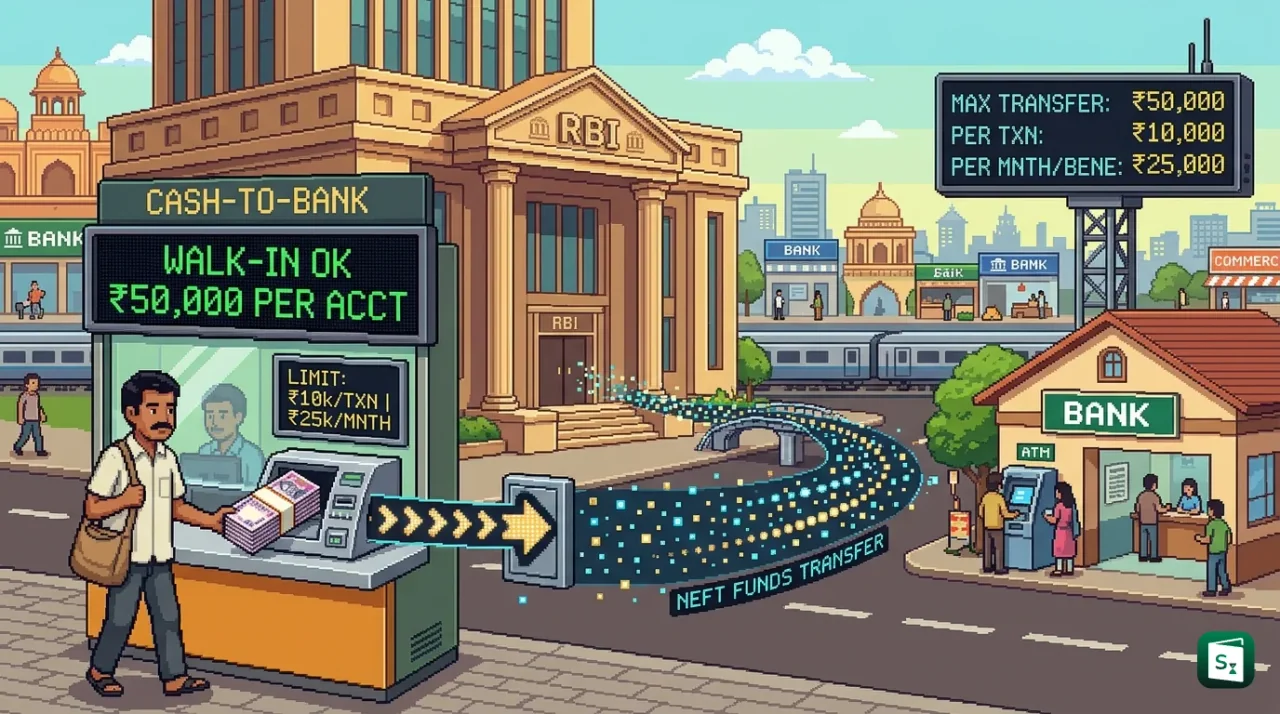
The Reserve Bank of India issued the Reserve Bank of India (Domestic Money Transfer) Directions, 2026 on 11 November 2026 to consolidate all existing domestic money transfer rules into a single framework. The directions retain the facility for walk-in customers without a bank account to deposit up to ₹50,000 in cash at a branch for transfer to a beneficiary account through NEFT. They also retain strict per transaction and monthly caps, KYC registration and monitoring safeguards to keep small value transfers safe.
What Is Domestic Money Transfer?
Domestic money transfer is a facility that allows small value fund transfers within India through formal banking channels for people who lack easy access to such channels. The Reserve Bank of India introduced this framework in 2011 to help migrant workers and others who could not open or operate bank accounts easily for want of identity or address proof. It covers two types of services, cash pay-in where cash is deposited for credit to a bank account, and cash pay-out where money from a bank account is paid in cash to a person without an account.
The Reserve Bank of India (RBI), which was established in 1935 and is headquartered in Mumbai, regulates payment systems in India. The Reserve Bank issued the 2026 directions under Section 18 read with Section 10(2) of the Payment and Settlement Systems Act, 2007. This Act, passed as Act 51 of 2007, designates the Reserve Bank as the authority for regulation and supervision of payment systems.
The directions apply to all Scheduled Commercial Banks, including Regional Rural Banks (RRBs), Urban Co-operative Banks, State Co-operative Banks and District Central Co-operative Banks. They also apply to authorised payment system operators and participants, both banks and non-banks, to the extent relevant. Card to card transfers stay outside this framework and continue under the rules approved for those payment instruments.
What Is NEFT and How Does NEFT Transfer Work?
National Electronic Funds Transfer (NEFT) is a nationwide centralised payment system owned and operated by the Reserve Bank of India. It allows one to one fund transfers between bank accounts across India in near real time through half hourly batches. The system started in November 2005 and has operated round the clock on all days of the year since 16 December 2019.
A walk-in customer in banking is a person who walks into a bank branch to use a service without holding an account at that branch. A beneficiary is the person whose bank account finally receives the money. Under the NEFT process, the sender provides the beneficiary name, account number, account type, bank name, branch name and Indian Financial System Code (IFSC). IFSC is an 11 character code that identifies a bank branch.
The originating bank sends the payment message to its pooling centre, called the NEFT Service Centre. The centre forwards the message to the NEFT Processing Centre run by the Reserve Bank for inclusion in the next available batch. The Reserve Bank sorts the transfers bank wise, debits the sending banks and credits the receiving banks. The receiving banks then credit the beneficiary accounts.
NEFT is not instant for each rupee like real time settlement. It settles in batches on a deferred net settlement basis, which means banks settle only the net amount due between them at the end of each batch. This keeps the system safe and efficient for large volumes of retail payments.
What Are the New Cash Pay-in Limits for Walk-in Customers?
Cash pay-in service allows a person to deposit cash for credit to the bank account of a beneficiary. The Reserve Bank has retained the existing limits under the 2026 directions. A walk-in customer at a bank branch can remit funds up to ₹50,000 to the bank account of a beneficiary through NEFT. This is the highest cash limit in the framework and it applies only to branch deposits routed through NEFT.
Banks may also allow such customers to send money to a beneficiary account through Business Correspondents (BCs), ATMs and other authorised channels. For these non-branch channels, the limit is lower. The cap is ₹5,000 per transaction with a monthly ceiling of ₹25,000 per remitter. A remitter is the person who sends the money, while a beneficiary is the person who receives it.
| Channel Used by Walk-in Customer | Per Transaction Limit | Monthly Cap | System Used |
|---|---|---|---|
| Bank branch | ₹50,000 | As per bank policy within overall framework | NEFT |
| Business Correspondent, ATM or other permitted channel | ₹5,000 | ₹25,000 per remitter | IMPS or NEFT |
The Reserve Bank has also retained identity and traceability rules for cash pay-in. The remitting bank or correspondent must register the remitter based on a verified mobile number and a self-certified Officially Valid Document (OVD). OVD refers to documents accepted for identity and address proof under the Reserve Bank KYC directions, such as passport, driving licence, voter identity card or Aadhaar. Every transaction must pass an Additional Factor of Authentication (AFA), which is a second security check beyond the basic instruction, such as a one time password on the registered mobile number.
The remitting bank must include remitter details in the IMPS or NEFT transaction message. The message must also carry an identifier to show that it is a cash based remittance. Banks and correspondents must follow the cash deposit provisions of the Income-tax Act, 2025 and the rules made under it.
What Are the Cash Pay-out Limits for Transfers From Bank Accounts?
Cash pay-out service works in the opposite direction to cash pay-in. Here the money moves from the bank account of a customer and is delivered in cash to a recipient who does not hold a bank account. Banks deliver this cash at an ATM, through an agent appointed as Business Correspondent, or through any other authorised payment channel.
The remitting bank must obtain and keep a record of the name and address of the beneficiary. The maximum amount under this service is ₹10,000 per transaction, subject to an overall monthly ceiling of ₹25,000 per beneficiary. These caps were part of the earlier framework issued in 2011 and reviewed in July 2024, and the 2026 directions retain them without change.
This distinction matters for exam recall. Cash pay-in at a branch allows up to ₹50,000 through NEFT to a bank account. Cash pay-out from an account for cash delivery to a person without an account is capped at ₹10,000 per transaction. The monthly ceiling of ₹25,000 applies to the beneficiary in pay-out service and to the remitter in non-branch pay-in service through correspondents and ATMs.
How Do NEFT Timings, Settlement and Charges Work?
The NEFT system is available round the clock throughout the year on all days, on a 24x7x365 basis. It settles in half hourly batches, with 48 batches in a day. Branch channel transfers follow branch working hours, while online transfers can be initiated at any time from home or work through internet or mobile banking.
A beneficiary can expect credit within two hours from the batch settlement in which the transaction was processed. If the beneficiary bank cannot credit the account for any reason, it must return the money to the originating branch within two hours of completion of that batch. If credit or return is delayed beyond two hours, the bank must pay penal interest to the affected customer at the current RBI repo rate plus two percent, without waiting for a claim. The repo rate is the rate at which the Reserve Bank lends short term money to banks.
NEFT transfers are possible on holidays and on Sundays because the system runs every day. Online NEFT transfers from savings bank accounts are free. The Reserve Bank stopped levying processing charges on banks from 1 July 2019 and advised banks to not charge savings account holders for online NEFT from 1 January 2020. For branch based outward transfers, banks may charge within the caps fixed by the Reserve Bank.
| NEFT Amount Slab | Maximum Charge a Bank Can Levy for Branch Mode |
|---|---|
| Up to ₹10,000 | Not more than ₹2.50 plus applicable tax |
| Above ₹10,000 up to ₹1 lakh | Not more than ₹5 plus applicable tax |
| Above ₹1 lakh up to ₹2 lakh | Not more than ₹15 plus applicable tax |
| Above ₹2 lakh | Not more than ₹25 plus applicable tax |
There is no charge for inward NEFT credit at the destination branch. For general account to account transfers, the Reserve Bank prescribes no minimum or maximum NEFT amount, though a member bank may set its own board approved limits. The ₹50,000 cap applies only to cash deposits by walk-in customers without an account.
How Does NEFT Compare With RTGS, IMPS and UPI?
Real Time Gross Settlement (RTGS) is the large value system owned and operated by the Reserve Bank. It started in 2004 and has been available 24x7x365 since 14 December 2020. Each RTGS transfer settles individually in real time in the books of the Reserve Bank, so the payment is final and irrevocable. The minimum amount is ₹2 lakh with no maximum set by the Reserve Bank. The beneficiary bank must credit the account within 30 minutes.
Immediate Payment Service (IMPS) and Unified Payments Interface (UPI) are run by the National Payments Corporation of India (NPCI). NPCI is a not for profit company promoted by the Reserve Bank and the Indian Banks Association to operate retail payment systems. IMPS started in 2010 and gives instant credit round the clock, with a per transaction cap of ₹5 lakh except on SMS and IVR channels. UPI started in 2016 and allows payments using a UPI ID, mobile number or QR code. The general UPI limit is around ₹1 lakh, with higher limits up to ₹5 lakh for specified verified merchant categories such as tax payments, insurance and capital markets.
| Feature | NEFT | RTGS | IMPS | UPI |
|---|---|---|---|---|
| Full form | National Electronic Funds Transfer | Real Time Gross Settlement | Immediate Payment Service | Unified Payments Interface |
| Operated by | RBI | RBI | NPCI | NPCI |
| Started in | 2005 | 2004 | 2010 | 2016 |
| Settlement | Half hourly batches, deferred net settlement | Real time, one by one, gross settlement | Instant | Instant |
| Availability | 24x7x365 since 16 Dec 2019 | 24x7x365 since 14 Dec 2020 | 24x7 | 24x7 |
| Minimum and maximum | No minimum or maximum set by RBI, cash walk-in capped at ₹50,000 per transaction | Minimum ₹2 lakh, no maximum | Maximum ₹5 lakh per transaction | Generally up to ₹1 lakh, up to ₹5 lakh for specified categories |
| Needs | Account number plus IFSC | Account number plus IFSC | Account plus IFSC, or mobile plus MMID | UPI ID, mobile number or QR code |
| Best for | Routine transfers of any size and cash to account transfers | Large value urgent transfers | Instant transfers up to ₹5 lakh | Everyday small payments |
NEFT suits salary credits, bulk files and scheduled transfers. RTGS suits large amounts of at least ₹2 lakh that must move at once. IMPS suits urgent transfers within ₹5 lakh. UPI suits daily person to person and merchant payments.
Why Did RBI Issue Consolidated Directions and What Safeguards Apply?
The domestic money transfer framework began with a Reserve Bank circular of 5 October 2011. The Reserve Bank reviewed the framework on 24 July 2024 to reflect growth in banking outlets, new payment options and easier KYC compliance. That review, effective from 1 November 2024, added rules on verified mobile numbers, self-certified OVD, second factor authentication and inclusion of remitter details in transaction messages. The Domestic Money Transfer Directions, 2026 of 11 November 2026, issued under reference RBI/DPSS/2026-27/476, consolidates these instructions into one document. The directions took effect immediately and repealed the 2011 and 2024 circulars. No transaction limit was changed.
The Reserve Bank requires strong monitoring because small value cash transfers carry misuse risks. Banks and non-banks must run velocity checks and send alerts to customers on credits received through these facilities. Any unusual rise in credits in an account or a group of accounts needs immediate checks. Suspicious transactions must be reported to the appropriate authorities. Fund transfers under the framework should move on a real time or near real time basis. Interbank settlement must use only Reserve Bank approved payment systems.
Banks and non-banks may fix reasonable charges to popularise the facility. They must maintain grievance redress systems for these services. Customer grievances under the directions fall within the Reserve Bank Integrated Ombudsman Scheme, 2026, which came into force on 1 July 2026. The scheme provides a cost free and centralised redress mechanism for deficiency in service. It allows compensation up to ₹30 lakh for financial loss and up to ₹3 lakh for time, expense and mental anguish.
Key Takeaways
- The Reserve Bank of India (Domestic Money Transfer) Directions, 2026 were issued on 11 November 2026 and took effect immediately under the Payment and Settlement Systems Act, 2007.
- A walk-in customer at a bank branch can deposit up to ₹50,000 in cash for transfer to a beneficiary bank account through NEFT.
- Transfers through Business Correspondents, ATMs and other permitted channels are capped at ₹5,000 per transaction with a monthly ceiling of ₹25,000 per remitter.
- Cash pay-out from a bank account for cash delivery to a person without an account is capped at ₹10,000 per transaction with a monthly ceiling of ₹25,000 per beneficiary.
- NEFT, expanded as National Electronic Funds Transfer, is owned by the RBI, started in 2005 and runs 24x7x365 since 16 December 2019 in 48 half hourly batches with credit within two hours.
- Grievances under these directions fall within the Reserve Bank Integrated Ombudsman Scheme, 2026, effective from 1 July 2026.