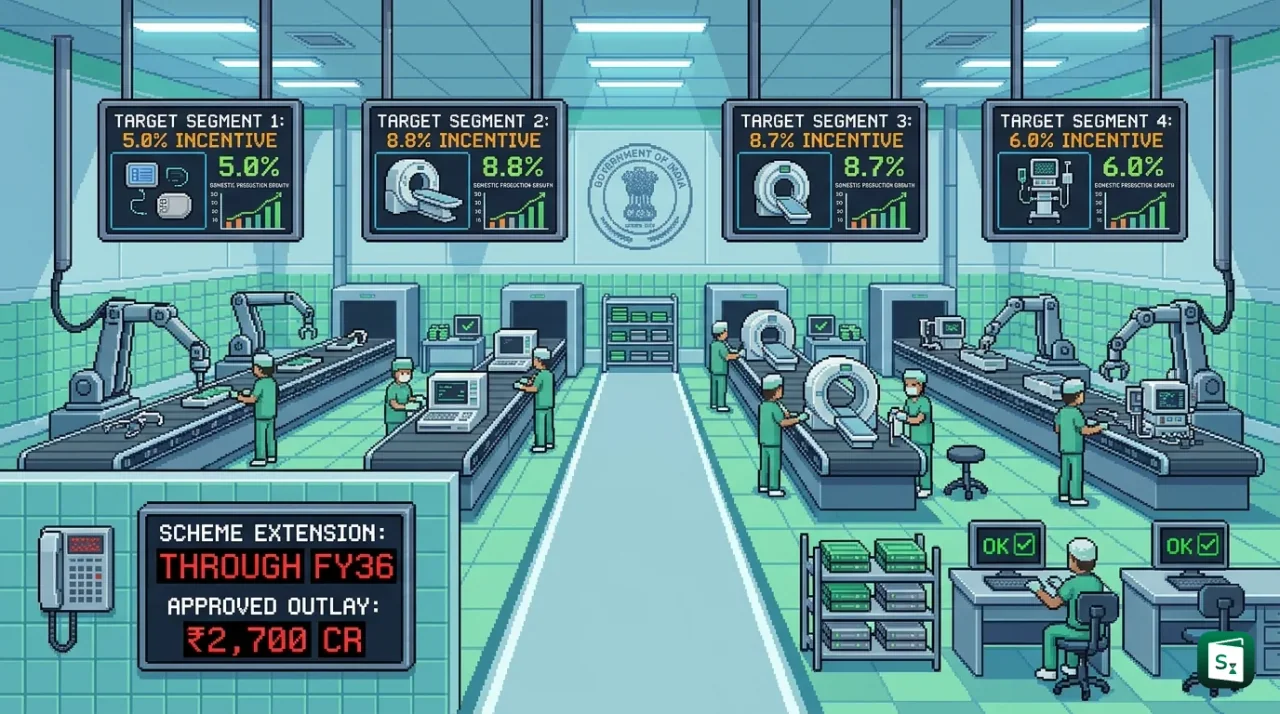
The Department of Pharmaceuticals extended the Production Linked Incentive Scheme for Promoting Domestic Manufacturing of Medical Devices (PLI-MD) till 2035-36 on 10 November 2026. About Rs 2700 crore from the original outlay will be used for fresh applications through a new online portal. The revised scheme offers segment-wise incentive rates and simpler rules to push deep manufacturing of high-end devices in India.
What Is the PLI Scheme?
The Production Linked Incentive (PLI) Scheme is a performance linked support programme that pays financial incentives to companies based on growth in sales of goods made in India. The incentive is calculated on incremental sales over a base year. Companies must first invest and produce, and the government pays only after results are verified.
The Union Cabinet approved the umbrella PLI programme on 11 November 2020 as a central part of Atmanirbhar Bharat. It covers 14 sectors with a total outlay of Rs 1.97 lakh crore. The sectors include mobile manufacturing and specified electronic components, drug intermediaries and active pharmaceutical ingredients, medical devices, automobiles and auto components, pharmaceutical drugs, specialty steel, telecom products, electronic products, white goods, food products, textiles, solar modules, advanced chemistry cell batteries, and drones and drone components.
Each sector scheme is run by its own administrative ministry. The PLI Scheme for Promoting Domestic Manufacturing of Medical Devices (PLI-MD) is run by the Department of Pharmaceuticals, which works under the Ministry of Chemicals and Fertilizers. The original PLI-MD had an outlay of Rs 3420 crore for the period 2020-21 to 2027-28 and offered a flat 5% incentive on incremental sales for five years from 2022-23 to 2026-27.
What Has Changed in the PLI-MD Extension till FY36?
The Department of Pharmaceuticals has extended the tenure of PLI-MD by eight years, from 2027-28 to 2035-36. The extension will use about Rs 2700 crore that remains unspent from the original Rs 3420 crore outlay. The Department has invited fresh applications under the revised guidelines, often called PLI-MD 2.0. Applicants approved before 31 October 2026 will continue under the old guidelines.
Every new applicant will get a maximum of three years as gestation period to set up the factory. This will be followed by a maximum of five years as performance period for claiming incentives. The year 2035-36 will be used to process and release the incentive for the last performance year.
The application process has been made simpler for ease of doing business. Companies can submit applications through an online portal, which was to become active within 10 days of the 10 November 2026 announcement. A company can file any number of applications in one or more target segments, and the window will remain open continuously over a long period.
Four Target Segments and New Incentive Rates
The revised PLI-MD divides medical devices into four Target Segments (TS). The segments are now organised by technical difficulty and depth of manufacturing, not only by clinical use. The earlier phase used clinical categories such as cancer care, imaging, anaesthesia and implants.
| Segment | What It Covers | Average Incentive on Incremental Sales |
|---|---|---|
| TS1 | Consumables, disposables and implants | About 5% |
| TS2 | Critical components used to make devices | About 9% |
| TS3 | High-end devices where domestic manufacturing is at a nascent stage | About 9% |
| TS4 | High-end devices where only assembly happens in India | About 6% |
In TS1, the focus is on scale and world class quality. Products include disposable syringes, needles, IV cannulas and infusion sets, blood bags and tubing sets, dialysis consumables such as dialyzers and catheters, and implants such as orthopaedic and cardiac implants.
In TS2, the focus is on components that decide value addition. The indicative list has more than 200 items. Examples are X-ray tubes, detectors and high voltage generators, CT detector modules and slip rings, MRI magnets, gradient coils and RF coils, ultrasound probes and beamformers, PET detector modules, radiotherapy parts, sensors for patient monitors and infusion pumps, implant grade titanium and polymers, and IVD reagents and optical modules.
In TS3 and TS4, priority is given to value chain integration to improve the quality and competitiveness of devices made in India. TS3 covers devices that India has started to make in small numbers. TS4 covers devices that are still largely assembled from imported kits. The goal is to move from assembly to deep manufacturing of equipment such as 3T MRI machines, PET-CT scanners, ultrasound probes and consoles, and high throughput IVD analysers, which are not yet made in the country.
The flat 5% rate of the first phase has been replaced by a tapering, segment specific rate. For TS1, the rate is 7%, 7%, 4%, 3% and 3% from the first to the fifth performance year. For TS2, the headline rate is 10%, 10%, 10%, 8% and 6% over the five years, with provisions for base rate and additional incentive linked to value addition. Higher rates apply where manufacturing is harder and import dependence is deeper.
How the Revised Eligibility Rules Help Manufacturers
The Department has removed the minimum sales threshold for claiming incentives. Earlier, a company had to cross a fixed sales value each year. Now there is no fixed floor. The company must still show yearly growth in sales of manufactured goods over the base year to receive payment for that year. If it misses the target in one year, it can still claim in later years when targets are met.
The minimum investment rule has also been eased. Applicants with average annual turnover of less than Rs 150 crore in the last three years must invest Rs 50 crore. Applicants with turnover of Rs 150 crore or more have no minimum investment condition. For TS1 and TS3, the investment must create a greenfield facility, which means a new factory built from the ground up. For TS4, no greenfield factory is needed, but the company must show higher value chain integration in India. For TS2, there is no minimum investment condition at all.
This change helps small firms. In the first phase, 14 of the 27 approved applicants were Micro, Small and Medium Enterprises (MSMEs). MSMEs are firms with limited turnover and investment as defined under the Micro, Small and Medium Enterprises Development Act, 2006. The focus on critical components under TS2 also helps MSMEs, because component makers are often smaller suppliers who feed large device makers.
Other rules support ease of doing business. The time to set up the plant is now uniform at three years for all segments, against tight timelines in the past. For TS1, TS3 and TS4, applicants must also obtain regulatory approval from a Stringent Regulatory Authority such as the United States, the European Union, Japan, Canada, Australia, Switzerland or the United Kingdom, and record sales in those markets. This step is meant to ensure that devices made in India meet global quality standards.
Why Domestic Manufacturing of Medical Devices Matters for India
India meets about 70% of its demand for medical devices through imports. In 2020, the share of imports was estimated at more than 85%. Imports of electromedical equipment and surgical instruments crossed USD 25 billion in the five years from 2020-21 to 2024-25. The United States, China, Germany, Singapore and the Netherlands are among the top suppliers. High-end electronics such as MRI and CT scanners, PET-CT systems, linear accelerators and many implants are still largely imported.
This dependence raises costs and affects access to care. Domestic production is still concentrated in low value, high volume goods such as syringes, catheters and surgical tools. The Indian medical device market was valued at about USD 11 billion in 2020, with only about 1.5% share in the global market. Domestic manufacturing has grown from about Rs 28000 crore in 2019-20 to about Rs 41500 crore in 2024-25, and exports have risen from Rs 26915 crore to Rs 42360 crore in the same period.
The first phase of PLI-MD, launched in 2020-21, showed early results. Production under the scheme has crossed Rs 16000 crore. More than 60 high-end devices and components are now made in India, including X-ray tubes and detectors, 1.5 Tesla MRI machines, CT scanners, mammography units, cath labs, linear accelerators and dialyzers. Data placed before Parliament reported actual investment of Rs 1153 crore across 27 approved applications and incentive release of Rs 266.64 crore till 2024-25, with nearly 5769 direct jobs.
The extension fits into a wider policy push. The National Medical Devices Policy, 2023 aims to grow the sector through simpler regulation, better infrastructure, research support, investment, skilled workers and brand building. The Scheme for Promotion of Medical Device Parks, with an outlay of Rs 300 crore, supports common facilities in parks at Greater Noida in Uttar Pradesh, Ujjain in Madhya Pradesh and Kanchipuram in Tamil Nadu. The Scheme for Strengthening Medical Device Industry, launched in November 2024 with an outlay of Rs 500 crore, supports common facilities, marginal investment to cut import dependence, skill development, clinical studies and industry promotion. Together, these steps support the goals of Make in India and self reliance in critical health technology, lower device prices and stronger export capacity.
Key Takeaways
- The PLI-MD was extended to 2035-36 on 10 November 2026 with about Rs 2700 crore available for fresh applications.
- The scheme is run by the Department of Pharmaceuticals under the Ministry of Chemicals and Fertilizers and was first launched in 2020-21 with an outlay of Rs 3420 crore.
- Incentives average about 5% for TS1, about 9% for TS2 and TS3, and 6% for TS4 on incremental sales over the base year.
- New applicants get three years to set up factories and up to five years to earn incentives, with no minimum sales threshold.
- The first phase produced goods worth over Rs 16000 crore and enabled domestic making of over 60 devices including 1.5 Tesla MRI and CT scanners.