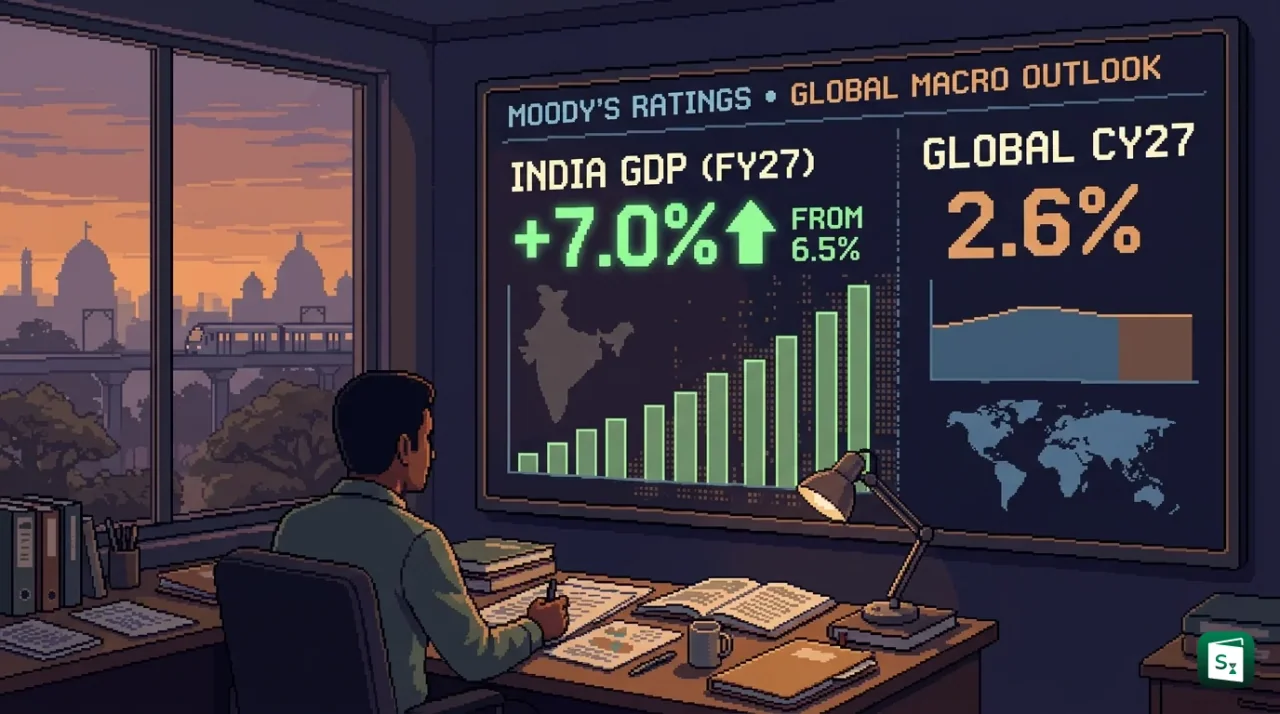
Moody’s Ratings raised its India GDP forecast for FY27 to 7 percent from 6.5 percent in its Global Macro Outlook 2027-28 released on 11 November 2026. FY27 refers to the financial year from April 2026 to March 2027, and the revision reflects strong consumption, improving investment and resilience to the energy price shock. In the same report, Moody’s projected global growth to slow to 2.6 percent in 2026 from 2.8 percent in 2025 and stay at 2.6 percent through 2027.
What Is GDP in Economics?
Gross Domestic Product (GDP) is the total value of all final goods and services produced within a country during a specific period. It is the most widely used measure to track the size and health of an economy, and its growth rate shows whether economic activity is expanding or slowing.
India calculates GDP through the National Statistics Office (NSO) under the Ministry of Statistics and Programme Implementation (MoSPI). The figures are released every quarter and every year at both constant prices and current prices. In February 2026, India moved to a new GDP series with base year 2022-23 for more accurate measurement.
| Term | What It Means |
|---|---|
| Real GDP | GDP measured at constant prices, after removing the effect of rising prices. It shows actual growth in output. |
| Nominal GDP | GDP measured at current prices, including the effect of inflation. It shows the money value of the economy. |
| GDP growth rate | Percentage change in real GDP from one year to the next. A 7 percent rate means output grew 7 percent after adjusting for prices. |
| GDP per capita | Nominal or real GDP divided by population. It gives a rough idea of average income per person. |
| GDP deflator | A price index that converts nominal GDP into real GDP. It reflects overall price changes in the economy. |
| GDP at PPP | GDP adjusted for purchasing power parity (PPP), which accounts for cost differences across countries. India is the third largest economy on this basis. |
What Is Moody’s Rating?
Moody’s Ratings is the credit ratings arm of Moody’s Corporation. The agency was founded in 1909 by John Moody and is headquartered in New York in the United States. Along with S and P Global Ratings and Fitch Ratings, Moody’s forms part of the Big Three global rating agencies.
Moody’s rates governments and companies on their ability to repay debt. Its long term scale runs from Aaa for the highest quality to C for the lowest quality. Ratings from Aaa to Baa3 are treated as investment grade, while ratings below that level are treated as speculative grade.
India’s sovereign rating with Moody’s stands at Baa3 with a stable outlook. Baa3 is the lowest level within investment grade. The Global Macro Outlook is Moody’s flagship report on the world economy. The 2027-28 edition was released on 11 November 2026 and sets out forecasts for growth, inflation, energy prices and borrowing costs for major economies.
What Moody’s Forecast for India in FY27
Moody’s revised its forecast for India’s real GDP growth in FY27 to 7 percent from 6.5 percent. FY27 covers April 2026 to March 2027. The agency also expects India to sustain growth close to 7 percent through 2027 and 2028.
The upgrade follows strong actual data. India’s real GDP grew 7.8 percent year on year in the first quarter of FY27, from April to June 2026. The Reserve Bank of India (RBI), India’s central bank headquartered in Mumbai, had projected 7 percent growth for that quarter. The RBI was established in 1935 under the RBI Act, 1934.
Official data for that quarter show the scale of activity. Real GDP stood at ₹81.36 lakh crore and nominal GDP at ₹88.27 lakh crore. Real Gross Value Added (GVA), which measures output before adding taxes and subtracting subsidies, grew 8.2 percent. Investment measured by Gross Fixed Capital Formation (GFCF) rose 11.9 percent, while private consumption rose 7.1 percent.
Why Moody’s Raised India Growth Estimate to 7 Percent
Moody’s pointed to broad based momentum across demand, industry and exports. The Indian economy showed strength in both manufacturing and services, based on expanding purchasing managers indices. Double digit year on year growth in Goods and Services Tax (GST) revenue, vehicle sales and merchandise exports also signalled steady demand.
Household consumption stayed resilient despite high energy prices, while supply diversification and policy buffers limited damage from the oil and gas shock. Early signs of a private investment revival also improved the medium term picture.
Energy resilience played a central role. India diversified its sources of crude oil and gas after the price shock linked to the conflict in West Asia. State backed oil marketing companies and tax cuts shielded consumers from the immediate impact. Moody’s also noted India’s large refining capacity, including the world’s largest single site refining complex at Jamnagar, which kept fuel supply stable and supported exports of refined petroleum products.
Signs of a New Private Investment Cycle
Moody’s said India may be near the start of a new private capital spending cycle after years of balance sheet repair by companies and banks. The evidence includes strong production and imports of capital goods, faster growth in industrial credit and rising capacity use by factories. Net foreign direct investment (FDI) inflows rose to $13.8 billion during April to August of FY27, up from $9.6 billion in the same period of the previous year.
The agency said a sustained investment boom that lifts manufacturing, jobs and productivity could push growth above its baseline forecast of 7 percent.
Global Growth Outlook for 2026 to 2028
Moody’s expects the world economy to keep expanding at a steady but uneven pace. Global real GDP growth is projected to ease from 2.8 percent in calendar year 2025 to 2.6 percent in 2026, and then hold at 2.6 percent through 2027 and 2028. Calendar year refers to January to December, while India’s FY27 follows April to March.
Advanced economies are expected to grow around 1.7 percent, while emerging markets are expected to slow from 4.5 percent in 2025 to 3.8 percent in 2026 before recovering toward 4 percent. The United States is expected to return to growth near 2 percent, China’s slowdown is expected to continue, and India at around 7 percent is expected to remain the fastest growing major economy among G20 members.
The report lists four forces shaping the path. Spending on artificial intelligence, digital infrastructure, defence and energy security will support activity, but growth in capital spending by large technology firms will slow. The conflict in West Asia keeps energy prices high, with oil assumed at $90 to $110 per barrel in early 2027 under a contested Strait of Hormuz scenario. Inflation is expected to stay volatile in 2027 before easing, so central banks may opt for limited rate rises and shift to cuts in the second half of 2027, while long term bond yields stay elevated.
How World Bank, IMF, RBI and Others Forecast India GDP
Moody’s upgrade matches a wider round of upgrades after strong June quarter data. Seven of eight major institutions now place India’s FY27 growth at 7 percent or more. The average forecast has moved from about 6.5 percent to about 7 percent.
| Institution | Earlier FY27 Forecast | Latest FY27 Forecast |
|---|---|---|
| World Bank | 6.6% | 7.1% |
| RBI | 6.7% | 7.1% |
| OECD | 6.3% | 7.1% |
| IMF | 6.4% | 7.0% |
| Asian Development Bank (ADB) | 6.6% | 7.0% |
| S and P Global Ratings | 6.6% | 7.0% |
| Moody’s Ratings | 6.5% | 7.0% |
| Fitch Ratings | 6.4% | 6.9% |
The World Bank, headquartered in Washington D.C. and founded in 1944, raised its estimate in October 2026 to 7.1 percent on strong exports and domestic demand. The International Monetary Fund (IMF), also headquartered in Washington D.C. and founded in 1944, raised its estimate to 7 percent in October 2026 and held its FY28 projection at 7 percent. The RBI raised its FY27 projection to 7.1 percent from 6.7 percent. The Organisation for Economic Cooperation and Development (OECD), headquartered in Paris and founded in 1961, made the sharpest revision from 6.3 percent to 7.1 percent.
Is India GDP Growing and Where Does India Rank in 2026
Yes, India GDP is growing in real terms at one of the fastest rates among large economies. After 7.8 percent growth in the June quarter of FY27, professional forecasters surveyed by the RBI in September 2026 placed median FY27 growth at 7.1 percent and FY28 growth at 7 percent.
The size and rank picture looks different because ranks use nominal GDP in dollars. The IMF’s April 2026 World Economic Outlook placed India’s nominal GDP at about $3.92 trillion in FY26 and about $4.15 trillion in 2026. That level made India the sixth largest economy in nominal terms, behind the United States, China, Germany, Japan and the United Kingdom. A weaker rupee against the dollar can lower the dollar value even when real growth is strong.
On purchasing power parity, which adjusts for local prices, India is the third largest economy after China and the United States, with GDP estimated near $18.9 trillion in 2026. India accounts for about 3.3 percent of world nominal GDP and about 8.5 percent on a PPP basis.
Risks That Could Limit Growth
Moody’s flagged clear near term risks even as it raised the forecast. Household consumption remains sensitive to broader price rises, with headline inflation close to the upper end of the RBI’s 2 to 6 percent target band. Retail inflation reached 5.54 percent in September 2026, and Moody’s expects average inflation at 4.5 percent in 2026, easing to 4.3 percent in 2027 and 4 percent in 2028.
Agriculture faces weather risks. A deficient southwest monsoon and strengthening El Nino conditions could lower farm output and rural demand. El Nino refers to warming of Pacific Ocean waters that often weakens Indian monsoon rainfall.
Policy rates form the third risk. The RBI raised rates for the first time in nearly four years in October 2026. Moody’s said further tightening could delay the recovery in private investment by raising borrowing costs for firms.
Key Takeaways
- Moody’s raised its India GDP forecast for FY27 to 7 percent from 6.5 percent in the Global Macro Outlook 2027-28 released on 11 November 2026.
- Moody’s projected global growth at 2.6 percent in 2026, down from 2.8 percent in 2025, and stable at 2.6 percent through 2027.
- India grew 7.8 percent in Q1 FY27, with real GDP at ₹81.36 lakh crore and investment growth at 11.9 percent.
- The World Bank, RBI and OECD now forecast 7.1 percent growth for FY27, while the IMF forecasts 7 percent.
- India’s sovereign rating with Moody’s remains Baa3 with stable outlook, the lowest investment grade level.