India marked the 138th birth anniversary of Sir CV Raman on 7 November 2026. Chandrasekhara Venkata Raman, born on 7 November 1888 in Tiruchirappalli in Tamil Nadu, discovered the Raman Effect in 1928 and won the 1930 Nobel Prize in Physics. He was the first Asian to win a science Nobel and later received the Bharat Ratna in 1954.
Who Was Sir CV Raman?
Sir CV Raman was born as Chandrasekhara Venkata Raman on 7 November 1888 in Tiruchirappalli, then called Trichinopoly, in Tamil Nadu. His father, R. Chandrasekhara Iyer, taught mathematics and physics, and his mother was Parvathi Ammal. The family later moved to Visakhapatnam in present day Andhra Pradesh, where Raman completed his schooling at St Aloysius Anglo-Indian High School at a young age.
Raman joined Presidency College, Madras in 1902. He stood first in the University of Madras Bachelor of Arts examination in 1904 and won the gold medal in physics. He completed his Master of Arts in 1907 with record marks. His first research paper on the diffraction of light appeared in 1906 while he was still a student.
A scientific career offered few openings at the time, so Raman joined the Indian Finance Service in 1907 as Assistant Accountant General. He served in Calcutta, Rangoon and Nagpur. After office hours, he worked in the laboratory of the Indian Association for the Cultivation of Science (IACS) in Calcutta. IACS, founded in 1876 by Mahendralal Sircar, was the first research institute in India devoted to basic sciences. Raman became its honorary secretary in 1919.
In 1917, Raman left finance to become the first Palit Professor of Physics at Calcutta University. After 15 years in Calcutta, he moved to Bengaluru in 1933 as the first Indian director of the Indian Institute of Science (IISc). He served as director from 1933 to 1938 and as professor of physics until 1948. He died in Bengaluru on 21 November 1970.
What Is the Raman Effect?
The Raman Effect is the change in colour, or wavelength, shown by a tiny part of light when it is scattered by molecules of a transparent substance. Most scattered light keeps its original colour. About one photon in a million exchanges energy with a molecule and returns with slightly more or slightly less energy. This shift reveals the vibrations inside the molecule.
When light strikes molecules, three things can happen. The terms below describe them in simple words.
| Type of Scattering | What Happens to Light | Result |
|---|---|---|
| Rayleigh scattering | Light bounces off without energy change | Scattered light keeps the same wavelength and colour. This is elastic scattering and the most common type. |
| Stokes Raman scattering | Molecule absorbs part of light energy to vibrate more | Scattered light loses energy and shifts to a longer wavelength. These lines are brighter and most used in study. |
| Anti-Stokes Raman scattering | Already vibrating molecule gives energy to light | Scattered light gains energy and shifts to a shorter wavelength. These lines are weaker because fewer molecules are in excited state at room temperature. |
The distance between the original colour and the new lines always stays fixed for a given substance. Scientists measure this gap as the Raman shift. The Raman shift is expressed in wavenumbers, written as per cm, and it is independent of the colour of the lamp or laser used.
What Is Raman Spectroscopy Used For?
Raman spectroscopy is a laboratory method built on the Raman Effect. A monochromatic source, today usually a laser, shines on a sample. A detector collects the scattered light and plots the Raman shifts as peaks. The set of peaks works like a chemical fingerprint because each type of bond vibrates at its own rate.
The method identifies materials without cutting or damaging them. It is used to study molecular structure, check purity of drugs, identify minerals and gems, detect explosives and narcotics, examine paintings and manuscripts, and monitor industrial processes. Raman instruments are now compact enough for use in field surveys, customs checks and hospital labs.
How the Raman Effect Was Discovered in 1928
The discovery grew from a seven year study of light scattering at IACS in Calcutta. In 1921, Raman was returning from Europe by ship and noticed the deep blue colour of the Mediterranean Sea. The accepted view blamed the reflection of blue sky light. Raman doubted this view and began careful tests on how water and other clear liquids scatter light.
At IACS, Raman worked with his young associate Kariamanickam Srinivasa Krishnan, known as K. S. Krishnan. The team first used filtered sunlight and then a mercury arc lamp with a small spectroscope. They purified liquids such as benzene again and again to rule out fluorescence from impurities.
On 28 February 1928, Raman and Krishnan saw two new faint lines in the scattered light that were absent in the incoming beam. The new lines moved with the incoming colour but kept the same gap from it. The team concluded that molecules had taken a fixed packet of energy from light or given such a packet to it. The papers announcing a new type of secondary radiation appeared in Nature in March, April and May 1928.
The result matched ideas from the new quantum theory of light. It showed that light travels as packets of energy, called photons, and that a photon can trade energy with a molecule. Soviet physicists Grigory Landsberg and Leonid Mandelstam found a similar change in crystals at the same time, but Raman and Krishnan published first. The global physics community named the change the Raman Effect.
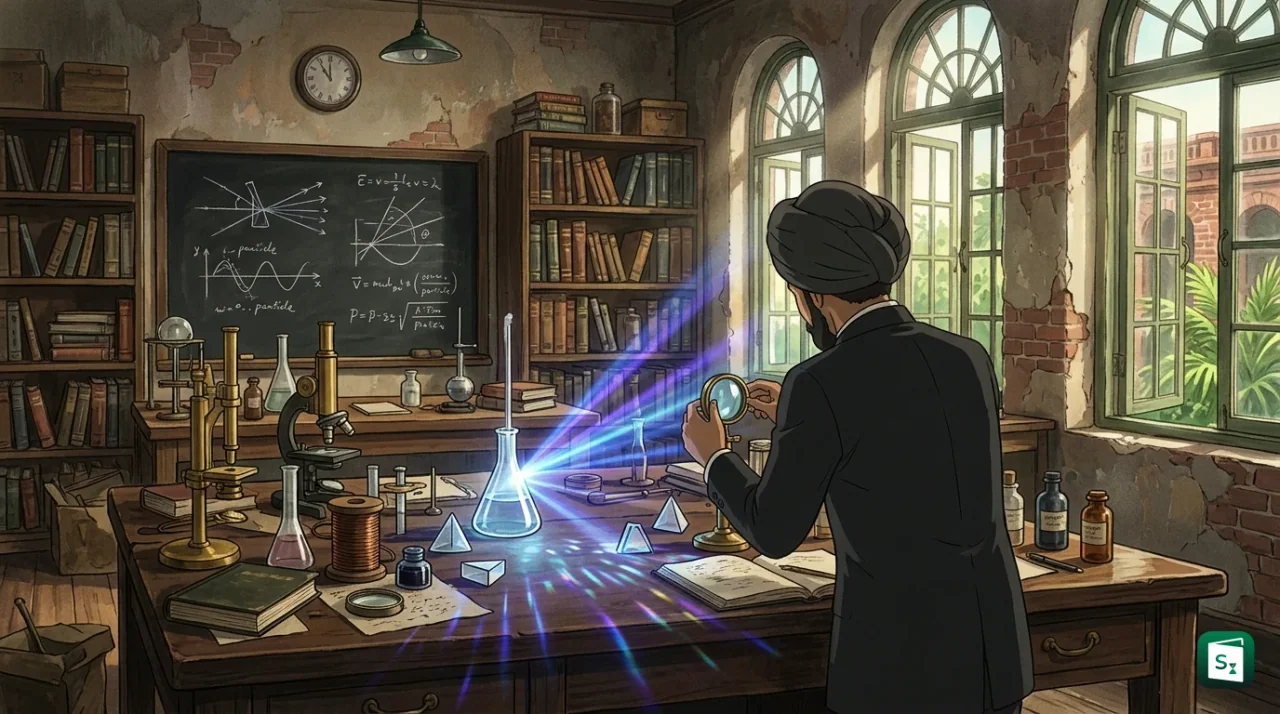
The setup was strikingly simple. It used a mercury lamp, a filter, a glass lens, a bottle of purified liquid and a pocket spectroscope. The low cost of the tools made the achievement widely admired.
When Did CV Raman Win the Nobel Prize and Bharat Ratna?
The Royal Swedish Academy of Sciences awarded Raman the Nobel Prize in Physics for 1930 for his work on the scattering of light and for the discovery of the effect named after him. Raman received the full prize alone. He was the first Asian and the first non white person to win a Nobel Prize in science. Rabindranath Tagore, also from India, had won the Nobel Prize in Literature in 1913.
Raman was elected a Fellow of the Royal Society in London in 1924. The British government knighted him in 1929. The Viceroy Lord Irwin conferred the knighthood in New Delhi in 1930. Raman used the title Sir after that honour.
Independent India honoured Raman with the Bharat Ratna in 1954. Bharat Ratna is the highest civilian award of India. In that first full list, Raman was named with C. Rajagopalachari and Sarvepalli Radhakrishnan. Raman also served as the first National Professor of India from 1948.
| Year | Honour | Awarding Body |
|---|---|---|
| 1924 | Fellow of the Royal Society | Royal Society, London |
| 1928 | Matteucci Medal | Academy of Sciences, Rome |
| 1929 | Knighthood | British government |
| 1930 | Nobel Prize in Physics | Royal Swedish Academy of Sciences |
| 1930 | Hughes Medal | Royal Society, London |
| 1941 | Franklin Medal | Franklin Institute, Philadelphia |
| 1954 | Bharat Ratna | President of India |
| 1957 | Lenin Peace Prize | Soviet Union |
Institutions Built by CV Raman
Raman founded the Indian Journal of Physics in 1926 and served as its editor. The journal gave Indian physicists a home for original papers, including the 1928 paper on new radiation.
In 1934, Raman founded the Indian Academy of Sciences in Bengaluru and served as its president from 1934 until his death in 1970. The Academy was registered on 27 April 1934 and formally inaugurated on 31 July 1934 with 65 founding fellows. It is now an autonomous body funded by the Department of Science and Technology (DST). The Academy publishes journals and the magazine Current Science.
In 1948, after retirement from IISc, Raman set up the Raman Research Institute (RRI) in Bengaluru on land gifted by the Mysore government. He funded the building with personal savings and private donations. He directed the institute and continued daily research until 1970. In 1972, RRI became an aided autonomous institute receiving funds from DST. Its present work covers astronomy and astrophysics, light and matter physics, soft condensed matter and theoretical physics.
Raman also inspired wider work in acoustics and optics. He studied the sound of Indian drums such as the tabla and mridangam, the optics of diamonds and gems, and the colours of natural materials such as opal and pearls. He published about 450 research papers and guided many students who later led Indian science.
Why November 7 Links to National Science Day on February 28
India honours Raman on two dates. 7 November marks his birth. The year 2026 marks 138 years since his birth in 1888, so the day is observed as his 138th birth anniversary. Schools, colleges and research institutes hold lectures, exhibitions and quiz programmes on this day to recall his life.
28 February marks his discovery. On that date in 1928, Raman announced the Raman Effect. The National Council for Science and Technology Communication (NCSTC) proposed the date for a national celebration. The central government accepted the proposal in 1986. The first National Science Day was observed on 28 February 1987.
National Science Day promotes scientific temper and spreads the message that science shapes daily life. The Department of Science and Technology announces a fresh theme each year. The theme for National Science Day 2026 was Women in Science Catalysing Viksit Bharat. Together, the November birth anniversary and the February science day keep Raman linked to both personal inspiration and public science.
Key Takeaways
- The 138th birth anniversary of Sir CV Raman was observed on 7 November 2026.
- Chandrasekhara Venkata Raman was born on 7 November 1888 in Tiruchirappalli in Tamil Nadu and died on 21 November 1970 in Bengaluru.
- Raman and K. S. Krishnan discovered the Raman Effect on 28 February 1928 at IACS in Calcutta.
- Raman won the Nobel Prize in Physics in 1930 and the Bharat Ratna in 1954, and was knighted in 1929.
- National Science Day is observed on 28 February every year since 1987 to mark the Raman Effect discovery, with the 2026 theme Women in Science Catalysing Viksit Bharat.