India has been re-elected President of the International Solar Alliance for the 2026 to 2028 term, while France has been re-elected Co-President. The decision was taken at the 9th ISA Assembly held in New Delhi alongside the Bharat Renewable Energy Summit in early November 2026. This third straight term for both countries places India and France at the centre of plans to move solar money and projects to Africa, Asia and small island nations.
What Is the International Solar Alliance?
The International Solar Alliance (ISA) is a treaty based intergovernmental organisation that brings countries together to expand solar power and cut dependence on fossil fuels. The ISA was launched jointly by India and France on 30 November 2015 at the 21st Conference of Parties (COP21) in Paris. Its Framework Agreement came into force on 6 December 2017, which made the ISA a full legal body under international law.
The ISA is headquartered at the National Institute of Solar Energy (NISE) campus in Gwal Pahari, Gurugram, Haryana. It is the first treaty based international organisation to be headquartered in India. Membership was first open to solar rich countries lying fully or partly between the Tropic of Cancer and the Tropic of Capricorn. After a 2020 amendment to the Framework Agreement, all United Nations member states can now join.
| ISA fact | Detail |
|---|---|
| Founded | 30 November 2015, Paris, by India and France |
| Headquarters | NISE campus, Gurugram, Haryana, India |
| Legal status | Treaty based intergovernmental organisation since 6 December 2017 |
| Membership | About 130 signatory and member countries, with more than 100 full members after ratification |
| Guiding plan | Towards 1000 strategy |
The Towards 1000 strategy sets four linked goals for 2030. The ISA aims to mobilise $1,000 billion in solar investment, deliver clean energy access to 1,000 million people, install 1,000 GW of solar capacity, and cut 1,000 million tonnes of carbon dioxide emissions every year. The work rests on three pillars. Analytics and advocacy supports solar friendly policies. Capacity building trains people and institutions. Programmatic support helps build actual projects in Least Developed Countries (LDCs) and Small Island Developing States (SIDS), which are island nations facing high fuel costs and climate risk.
India and France Re-elected at the 9th ISA Assembly
The 9th ISA Assembly, the top decision making body of the alliance, met in New Delhi from 2 to 5 November 2026 alongside the Bharat Renewable Energy Summit and Expo 2026. Prime Minister Narendra Modi inaugurated the summit on 2 November. Member countries re-elected India as President and France as Co-President for the 2026 to 2028 term.
This is the third consecutive term for both countries. India has held the presidency since the first Assembly in 2018. Union Minister for New and Renewable Energy Pralhad Joshi announced the result and thanked members for their trust. France was represented by its Minister for Ecological Transition, Biodiversity and International Negotiations on Climate and Nature. The Director General of ISA, Ashish Khanna, heads the ISA Secretariat and manages day to day work.
The Assembly reviewed progress and approved the work plan and budget. The message from New Delhi was direct. The ISA must now move from promises to projects, from small pilots to large programmes, and from ambition to delivery on the ground. Country Partnership Frameworks with countries such as Papua New Guinea, Sri Lanka and Rwanda were highlighted as a way to link policy, project lists, finance and training in one roadmap.
How the ISA Mobilises Solar Finance in Africa
The ISA says finance is where the gap between promise and delivery is widest. Africa holds huge solar potential but receives only a tiny share of global solar investment. Projects stall because ticket sizes are small and risks look high. The ISA answer is catalytic finance, where small public funds absorb early risk so private money can follow.
The central tool is the Global Solar Facility (GSF), a blended finance platform of about $200 million that offers payment guarantees, insurance and concessional capital. Its first regional arm is the Africa Solar Facility (ASF). The ISA selected Africa50, the pan African infrastructure investor, to manage the facility. The term sheet was signed in December 2024 in Rabat.
A second model is the Nigeria Distributed Renewable Energy (DRE) Fund. Distributed renewable energy means small, local systems such as mini grids and standalone solar units that work without the main grid. The Nigeria fund targets $300 million and is co managed by Africa50 and the Nigeria Sovereign Investment Authority (NSIA). Partners include the World Bank and Sustainable Energy for All. It reached commercial launch in September 2026 and will fund commercial and industrial solar, mini grids, standalone systems, clean cooking and electric mobility.
India has committed about ₹225 crore ($25 million) to support affordable solar access through the alliance. The push also includes local currency financing. Many projects earn in local currency but borrow in dollars, so exchange rate swings raise costs. Lending in local currency cuts that risk and draws in domestic banks and insurers.
What the 1 Million Solar Pumps and 500 MW Island Plan Involve
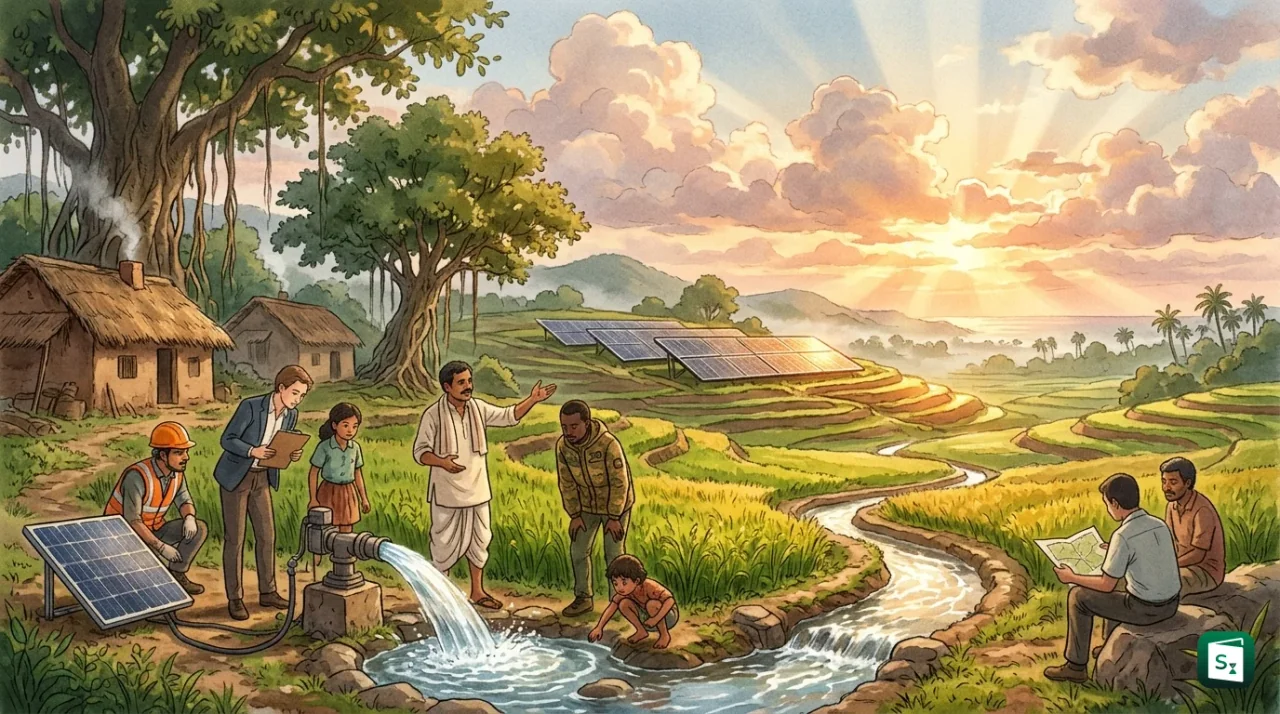
Solar powered farming is a major focus for the next term. The ISA plans to deploy 1 million solar pumps globally for irrigation and drinking water. The model draws on PM-KUSUM, which stands for Pradhan Mantri Kisan Urja Suraksha evam Utthaan Mahabhiyan.
PM-KUSUM was approved in March 2019 and is run by the Ministry of New and Renewable Energy (MNRE). It aims to add 34,800 MW of solar capacity through three parts. Component A sets up small grid connected solar plants on barren or fallow farm land. Component B installs standalone solar pumps in off grid areas. Component C solarises existing grid connected farm pumps so farmers can irrigate in the day and sell surplus power to distribution companies. Central assistance is generally 30 percent of cost, rising to 50 percent in hill, northeastern and island areas, with states and farmers sharing the balance.
The second focus is the SIDS Platform, built with the World Bank to serve island nations. These countries often depend on imported diesel for 80 to 85 percent of power. Power can cost 25 to 30 US cents per unit, and fuel imports can eat up a large share of national income. Solar plus storage can cut that cost sharply.
The platform aggregates demand across many small markets so large developers bid. It uses an E-Marketplace, which is a live digital list where island governments post ready projects for global developers and banks. Mauritius leads with a 220 MW solar plus storage tender covering ten 10 MW projects and three 40 MW projects. The ISA says the portfolio is worth almost half a billion dollars and has already drawn private interest.
The wider target is up to 500 MW of solar capacity in SIDS by 2030. Nineteen member countries are part of the platform. Early projects support health clinics, schools, clean drinking water and farm cold storage in Fiji, Madagascar, Comoros, Seychelles and Mauritius. Fiji has stressed fuel dependence and climate risk, while Mauritius offers a shared procurement model that Pacific and Caribbean islands can copy.
How STAR-Cs, SHINE and the ISA Academy Build Solar Skills
Money alone does not build projects. Countries need trained people, testing labs and clear standards. The ISA runs 17 Solar Technology Application Resource Centres (STAR-Cs) to fill that gap. A STAR Centre is a national or regional hub for solar training, testing and business support.
Each centre works on four tasks. It trains officials, engineers and technicians. It tests solar parts against national and global standards. It manages knowledge through data, guidelines and tools. It incubates start ups that link solar power to local income, from repair shops to farm services. The project is run with the United Nations Industrial Development Organization (UNIDO) with funding from France, with early focus on West Africa, East Africa and the Pacific islands. Stronger quality control lowers failure risk and makes banks more willing to lend.
The next layer is SHINE, which stands for Strategic Hub for Innovation Network and Execution. SHINE works as the Global Capability Centre for solar under the ISA Academy. It connects digital learning with hands on training. It also supports grid digitisation, which helps utilities map and manage solar in the network, and project bankability work, which prepares projects for investor review.
The AI enabled ISA Academy is the online learning platform. It offers courses for technicians, engineers, policymakers, entrepreneurs and students. Artificial intelligence helps personalise lessons, track skills and share global best practice in local languages. The ISA 2027 to 2031 strategy, discussed at the 9th Assembly, ties these three tools together to create a skilled workforce with stronger roles for women.
Key Takeaways
- India was re-elected President of the ISA and France was re-elected Co-President for the 2026 to 2028 term at the 9th ISA Assembly in New Delhi.
- The International Solar Alliance was launched on 30 November 2015 by India and France at COP21 in Paris and is headquartered in Gurugram, Haryana.
- The Africa Solar Facility targets $200 million and the Nigeria DRE Fund targets $300 million to expand distributed solar in Africa.
- The ISA plans 1 million solar pumps based on PM-KUSUM and up to 500 MW of solar capacity in Small Island Developing States by 2030.
- Solar skills are supported through 17 STAR-Cs, the SHINE Global Capability Centre and the AI enabled ISA Academy.