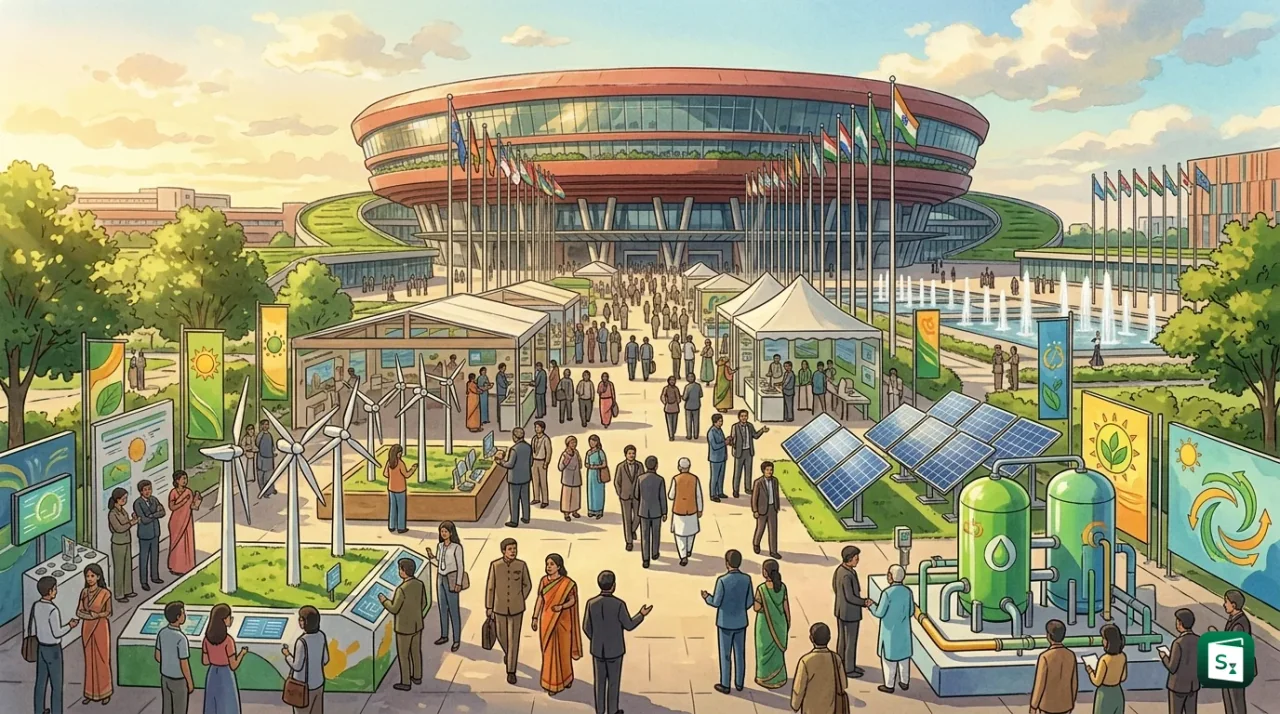
Prime Minister Narendra Modi inaugurated the Bharat Renewable Energy Summit and Expo 2026 on 2 November 2026 at Bharat Mandapam in New Delhi. The four day event was held together with the 9th International Solar Alliance Assembly and the 4th International Conference on Green Hydrogen. India used the platform to report 50 percent non fossil power capacity in 2025, set a plan to add another 500 GW in 10 to 11 years, and announce nearly $400 billion in investment commitments.
What Is the Bharat Renewable Energy Summit and Expo 2026?
The Bharat Renewable Energy Summit and Expo 2026 is India’s flagship global platform for renewable energy. The Ministry of New and Renewable Energy organised the inaugural edition from 2 to 5 November 2026 at Bharat Mandapam in New Delhi. Its theme was Invest. Innovate. Inspire.
The summit builds on the earlier RE-INVEST platform. RE-INVEST has served as the central investment meet for clean energy since 2015. The new summit keeps that investment focus but adds policy dialogue, technology, manufacturing, innovation and international cooperation.
For the first time, three large clean energy events were held on one campus:
| Event | What It Covered |
|---|---|
| Bharat Renewable Energy Summit and Expo | Policy, investment, manufacturing and technology for solar, wind, storage and grids |
| 9th International Solar Alliance Assembly | Annual meeting of solar alliance member countries |
| 4th International Conference on Green Hydrogen | Production, use and market building for green hydrogen |
The scale made it one of the largest clean energy gatherings hosted in India. The government reported participation from about 135 countries, more than 75,000 visitors, over 400 exhibitors and more than 620 speakers across 113 sessions. The gathering included 32 international ministers, 6 chief ministers and 10 state energy ministers.
Nine partners joined as country partners. They included Australia, Denmark, France, Germany, the Netherlands, Norway, Sweden, the United Kingdom and the European Union. Thirteen states and union territories joined as partner states, including Andhra Pradesh, Assam, Bihar, Chhattisgarh, Delhi, Gujarat, Karnataka, Madhya Pradesh, Maharashtra, Odisha, Rajasthan, Uttar Pradesh and West Bengal. The states presented project pipelines, land banks, policies and manufacturing offers.
The expo displayed solar modules, wind parts, batteries, green hydrogen equipment, startups and research models. Side attractions included the Bharat Renewable Energy Hackathon 2026, the national renewable energy quiz finale and the REGen Pavilion for students and young innovators. Business meetings connected investors, makers and governments through business to business, business to government and government to government formats.
Why Renewable Energy Is Important for India
Renewable energy is power made from sources that nature replaces on its own, such as sun, wind, water, plants and earth heat. Renewable energy is important for India because it cuts costly fuel imports, strengthens energy security and supports clean growth while electricity demand keeps rising.
India is one of the fastest growing large economies in the world. Power use is rising fast from homes, farms, factories and new data centres. In the past, much of this demand was met by imported coal, oil and gas. Price shocks during the pandemic and the West Asia crisis showed how risky that dependence can be.
Clean power has reduced that risk. The International Energy Agency found that renewable electricity saved India more than $100 billion in coal and gas import costs between 2011 and 2025. Without the solar, wind and bioenergy added since 2010, coal imports in 2025 would have been about 110 million tonnes higher. Domestic biofuels also cut crude oil import dependence by about 4 percentage points in 2025.
Cost adds to the case. Competitive bidding has made India one of the cheapest places in the world to build solar power. Utility scale solar now costs about $30 to $35 per MWh, among the lowest rates in the world. Hybrid tenders that combine solar with wind or storage averaged about $45 per MWh between 2023 and 2025, about 20 percent below coal power costs in the same period.
Manufacturing and jobs add further weight. India is now the second largest maker of solar photovoltaic modules in the world, with module capacity above 225 GW. A ₹24,000 crore Production Linked Incentive scheme supports local solar and wind manufacturing. The clean energy push also supports farm income through solar pumps, rooftop systems for homes, and new work in installation, maintenance and storage.
What Did India Announce on 500 GW and Non Fossil Capacity?
The Ministry of New and Renewable Energy confirmed that India reached 50 percent non fossil installed power capacity in June 2025, five years before its 2030 climate pledge under the Paris Agreement. Non fossil capacity means power plants that do not burn coal, oil or gas. It includes solar, wind, large hydro, small hydro, bioenergy and nuclear power.
By March 2026, India had about 283.46 GW of non fossil capacity. This included 274.68 GW of renewable energy and 8.78 GW of nuclear power. Solar capacity stood at 150.26 GW and wind at 56.09 GW. By late 2026, total renewable power capacity crossed 300 GW, after almost quadrupling in ten years. India ranks third in the world for solar and renewable installed capacity and fourth for wind capacity.
At the summit, Prime Minister Narendra Modi said India had already achieved nearly 300 GW of the 2030 goal of 500 GW of non fossil capacity. He then set the next goal. India will add another 500 GW of non fossil capacity over the next 10 to 11 years.
The target sits inside two larger pledges. At the COP26 climate summit, India promised 500 GW of non fossil capacity by 2030 and net zero greenhouse gas emissions by 2070. Net zero means the country will balance the gases it releases with the gases it removes. India also aims to meet 50 percent of electricity needs from renewable sources by 2030. The International Energy Agency now expects India to reach about 530 GW of renewable capacity by 2030, with solar providing more than 80 percent of the new addition.
The 50 percent milestone describes capacity, not daily generation. Solar and wind depend on sun and wind, so their share in actual electricity supply is lower. In 2025 to 2026, non fossil sources supplied about 29.2 percent of total electricity generated, while meeting about one third of demand during the first seven months of 2026.
What Is the International Solar Alliance?
The International Solar Alliance is a treaty based group of countries that works to expand solar power around the world. The alliance brings together sunshine rich nations and other partners to cut technology costs, improve finance and share skills so that solar energy reaches homes, farms, schools and clinics.
India and France launched the alliance on 30 November 2015 in Paris during the COP21 climate summit. The framework agreement opened for signature in Marrakesh in November 2016. The alliance became a full intergovernmental organisation in December 2017. It was first meant for countries between the Tropic of Cancer and the Tropic of Capricorn, but membership was later opened to all United Nations member states. The alliance now has more than 120 signatory countries, with over 100 full members.
The International Solar Alliance Secretariat is located at Surya Bhawan on the campus of the National Institute of Solar Energy at Gwal Pahari in Gurugram, Haryana. It is the first treaty based international organisation headquartered in India. The Director General is Ashish Khanna. India holds the presidency and France holds the co presidency. The alliance guides its work through the Towards 1000 strategy, which aims to raise $1,000 billion in solar investment, install 1,000 GW of solar capacity and give clean energy access to 1,000 million people by 2030.
Its flagship grid idea is One Sun One World One Grid. The plan, first proposed by India in 2018 and launched jointly with the United Kingdom at COP26 in 2021, seeks to link regional grids across continents. The logic is simple. The sun is always shining somewhere in the world, so connected grids can move daytime solar power across time zones.
How the 9th ISA Assembly Was Organised in New Delhi
The 9th session of the International Solar Alliance Assembly met from 2 to 5 November 2026 at Bharat Mandapam. The Assembly is the top decision making body of the alliance. Ministers and officials review progress, approve the work plan and budget, and set priorities for finance, skills and deployment.
At this session, members elected India as president for a third straight term and re elected France as co president for 2026 to 2028. France announced a voluntary contribution of 50,000 euros for 2026 and support for training and finance tools such as the STAR Centres programme and the Africa Solar Facility.
Key outcomes included a $200 million Africa Solar Facility to back small solar systems in Africa and a $300 million Nigeria Distributed Renewable Energy Fund built with the World Bank and other partners. India committed about ₹225 crore (about $25 million) to support affordable solar in poor communities. Members also discussed a Small Island Developing States platform covering 19 countries with about 220 MW of solar and storage projects, 17 Solar Technology Application Resource Centres, and a new Global Capability Centre for digital tools and artificial intelligence training.
How Is Green Hydrogen Produced and Why Does India Need It?
Green hydrogen is hydrogen gas made by splitting water with electricity from renewable sources such as solar and wind. The process is called electrolysis. An electrolyser passes clean power through water to separate hydrogen and oxygen. When the power comes from clean sources, the hydrogen is called green because it releases almost no carbon during production.
Green hydrogen matters because it can carry clean energy into uses that direct electric power cannot easily reach. These include fertilisers, refining, steel, long distance transport, shipping and storage of extra solar power. Grey hydrogen made from gas and blue hydrogen made from gas with carbon capture release more carbon. Green ammonia and green methanol, which are made from green hydrogen, can serve as clean fuels for ships and industry.
India runs this push through the National Green Hydrogen Mission. The Union Cabinet approved the mission on 4 January 2023 with an initial outlay of ₹19,744 crore. The mission aims to build capacity to make at least 5 million metric tonnes of green hydrogen per year by 2030, with scope to reach 10 million tonnes if exports grow. It also targets about 125 GW of extra renewable capacity, more than ₹8 lakh crore in total investment, over 6 lakh jobs, savings of more than ₹1 lakh crore in fossil fuel imports, and cuts of about 50 million tonnes of carbon emissions per year.
The mission works through the Strategic Interventions for Green Hydrogen Transition programme, known as SIGHT, with ₹17,490 crore for electrolyser making and hydrogen production, along with funds for pilot projects, research, hubs, standards and skills.
The 4th International Conference on Green Hydrogen advanced this mission at the summit from 2 to 5 November. Started in 2023, the conference links government, industry, researchers and global buyers. The 2026 edition focused on practical steps to move from test projects to regular sales. Sessions covered hydrogen for fertilisers and steel, fuel cells, mobility, electrolyser making, safety, storage and quality rules. The talks also covered offtake deals, which are long term purchase pacts that give makers the confidence to build large plants.
Who Organised the Summit: MNRE, IREDA and SECI?
The Ministry of New and Renewable Energy was the nodal organiser of the summit in partnership with the International Solar Alliance. The ministry is the central government body for all matters linked to new and renewable energy. It was first created as the Department of Non Conventional Energy Sources in 1982, became a full ministry in 1992 and received its present name in October 2006. The Union Minister for New and Renewable Energy is Pralhad Joshi and the Secretary is Santosh Kumar Sarangi.
Two public sector bodies served as organising partners:
| Body | Full Form and Role |
|---|---|
| Indian Renewable Energy Development Agency (IREDA) | A Navratna finance company under the ministry, set up in 1987. It lends to solar, wind, hydro, bioenergy and efficiency projects. It is registered with the Reserve Bank of India as a non banking finance company and calls itself the largest green financier in the country. |
| Solar Energy Corporation of India (SECI) | A Navratna public sector unit under the ministry, set up in 2011 and headquartered in New Delhi. It runs bidding and project development for solar, wind, hybrid, round the clock supply and green hydrogen, and acts as a trader between makers and power distribution companies. |
The ministry also works with research bodies such as the National Institute of Solar Energy in Gurugram and the National Institute of Wind Energy in Chennai. Together, these bodies shape policy, build test standards, run tenders and channel funds to projects.
What Were the $400 Billion Commitments, 10 MoUs and IEA Market Report?
The Ministry of New and Renewable Energy said investors pledged nearly $400 billion for clean energy at a chief executive roundtable held during the summit. The figure is preliminary and company wise details were still being compiled. The pledges covered power generation, green hydrogen, battery storage, power lines and factories.
The amount is almost double the estimated need of about $220 billion by 2030 to reach 500 GW of non fossil capacity. The ministry said that even if only part of the pledges turn into real projects, India would still be close to meeting the need. Officials cited strong interest from domestic groups and global funds, including the Canada Pension Plan Investment Board.
Concrete deals were led by states. Odisha signed 18 investment pacts worth ₹1,17,557 crore for about 11,742 MW of tentative capacity across pumped storage, solar, wind, batteries, green hydrogen and data centres. Goa signed projects worth about ₹3,000 crore with Bondada Engineering.
At the national level, the summit recorded 10 memorandums of understanding and framework agreements. One SECI linked pact could supply up to 3 lakh tonnes per year of green methanol. The summit also released 37 reports and guidebooks.
The most watched release was the India RE Market Report 2026: Analysis and Forecast to 2030 by the International Energy Agency (IEA). The IEA is an energy policy body headquartered in Paris that advises countries on secure and clean energy. The report was launched at the summit and made four points:
| IEA Finding | Detail |
|---|---|
| Capacity growth | Renewable capacity crossed 300 GW in 2026 and is set to reach about 530 GW by 2030 |
| Energy security | Clean power will more than double import savings after 2025 and supply 35 percent of electricity by 2030 |
| Manufacturing | India is the second fastest growing renewables market and the second largest solar module maker |
| Next steps | Faster grids, storage, simpler approvals and stronger utility finances could raise deployment by more than 20 percent |
The Cabinet backed these goals around the summit with two storage and supply steps. It approved a ₹14,500 crore viability gap funding scheme for 92 GWh of grid storage from 2026 to 2031, split into 60 GWh of pumped storage, 30 GWh of batteries and 2 GWh of new technologies. It also cleared a ₹2,814 crore scheme for processing lithium and nickel, two minerals needed for batteries.
Key Takeaways
- The Bharat Renewable Energy Summit and Expo 2026 was held from 2 to 5 November 2026 at Bharat Mandapam in New Delhi under the theme Invest. Innovate. Inspire.
- India reached 50 percent non fossil installed power capacity in June 2025, five years before the 2030 Paris Agreement target, and plans to add another 500 GW in 10 to 11 years.
- The 9th International Solar Alliance Assembly elected India as president for a third term and France as co president for 2026 to 2028.
- The National Green Hydrogen Mission, approved in January 2023 with ₹19,744 crore, targets 5 million metric tonnes of green hydrogen per year by 2030.
- The summit reported nearly $400 billion in preliminary investment commitments, the signing of 10 MoUs, and the launch of the IEA India RE Market Report 2026.