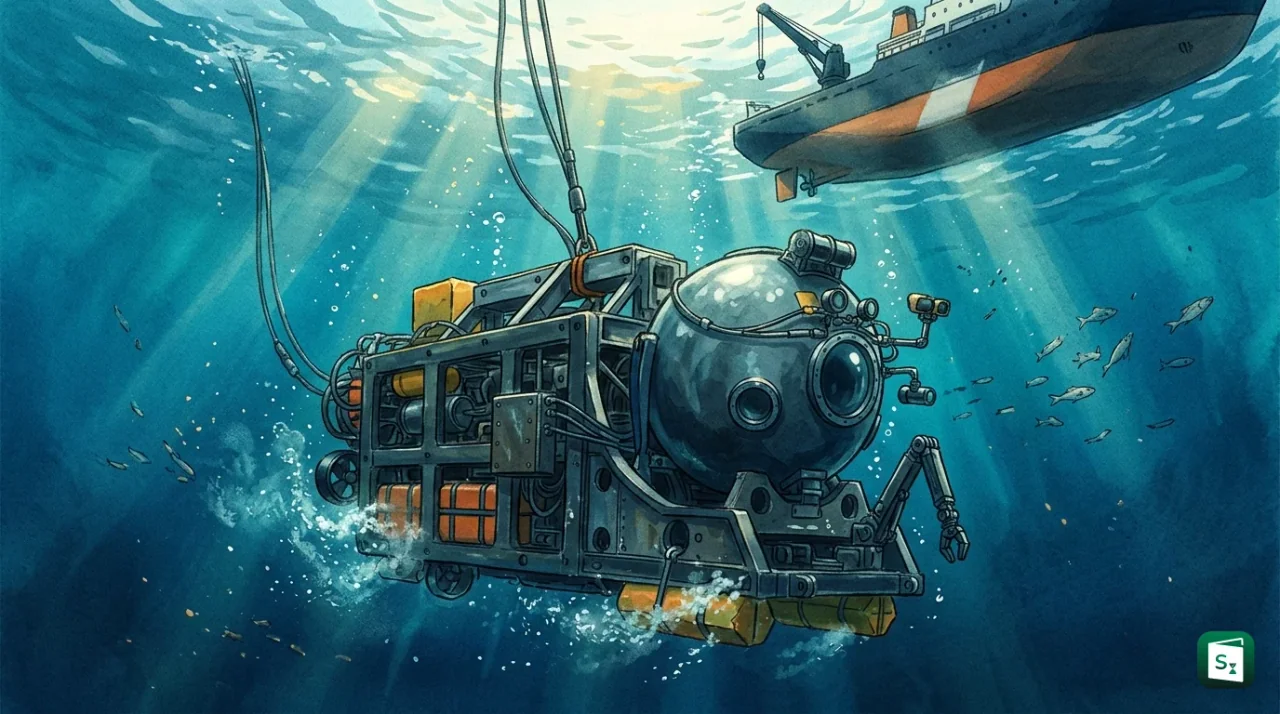
India completed the unmanned trials of MATSYA 6000, its manned deep ocean submersible, on 6 November 2026 at the L&T Shipyard in Kattupalli, Tamil Nadu. The trial validated the flotation, submerged stability and ballast systems of the vehicle developed by the National Institute of Ocean Technology (NIOT) in Chennai. The success clears MATSYA 6000 for the next phase of testing under the Samudrayaan Project of the Deep Ocean Mission.
What Is MATSYA 6000?
MATSYA 6000 is India’s manned deep ocean submersible designed to carry three people to a depth of 6000 metres. The National Institute of Ocean Technology (NIOT), Chennai developed the vehicle under the Ministry of Earth Sciences. The name Matsya refers to the fish incarnation in Indian tradition.
The submersible is built to operate normally for 12 hours and to support life for up to 96 hours in an emergency. It keeps the crew at normal surface pressure of one atmosphere inside a spherical cabin, while the outside pressure at 6000 metres is about 600 bar, or nearly 600 times the pressure at sea level. At that depth, temperature is close to freezing, no sunlight reaches, and the vehicle must float on its own unless it takes water into its ballast tanks to dive.
The people who will travel in such a vehicle are called aquanauts. They are personnel trained to work underwater and to pilot the submersible, handle scientific tools and manage life support during the dive.
What Happened at Kattupalli During the Unmanned Trials?
The National Institute of Ocean Technology conducted the latest unmanned trials at the L&T Shipyard in Kattupalli, Tamil Nadu on 6 November 2026. Ministry of Earth Sciences Secretary Srinivasa Kumar Tummala and NIOT Director G A Ramadass reviewed the exercise on site.
The team tested the flotation of the vehicle, its stability when fully submerged and the working of its ballast systems. Ballast systems are tanks that take in or release water to control sinking and rising. The trial also checked subcomponents such as power distribution, control hardware and software, thrusters for movement, navigation aids and communication links. The vehicle completed the checks as per the prescribed test protocol.
This trial builds on earlier wet tests. MATSYA 6000 was moved to Kattupalli in early 2025 for harbour trials in shallow water. Those tests studied power and control networks, floating balance, human safety systems, forward and reverse movement, underwater voice links and ocean sensors. The shallow water checks showed that voice communication needs deeper water for full confidence, so further sea trials were planned. The successful November 2026 trial now allows the programme to move to the next stage of advanced testing.
How MATSYA 6000 Is Built to Survive 6000 Metre Depth
The heart of MATSYA 6000 is its personnel sphere, the round cabin that holds the crew. The Vikram Sarabhai Space Centre (VSSC) of the Indian Space Research Organisation (ISRO) designed the sphere and developed the material and welding process under an agreement with NIOT. The sphere is about 2.26 metres in outer diameter with an inner space of 2.1 metres. Its wall is 80 mm thick and is made of titanium alloy Ti6Al4V ELI grade, a metal that is strong, light and resists corrosion in sea water.
The sphere is built to bear external pressure of 600 bar at 6000 metres and is tested to 720 bar, which is 1.2 times the expected load. Joining such thick titanium needed a special high penetration Electron Beam Welding process over a weld length of about 7100 mm, completed for the first time in the country. High energy X-ray imaging is used to check the welds. Certification is done through DNV, an internationally accredited classification society headquartered in Norway, since India has no domestic certifier for such a system.
Other core systems keep the vehicle safe and mobile:
- Buoyancy and diving: main ballast tanks for diving, syntactic foam blocks for extra floatation, and three separate weight drop systems that release weights to rise quickly in an emergency.
- Movement and power: multi directional thrusters, a high density lithium polymer battery bank and a full power distribution and control network.
- Navigation and communication: inertial navigation linked with global positioning, Doppler velocity log to measure speed, depth sensors, underwater acoustic positioning, an underwater acoustic telephone tested for deep use, an acoustic modem for data and very high frequency radio for surface contact. Voice updates between the pilot and the ship based mission control are planned about every 30 minutes.
- Life support and safety: a DNV compliant Human Support and Safety System that keeps oxygen near 20 percent, carbon dioxide below 1000 parts per million by volume and controls humidity and temperature. The vehicle also carries emergency power, control and communication units, crew health monitoring vests and external lights and cameras.
| Feature | Detail |
|---|---|
| Type | Manned deep ocean scientific submersible |
| Carrying capacity | 3 people |
| Rated depth | 6000 metres |
| Cabin | Titanium alloy sphere, 2.1 metre inner diameter, 80 mm wall |
| Pressure rating | 600 bar working, 720 bar tested |
| Normal operation | 12 hours |
| Emergency support | 96 hours |
| Developers | NIOT Chennai with ISRO for the personnel sphere, industry partners and DRDO for navigation and communication |
The 500 metre trial version uses a steel sphere for shallow tests. The titanium sphere is meant for the final 6000 metre mission.
What Is the Samudrayaan Project?
The Samudrayaan Project is India’s first mission to send people to the deep ocean. It is a project under the Deep Ocean Mission and is implemented by NIOT. The project aims to send three aquanauts to 6000 metre depth in MATSYA 6000 to study marine life, geology and mineral resources.
The project took shape after NIOT proposed a three person 6000 metre mission in 2019. An uncrewed trial of the personnel sphere was held off Chennai on 27 October 2021, and the project was formally launched on 29 October 2021. The government has set 2028 as the target for the first human dive to 6000 metres.
Testing is planned in stages. The next major step is a 500 metre trial dive in the Bay of Bengal in January to February 2027. Two NIOT aquanauts, Raju Ramesh and Jatinder Pal Singh, are under training as pilots, and a scientist may join as the third crew member for that dive. In this phase the vehicle will use a steel cabin. The titanium cabin built with ISRO will be integrated later for deep dives.
India is also gaining operational experience through cooperation with France. NIOT signed an agreement with the French Research Institute for Exploitation of the Sea (IFREMER) for knowledge exchange. In August 2025, the two NIOT aquanauts completed dives to 5000 metres in the Atlantic Ocean on board the French submersible Nautile, practising piloting, buoyancy control, sample collection with robotic arms, acoustic communication and dive planning.
What Is the Deep Ocean Mission?
The Deep Ocean Mission is a mission mode programme to explore deep sea resources and develop deep sea technologies for sustainable use of ocean wealth. The Ministry of Earth Sciences is the nodal ministry for this multi institutional mission. It was approved by the Cabinet Committee on Economic Affairs and launched on 7 September 2021.
The mission has an approved cost of ₹4077 crore for five years, with ₹2823.4 crore set for the first phase from 2021 to 2024. It supports the Blue Economy vision, which covers fisheries, shipping, tourism, renewable energy, seabed minerals and marine biotechnology. The mission is also listed as one of the nine national missions under the Prime Minister Science Technology and Innovation Advisory Council.
| Vertical | Focus |
|---|---|
| Technologies for deep sea mining, manned submersible and underwater robotics | MATSYA 6000 for 6000 metres and an integrated mining system for polymetallic nodules from about 5500 metres depth |
| Ocean climate change advisory services | Sea level, cyclone, storm surge and wave forecasts, deep ocean observing systems |
| Biodiversity exploration and conservation | Study of deep sea flora, fauna and microbes, DNA bank and search for useful biomolecules |
| Deep ocean survey and exploration | Search for multi metal hydrothermal sulphides along Indian Ocean ridges and building a new research vessel |
| Energy and fresh water from the ocean | Offshore Ocean Thermal Energy Conversion (OTEC) desalination plant design and trials |
| Advanced Marine Station for Ocean Biology | Translating ocean biology research into industry use through incubators and training |
NIOT was established in November 1993 as an autonomous body under the Ministry of Earth Sciences and is based in Chennai. For seabed minerals, India holds a contract with the International Seabed Authority, a United Nations body, for exploration of polymetallic nodules in 75000 square km in the Central Indian Ocean Basin and polymetallic sulphides in 10000 square km along the Central and South West Indian ridges.
Why Deep Sea Exploration Matters for India
The ocean floor at 5000 to 6000 metres holds polymetallic nodules, potato shaped deposits rich in manganese, nickel, cobalt and copper. These metals are needed for batteries, electronics, steel and clean energy equipment. India has surveyed the Central Indian Ocean Basin for these nodules and tested parts of an integrated seabed mining system at 5270 metres in 2021. Secure access to such minerals can reduce import dependence for critical raw materials.
A second target is polymetallic sulphides near hot vents along mid ocean ridges. These deposits form when hot mineral rich fluids meet cold sea water and they contain copper, zinc and other metals. They also host unusual life forms that live without sunlight through chemosynthesis, a process where microbes use chemical energy instead of sunlight for food. Study of these systems helps in biotechnology, understanding of ocean geology and search for new molecules.
Strategic capability is also at stake. Only a few countries such as the United States, China, Russia, France and Japan operate human occupied vehicles that can reach such depths. China has tested vehicles beyond 10000 metres and France operates Nautile for 6000 metres. If MATSYA 6000 succeeds, India will join this small group. Direct human observation adds value over remote mapping, because crew can select samples, test tools and respond to unexpected findings on the seabed.
Key Takeaways
- MATSYA 6000 completed its unmanned trials on 6 November 2026 at the L&T Shipyard in Kattupalli, Tamil Nadu.
- MATSYA 6000 is designed to carry three people to 6000 metre depth with 12 hour operation and 96 hour emergency support.
- The titanium personnel sphere of 2.1 metre inner diameter was developed with ISRO to withstand 600 bar pressure.
- The Samudrayaan Project targets the first human dive to 6000 metres by 2028, with a 500 metre Bay of Bengal trial in early 2027.
- The Deep Ocean Mission of the Ministry of Earth Sciences was launched in 2021 with an outlay of ₹4077 crore to support the Blue Economy.