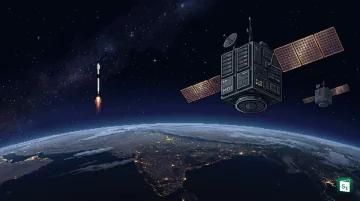
Skyroot Aerospace Pvt Ltd has signed a contract with the US-based Reflect Orbital for two dedicated satellite launches. The launches will use the Vikram family of rockets to support the development of on-demand sunlight at night.
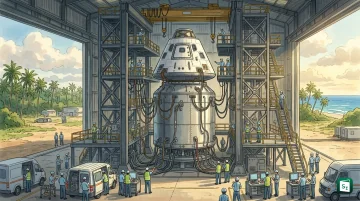
ISRO has successfully completed a series of Crew Module (CM) and Service Module (SM) separation tests at the Vikram Sarabhai Space Centre (VSSC) in Thiruvananthapuram.
The tests validated the design adequacy of the separation systems ahead of the first uncrewed mission “Gaganyaan-1 (G1)” which is scheduled to carry the Vyommitra half-humanoid.
The Ministry of Defence has signed contracts worth ₹4,106 crore to procure a dedicated communication satellite (GSAT-7C) for the Indian Air Force (IAF) and Varunastra Heavy Weight Torpedoes for the Indian Navy.
The ₹2,563 crore contract for the GSAT-7C satellite was signed with New Space India Ltd, while the ₹1,543 crore contract for the Varunastra torpedoes was inked with Bharat Dynamics Ltd (BDL).
Union Minister of State Sanjay Seth has inaugurated the 12th National Maritime Search & Rescue Exercise (SAREX-2026) organised by the Indian Coast Guard (ICG) off the Paradip coast in Odisha.
The exercise witnessed the participation of 32 observers from 30 countries to bolster international cooperation and operational synergy in maritime safety.
Hyderabad-based TakeMe2Space is set to launch the first networked orbital data centre mission of India in late 2028. The mission will be launched aboard the Falcon 9 rocket of SpaceX.
It is to be noted that the organization has signed a launch service agreement with RIDE! Space, a France-based space technology firm specializing in launch mission management. The company plans to establish a constellation of 6 satellites over the following years to facilitate its orbital data operations.
The Technology Development Board (TDB) has signed an agreement with the Chennai-based Agnikul Cosmos Pvt Ltd to facilitate the development of the ‘Agnibaan’ Reusable Launch Vehicle (RLV).
The project involves a financial commitment of ₹200 crore, which will be provided through Optionally Convertible Debentures (OCD) under the Research Development and Innovation (RDI) Fund.
Assam CM Himanta Biswa Sarma has laid the foundation stone for the Indian Space Research Organisation (ISRO) Telemetry, Tracking and Command Network (ISTRAC) Advanced Radar Research Facility (IARRF) at Chandrapur in Kamrup Metropolitan district, Assam.
The facility is being developed under the Network for Space Object Tracking and Analysis (NETRA) programme. The initial system at the site will be a cloud-research radar, which is scheduled to be commissioned and become operational by February 2027.
The Department of Consumer Affairs (DoCA), under the Ministry of Consumer Affairs, Food and Public Distribution (MoCAF&PD), has notified the “Legal Metrology (Indian Standard Time) Rules, 2026”.
The rules mandate Indian Standard Time (IST) as the sole and compulsory time reference for all legal, administrative, commercial, and official purposes in India. The regulations will come into effect 180 days after their publication in the Official Gazette.
The ISRO has successfully launched the “EOS-05” Earth Observation Satellite (EOS) onboard the Geosynchronous Satellite Launch Vehicle (GSLV)-F17 from the Second Launch Pad of the Satish Dhawan Space Centre (SDSC) in Sriharikota. It is to be noted that the EOS-05 is the first Indian imaging satellite deployed from a geosynchronous orbit.
It aims to strengthen domestic Earth observation and imaging capabilities. The GSLV-F17 is a 51.7 m tall 3-stage rocket with a total liftoff mass of 420.5 tonnes. The launch vehicle successfully injected the 2,367 kg satellite into a Sub-Geosynchronous Transfer Orbit (Sub-GTO).
The Indian Space Promotion and Authorization Centre (IN-SPACe) has approved an agreement for the development of the first indigenous and fully commercial Earth Observation (EO) constellation of India under the Public Private Partnership (PPP) model.
The agreement is signed with a private consortium, Allied Orbits Pvt Ltd, which is led by PixxelSpace India Pvt Ltd and includes Dhruva Space Pvt Ltd, PierSight Space Pvt Ltd, and Satsure Analytics India Pvt Ltd.
The consortium will be responsible for the design, construction, ownership, and operation of the 12-satellite constellation. It is to be noted that the consortium will invest over ₹1,200 crore for the project, which is expected to be developed and operationalized by 2029.
Somanath Panicker, the former Chairman of the ISRO, has been appointed as a part-time, non-official director on the Central Board of the RBI) for 4 years, starting August 20, 2026. Anand Mahindra has also been re-appointed to the board for another 4 years.
It is to be noted that other non-official directors on the board include Venu Srinivasan (Chairman Emeritus of TVS Motor Company), Pankaj Ramanbhai Patel (Chairman of Zydus Lifesciences), and Dr Ravindra H Dholakia.
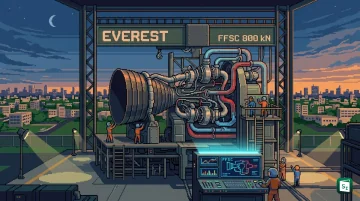
Astrobase Space Technologies Pvt Ltd has unveiled “EVEREST”, the first privately developed 800 kilonewton (kN) Full-Flow Staged Combustion (FFSC) rocket engine of India, in Bengaluru. The engine is specifically designed for reusable medium-lift launch vehicles and advanced orbital missions.
It is to be noted that Astrobase completed sub-scale and turbopump tests during 2025 and 2026, with plans to produce around 20 engines and conduct full-scale hot-fire testing in 2026.
Dr. Annapurni Subramaniam, the Director of the Indian Institute of Astrophysics (IIA) in Bengaluru, has been awarded the Vikram Sarabhai Medal 2026 by the Committee on Space Research (COSPAR). The award was presented at the 46th COSPAR Scientific Assembly in Florence, Italy.
She is the first Indian woman scientist and the third woman globally to receive this international honour. She is also the fourth Indian recipient of the medal, following UR Rao (1996), Gurbax Lakhina (2014), and Anil Bhardwaj (2024).
The Indian National Space Promotion and Authorisation Centre (IN-SPACe) has released guidelines titled "Norms, Guidelines and Procedures for Implementation of Indian Space Policy-2023 in respect of Authorisation for Undertaking Planned Re-entry of Space Objects".
Under these guidelines, entities of India must obtain approval from IN-SPACe for the planned re-entry of space objects. Foreign entities intending to perform re-entry must apply through an entity incorporated in India. Entities are required to maintain a casualty risk of less than 1 in 10,000 and must submit trajectory and risk assessments for approval.
The Vikram Sarabhai Space Centre (VSSC), a unit of the ISRO, has signed an MoU with the Council of Scientific and Industrial Research-Indian Institute of Chemical Technology (CSIR-IICT) to jointly develop indigenous technology for next-generation, environmentally sustainable blowing agents.