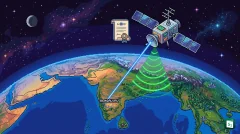
Dr Annapurni Subramaniam, the director of the Indian Institute of Astrophysics (IIA) in Bengaluru, has been awarded the Vikram Sarabhai Medal 2026 by the Committee on Space Research (COSPAR). The honour was presented during the 46th COSPAR Scientific Assembly held in Florence, Italy, from 1 to 9 August 2026. With this, she has become the first Indian woman scientist and only the third woman globally to receive the medal, and the fourth Indian overall.
The Vikram Sarabhai Medal: An Honour Named After a Pioneer
The Vikram Sarabhai Medal is a premier international award recognising outstanding contributions to space research, especially the advancement of space science capabilities in or for developing countries. It is conferred jointly by COSPAR and the Indian Space Research Organisation (ISRO), and was instituted in 1990 to commemorate Dr Vikram Sarabhai, the founding father of India’s space programme.
The medal is awarded biennially, that is, once every two years, during COSPAR’s Scientific Assembly. To be eligible, a candidate’s relevant work must have been carried out mainly in the five-year period ending one year before the Assembly at which the medal is presented. The award is open to scientists from any country.
The other Indians to have won this medal before her are U R Rao (1996), the former ISRO chairman; Gurbax Singh Lakhina (2014), a space plasma physicist; and Anil Bhardwaj (2024), the director of the Physical Research Laboratory in Ahmedabad. Globally, only three women have ever received the medal, and Subramaniam joins Christine Amory-Mazaudier (2022) and Alexi Glover (2020) on that list.
COSPAR: The Body Behind the Award
COSPAR, short for the Committee on Space Research, is the international scientific body that presents the medal jointly with ISRO. Established in 1958 by the International Council of Scientific Unions (now the International Science Council), it was set up in the wake of the Soviet Union’s launch of Sputnik in 1957, which opened the space age. It has its headquarters in Paris, France.
COSPAR works to promote scientific research in space at the international level, with a focus on the free exchange of results and information among scientists, and it provides a forum for discussing problems that affect space research. The organisation is also connected with the United Nations through UN-COPUOS, the UN Committee on the Peaceful Uses of Outer Space. Every two years, it organises a Scientific Assembly that brings together around 3,000 space scientists from around the globe, and these gatherings are among the largest forums for space researchers in the world.
Annapurni Subramaniam: The Scientist and Her Journey
Born in Palakkad, Kerala, Annapurni Subramaniam grew up in a family steeped in Carnatic music, and she herself is a trained violinist. Her journey into astronomy began when, as a girl, she would gaze at the night sky to escape the summer heat and wonder at the stars, with no one to answer her questions about them. She went on to earn her B.Sc. and M.Sc. in physics, and completed her PhD in astrophysics from the IIA in 1996, working on star clusters and stellar evolution.
She joined the IIA as a research fellow in 1990, and in 2019 she became the first woman director of the institute, a post she continues to hold. She also serves as the director of the Centre for Nano and Soft Matter Sciences (CeNS) in Bengaluru as an additional charge. Over her career, she has authored nearly 175 scientific papers and guided 15 PhD scholars.
Research on Stars and Galaxies
Subramaniam specialises in stellar physics, studying star clusters, nearby galaxies and the Magellanic Clouds, the two small galaxies that orbit the Milky Way. A significant part of her research concerns blue straggler stars, an unusual class of stars found in old star clusters that appear bluer and more massive than the surrounding stars, as if they were far younger. Her work has helped explain how these stars form by gaining mass from companion stars, and her team’s findings have been published in several major scientific journals.
AstroSat and the Ultraviolet Imaging Telescope
Among the recognition for which she was chosen, a key role was her work as the calibration scientist for the Ultraviolet Imaging Telescope (UVIT) onboard AstroSat. AstroSat, launched by ISRO in September 2015, is India’s first dedicated space observatory, and it carries five payloads that observe the universe simultaneously from the ultraviolet to X-ray wavelengths. UVIT is one of its key instruments, and Subramaniam led the calibration that ensured the telescope’s observations were accurate, helping to guarantee the mission’s scientific success.
She is also the principal investigator of INSIST, the Indian Spectroscopic and Imaging Space Telescope proposed as India’s next-generation ultraviolet-optical space telescope, and she plays a role in the Thirty Metre Telescope (TMT) project, one of the largest international astronomy collaborations, for which the IIA serves as India’s coordinating centre.
The Indian Institute of Astrophysics: A Two-Century Legacy
The Indian Institute of Astrophysics (IIA) is one of India’s premier research institutions, devoted to astronomy, astrophysics and allied areas of physics. Its roots go remarkably deep, tracing back to the Madras Observatory, established in 1786, which makes it one of the oldest scientific foundations in the country. The observatory moved to Kodaikanal in 1899, and in 1971 it was reconstituted as an autonomous institute, the IIA, with its headquarters shifting to Koramangala in Bengaluru in 1975.
The institute is funded by the Department of Science and Technology of the Government of India. Its observing facilities are spread across the country, including the Kodaikanal Solar Observatory, the Vainu Bappu Observatory at Kavalur with the 2.34-metre Vainu Bappu Telescope, the Gauribidanur Radio Observatory, and the high-altitude Indian Astronomical Observatory at Hanle in eastern Ladakh, home to the 2-metre Himalayan Chandra Telescope. The IIA also designed and built the Visible Emission Line Coronagraph, the main payload of ISRO’s solar mission Aditya-L1.
Why This Honour Matters
The award carries significance on several levels. For the scientific community, it shines a light on India’s growing strengths in space astronomy, particularly through indigenous missions such as AstroSat and the ongoing work on international projects like the Thirty Metre Telescope. Subramaniam’s selection recognises not just her individual research but the depth of India’s capabilities in building and operating world-class space instruments.
The distinction also carries a wider social meaning. As the first Indian woman scientist to win the medal, and only the third woman anywhere in the world to do so, her achievement stands as a powerful example of women’s leadership in science and space research. Earlier, in 2024, she had been awarded the Rashtriya Vigyan Puraskar Vigyan Shri in the Space Science and Technology category for her contributions, and her latest recognition continues to show how the country’s scientific institutions are being led by accomplished scientists.
Her own words after receiving the honour reflect a simple and genuine joy. Sharing her happiness at receiving the medal in Florence, she described it as a moment of personal pride, one that also signals how far Indian space science has travelled since the vision of Vikram Sarabhai first set it in motion.
Key Takeaways
- Dr Annapurni Subramaniam, director of the Indian Institute of Astrophysics (IIA), received the Vikram Sarabhai Medal 2026 from the Committee on Space Research (COSPAR) at the 46th COSPAR Scientific Assembly in Florence, Italy.
- She is the first Indian woman scientist and the third woman globally to receive the medal, and the fourth Indian overall.
- The previous Indian recipients were U R Rao (1996), Gurbax Singh Lakhina (2014) and Anil Bhardwaj (2024).
- The medal, instituted in 1990, is awarded biennially by COSPAR and ISRO for outstanding contributions to space research in developing countries.
- COSPAR, established in 1958 with headquarters in Paris, France, is an international scientific body affiliated with the International Science Council and UN-COPUOS.
- Subramaniam was recognised for her work on stellar populations, blue straggler stars and her role as the calibration scientist for the Ultraviolet Imaging Telescope (UVIT) onboard AstroSat, India’s first dedicated space observatory launched in 2015.