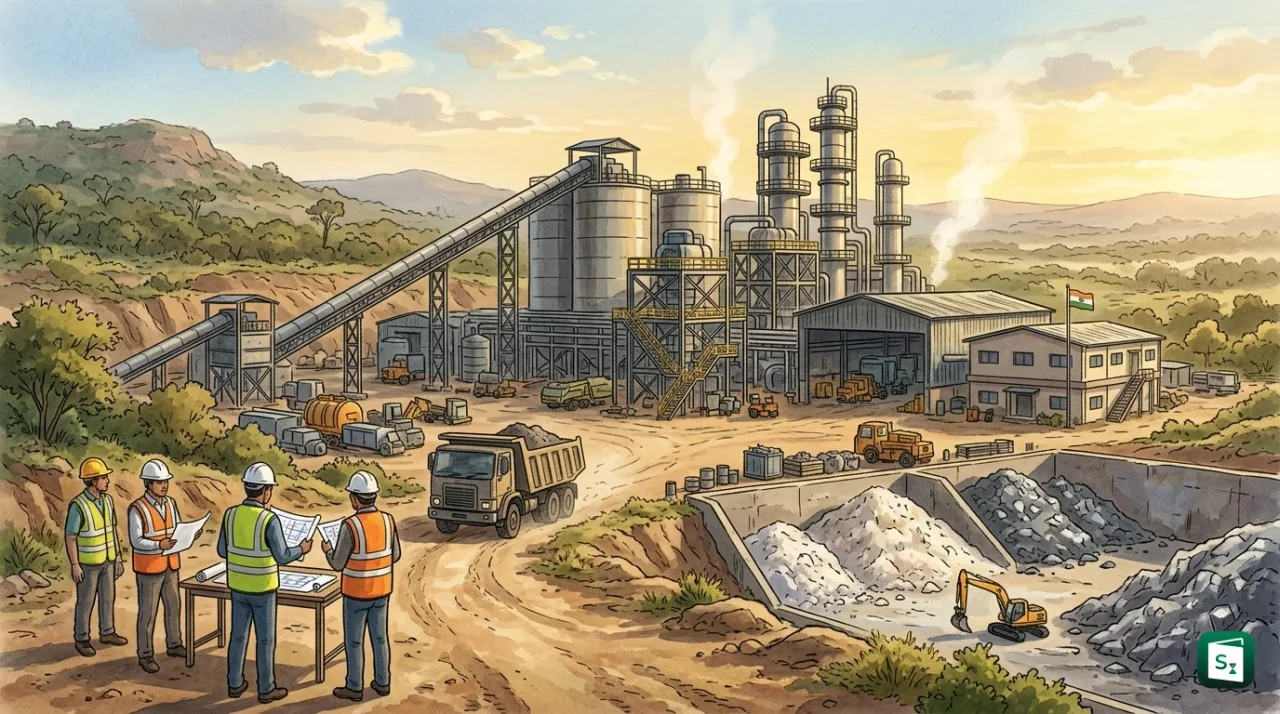
The Union Cabinet approved the Capex Support Scheme to Promote Critical Mineral Processing on 4 November 2026 with an outlay of ₹2,814 crore for the period from FY27 to FY31. The scheme will provide a 30 percent capital subsidy to set up two lithium processing plants and two nickel processing plants in India. It aims to cut import dependence and build domestic refining capacity for electric vehicles, batteries, electronics and defence.
What Does the New Capex Support Scheme Offer
The Capex Support Scheme to Promote Critical Mineral Processing is a central sector scheme of the Ministry of Mines. It will run for five years, from FY27 to FY31, with a total financial outlay of ₹2,814 crore. The scheme funds the setting up of domestic plants that convert lithium and nickel ores and intermediate products into high purity compounds used by industry.
The scheme covers four plants in total. Two plants will process lithium with a minimum capacity of 30 kt each. Two plants will process nickel with a minimum capacity of 50 kt each. Cobalt is also expected to be recovered as a byproduct of nickel processing.
| Feature | Detail |
|---|---|
| Nodal ministry | Ministry of Mines |
| Scheme period | FY27 to FY31 (5 years) |
| Total outlay | ₹2,814 crore |
| Capital subsidy | 30 percent of eligible investment |
| Lithium plants | 2 plants, minimum 30 kt capacity each |
| Nickel plants | 2 plants, minimum 50 kt capacity each |
| Cap per lithium beneficiary | ₹500 crore |
| Cap per nickel beneficiary | ₹900 crore |
| Disbursement | 3 tranches linked to milestones |
What Are Critical Minerals and Why Do Lithium and Nickel Matter
Critical minerals are minerals that are essential for the economy and national security but face a high risk of supply disruption. India released its first list of 30 critical minerals in June 2023 on the report of a committee set up by the Ministry of Mines. The list includes lithium, nickel, cobalt, copper, graphite, gallium, germanium, titanium, tungsten, vanadium and rare earth elements.
Lithium is called a critical raw material because it is the core of rechargeable lithium ion batteries. It powers electric vehicles, mobile phones, laptops and large Battery Energy Storage Systems that store solar and wind power. Nickel is used in stainless steel, speciality steel, aerospace parts and defence equipment. It is also a key cathode material in high energy density EV batteries, where it raises driving range.
Both minerals face concentrated global refining. China refines about 60 to 75 percent of the world supply of lithium and cobalt, and holds a large share of nickel and graphite refining. Indonesia dominates mined and refined nickel after its ban on raw ore exports. This concentration exposes buyers to price swings and export controls. India at present imports almost all of its lithium, nickel and cobalt in refined or intermediate form.
How Many Critical Minerals Does India List and Where Are They Found
India lists 30 critical minerals. The Geological Survey of India (GSI), set up in 1851 and headquartered in Kolkata, leads domestic exploration for these minerals. The Mines and Minerals (Development and Regulation) Act, 1957 was amended in 2023 to give the central government exclusive power to auction 24 of the 30 critical minerals.
Lithium is available in India but mining has not yet started. The GSI established inferred resources of 5.9 million tonnes of lithium ore in the Salal Haimana area of Reasi district in Jammu and Kashmir in February 2023. The find was at the G3 stage, which means preliminary exploration. The government later informed Parliament that about 10.88 million tonnes of lithium resources have been identified in Jammu and Kashmir across areas including Salal Haimana and Kotla, along with resources in Rajasthan and a small 1,600 tonne inferred resource at Marlagalla in Mandya district of Karnataka.
Nickel is found in India in small deposits linked with copper ores. The main occurrences are in the Sukinda valley in Jajpur district of Odisha and in parts of Jharkhand. The reserves are modest and there is no working nickel mine in the country for production at present. India therefore depends on imports of nickel sulphate, nickel matte and other intermediates, mainly from Indonesia and the Philippines, for its stainless steel and battery needs.
Why India Needs Domestic Processing Capacity Now
India has no commercial scale lithium refining capacity. Domestic nickel processing is limited to a small plant at Goa. Commercial projects face high capital costs, limited access to suitable technology and uncertain raw material supply. Without local refining, Indian battery and steel makers must buy high priced imported intermediates.
Local processing will add value inside India. Lithium ore or spodumene concentrate will be turned into lithium carbonate and lithium hydroxide. Nickel ore or matte will be turned into nickel sulphate and high purity nickel compounds. These compounds feed electric mobility, Battery Energy Storage Systems, electronics, defence and speciality steel.
The timing is linked to clean energy goals. India aims for Net Zero by 2070 and plans rapid growth in solar, wind, electric vehicles and grid storage. All these need secure supplies of lithium and nickel. Domestic plants will support the Production Linked Incentive (PLI) Scheme for Advanced Chemistry Cells, which has an outlay of ₹18,100 crore, and reduce the risk from geopolitical disruptions and export restrictions.
How Beneficiaries Will Be Selected and Paid
The Ministry of Mines will select four beneficiaries in total, two for lithium and two for nickel. Selection will follow a two stage process. In the first stage, applicants must clear technical qualification based on technology, capacity and execution ability. Only technically qualified applicants will move to the second stage of financial bidding.
In the second stage, winners will be chosen on a least cost basis. This means the bidders who seek the lowest capex support from the government will be selected for each mineral. The government has identified states including Andhra Pradesh, Odisha, Gujarat and Maharashtra as possible locations for processing parks, but the final sites will depend on the selected companies.
Payment will be made in three tranches linked to milestones such as financial closure, construction progress and start of commercial production. The cap of ₹500 crore per lithium plant and ₹900 crore per nickel plant keeps the outlay fixed. Nickel plants get a higher cap because they need larger investment in high pressure acid leaching and related refining systems.
National Critical Mineral Mission Provides the Larger Framework
The new capex scheme is part of the National Critical Mineral Mission (NCMM). The Union Cabinet launched the mission on 29 January 2025. The mission has a government expenditure of ₹16,300 crore over seven years from FY25 to FY31, with an expected ₹18,000 crore investment by public sector companies. It is run by the Ministry of Mines and covers exploration, mining, processing, recycling and overseas asset acquisition.
The mission aims to explore 1,200 domestic projects, auction more than 100 critical mineral blocks and speed up clearances. The Geological Survey of India has taken up over 350 exploration projects for critical minerals in recent years. The National Mineral Exploration Trust supports risk coverage and funding. The Khanij Bidesh India Ltd (KABIL), a joint venture of three central public sector firms, has secured lithium brine blocks in Catamarca province of Argentina and signed cooperation pacts with Australia.
Recycling is the second pillar. The Cabinet approved a ₹1,500 crore Incentive Scheme for Critical Mineral Recycling on 3 September 2025 for six years from FY26 to FY31. It gives capex and opex support for extracting minerals from e-waste, lithium ion battery scrap and catalytic converters. By April 2026, 58 recyclers with a pledged capacity of about 850 kt per year were found eligible. Customs duty on lithium ion battery scrap was removed in the Union Budget 2025-26 to improve feedstock supply. The new processing scheme extends the same logic from recycling to primary refining.
Key Takeaways
- The Capex Support Scheme to Promote Critical Mineral Processing was approved on 4 November 2026 with an outlay of ₹2,814 crore for FY27 to FY31.
- The scheme gives 30 percent capital subsidy to set up 2 lithium plants of 30 kt each and 2 nickel plants of 50 kt each.
- Capital support is capped at ₹500 crore per lithium beneficiary and ₹900 crore per nickel beneficiary, paid in 3 tranches.
- India lists 30 critical minerals, with 5.9 million tonnes of lithium inferred in Reasi in Jammu and Kashmir and nickel deposits in Odisha.
- The scheme is part of the National Critical Mineral Mission, launched on 29 January 2025 with ₹16,300 crore outlay and run by the Ministry of Mines.