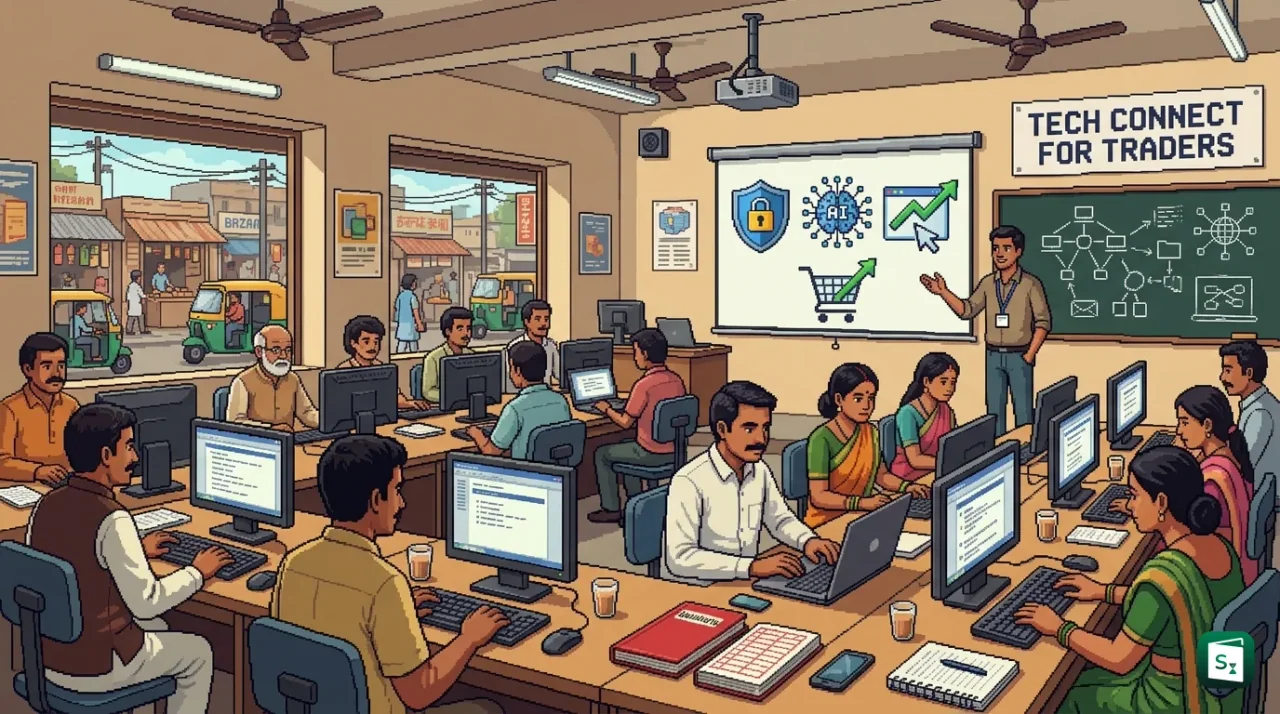
The Confederation of All India Traders (CAIT) and the National Association of Software and Service Companies (NASSCOM) signed a memorandum of understanding in New Delhi on 27 October 2026 to train traders and MSMEs in artificial intelligence, cybersecurity and digital marketing. The pact was signed under the programme Tech Connect for Traders and MSMEs, Accelerating Digital Transformation, in the presence of Minister of State for Electronics and IT Jitin Prasada. It aims to take practical digital skills to more than nine crore traders, including village level shops and street vendors.
What Did CAIT and NASSCOM Agree To Do?
The CAIT NASSCOM MoU was signed on 27 October 2026 in New Delhi under the programme Tech Connect for Traders and MSMEs, Accelerating Digital Transformation. The signing took place in the presence of Jitin Prasada, Minister of State for Commerce and Industry and Electronics and Information Technology, along with CAIT Secretary General and Member of Parliament Praveen Khandelwal and NASSCOM President Rajesh Nambiar.
Under the pact, the two bodies will jointly run training and awareness activities across India in three practical areas. The focus areas are use of artificial intelligence (AI) tools in daily business, protection against cyber fraud and improvement of cybersecurity, and growth through digital marketing and online trade.
| Training Area | What Traders Will Learn |
|---|---|
| AI adoption | Use of AI tools for billing, stock planning, demand forecast, customer service and cost control |
| Cybersecurity | Safe digital payments, data protection, identification of fraud calls and phishing links |
| Digital marketing | Online listing, product promotion, customer reach and expansion to new markets |
CAIT said the campaign will not remain limited to big cities. The plan is to carry it to village level markets so that small traders, transport operators, street vendors and other non corporate businesses can also benefit, along with consumers.
What Is CAIT and Whom Does It Represent?
CAIT stands for the Confederation of All India Traders. It is an apex body of traders that presents itself as the voice of more than nine crore traders and over 40,000 trade associations across India. Its national headquarters is Vyapar Bhawan at Naiwalan, Karol Bagh in New Delhi.
CAIT works on trader education, fair trade practices, policy advocacy and adoption of digital payments and e commerce by small shops. Its National President is B. C. Bhartia and its Secretary General is Praveen Khandelwal, who is also a Member of Parliament. The organisation describes itself as the largest organisation for the non corporate sector, covering retailers, wholesalers, transporters, small traders and street vendors.
What Is NASSCOM and What Does It Do?
NASSCOM stands for the National Association of Software and Service Companies. It is a non governmental trade association for the Indian technology industry. It was established on 1 March 1988 and is registered under the Societies Registration Act, 1860.
NASSCOM is not a government department and it does not work under any ministry. It is a not for profit body funded by industry. It works closely with the Ministry of Electronics and Information Technology (MeitY) on policy, skilling and digital programmes. Its headquarters are at Noida in Uttar Pradesh, with its registered office in New Delhi and other offices in Bengaluru, Chennai, Hyderabad, Kolkata, Mumbai, Pune and Kochi.
NASSCOM represents more than 3,000 member companies covering information technology services, business process management, software products and startups. These members account for about 95 percent of industry revenue. The current President is Rajesh Nambiar and the Chairperson is Sindhu Gangadharan. The association works on business promotion, policy advocacy, global trade, startups, innovation and workforce skilling.
What Is FutureSkills Prime?
FutureSkills Prime is a digital skilling initiative jointly run by MeitY and NASSCOM. It is described as India’s Technology Skilling Hub. The platform offers courses in areas such as AI, data analytics, cloud computing and cybersecurity, along with professional skills.
Courses on the platform are aligned to the National Occupational Standards (NOS) and the National Skills Qualification Framework (NSQF). Learners can earn industry backed NASSCOM certification after assessment by the IT-ITeS Sector Skills Council. The CAIT partnership is expected to use this content and certification approach to create simple, shop level modules for traders.
What Is the NASSCOM Foundation?
The NASSCOM Foundation is the social arm set up by NASSCOM to run corporate social responsibility and digital literacy programmes. It is different from NASSCOM itself, which handles industry and policy work, and from the Data Security Council of India (DSCI), which NASSCOM set up in 2008 as a body for data protection and cybersecurity standards, research and capacity building.
What Is an MSME?
MSME stands for Micro, Small and Medium Enterprises. It is a classification for enterprises based on investment in plant and machinery or equipment and annual turnover. The framework comes from the Micro, Small and Medium Enterprises Development Act, 2006, which is administered by the Ministry of Micro, Small and Medium Enterprises.
Under the revised limits effective from 1 April 2025, the classification is as follows.
| Category | Investment Limit | Turnover Limit |
|---|---|---|
| Micro | Up to ₹2.5 crore | Up to ₹10 crore |
| Small | Up to ₹25 crore | Up to ₹100 crore |
| Medium | Up to ₹125 crore | Up to ₹500 crore |
Enterprises register on the government portal Udyam Registration to get an Udyam Registration Certificate with a permanent number and QR code. Registration is free, paperless and based on self declaration with Aadhaar, PAN and GST linked details. Retail and wholesale traders were brought back into the MSME fold for Udyam purposes in 2021, which is why trader bodies like CAIT work closely with the MSME ecosystem on credit, formalisation and skilling.
Why AI, Cybersecurity and Digital Marketing Matter for Small Shops
Consumer habits have shifted fast toward online search, digital payments and home delivery. CAIT Secretary General Praveen Khandelwal said traders who delay technology adoption risk losing customers to faster competitors. NASSCOM President Rajesh Nambiar said every business today is a technology business and small traders must stay at the front in the age of AI and agentic AI, where software can complete routine tasks on its own.
Jitin Prasada said adoption of digital tools is now a necessity, not an option. He asked industry to take training to Tier 2 and Tier 3 towns and villages so that productivity gains reach the last mile. He pointed to rural 5G connectivity and public digital infrastructure that allow even a neighbourhood kirana store to combine walk in sales with online orders, manage stocks better and forecast festival demand.
Growth in digital use also raises risk. Fraud calls, fake payment links, counterfeit listings and data theft rise when more trade moves online. The MoU therefore pairs AI training with cybersecurity essentials. Traders will learn safe payment practices and methods to spot phishing and protect customer data, which helps maintain trust and business continuity.
Key Takeaways
- CAIT and NASSCOM signed an MoU on 27 October 2026 in New Delhi under Tech Connect for Traders and MSMEs to train traders in AI, cybersecurity and digital marketing.
- CAIT stands for the Confederation of All India Traders and claims a network of over nine crore traders and 40,000 trade associations.
- NASSCOM stands for the National Association of Software and Service Companies, a non profit industry body founded on 1 March 1988 and headquartered in Noida.
- FutureSkills Prime is a joint digital skilling initiative of MeitY and NASSCOM aligned to NOS and NSQF standards.
- A micro enterprise has investment up to ₹2.5 crore and turnover up to ₹10 crore under the MSME limits effective from 1 April 2025.