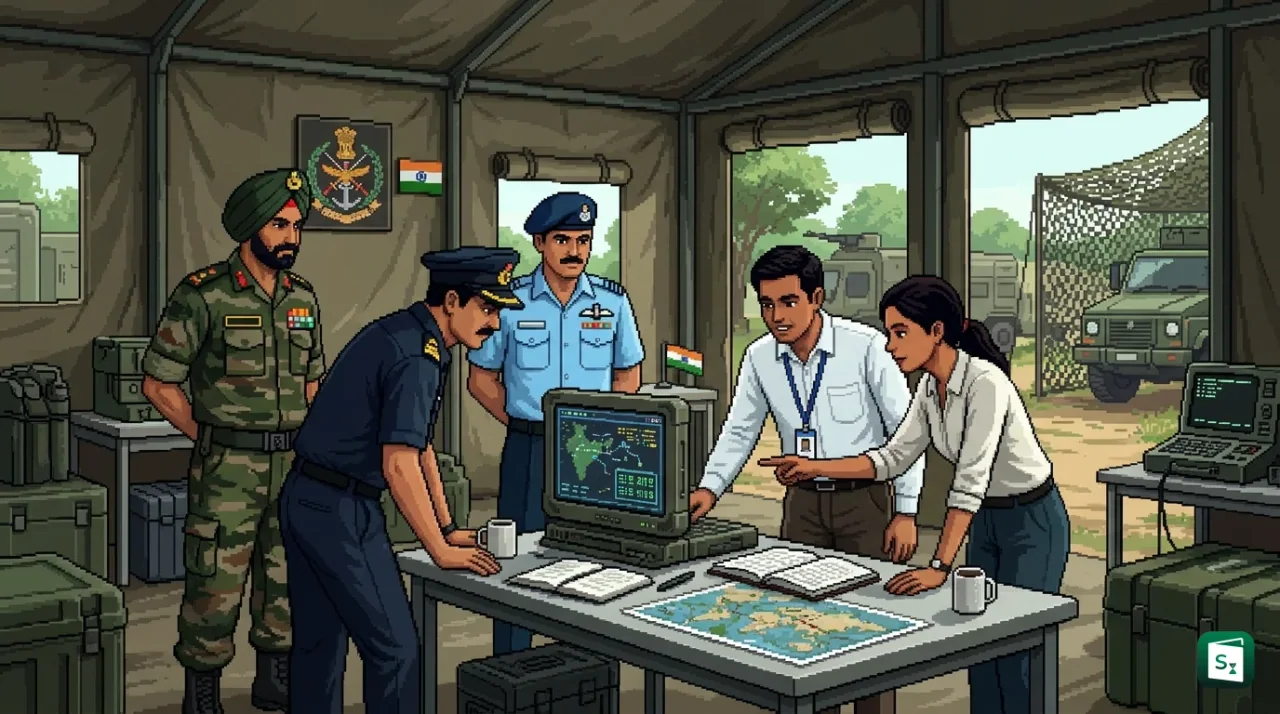
The Headquarters Integrated Defence Staff (HQ IDS) signed a five-year Memorandum of Understanding (MoU) with Bengaluru based Sarvam AI on 26 October 2026 to build indigenous AI for the Indian Army, Indian Navy and Indian Air Force. The pact creates a single umbrella framework for AI projects across the three Services and the joint organisations under HQ IDS. Work will run through Sarvam’s defence division Chanakya using the Sarvam 105B model that supports 22 Indian languages.
What the Five-Year HQ IDS Sarvam Pact Covers
HQ IDS announced the MoU on 26 October 2026 in New Delhi, and Sarvam AI made the details public on 27 October 2026. Sarvam later clarified that the agreement was signed with HQ IDS, which functions under the Ministry of Defence, and not directly with the Ministry itself. The signing brought together Sarvam co-founder Pratyush Kumar and the Chief of Integrated Defence Staff, Air Marshal Tejinder Singh.
Under the pact, Sarvam will design, develop and deploy AI applications for the operational, training and decision support needs of the three Services. Sarvam will also provide follow on technical support after deployment, while HQ IDS will facilitate engagement across the Services. The framework covers joint, tri-service and integrated organisations placed under HQ IDS, so projects in one Service can be reused in others.
| Item | Detail |
|---|---|
| Partners | HQ IDS and Sarvam AI |
| Duration | Five years |
| Announced on | 26 October 2026 |
| Scope | Army, Navy, Air Force plus joint organisations under HQ IDS |
| Work areas | AI applications, research, knowledge management, training and decision support |
| Value and project list | Not disclosed |
The MoU does not yet reveal the contract value, the number of projects or delivery timelines. It is structured as an umbrella framework, which means individual projects will be taken up separately within the same common rules and shared systems.
What Is Sarvam AI
Sarvam AI is an Indian AI company based in Bengaluru, founded in August 2023 by Vivek Raghavan and Pratyush Kumar. Raghavan earlier worked on large population scale digital systems including Aadhaar, while Kumar earlier worked on open source AI for Indian languages through AI4Bharat at IIT Madras. The company builds full stack AI that is voice first and multilingual, with a stated goal of AI built in India for Indian needs.
In 2025, the government selected Sarvam AI under the IndiaAI Mission to build an indigenous sovereign large language model. The IndiaAI Mission is a national programme with an outlay of ₹10,372 crore to create Indian compute capacity, datasets and foundation models. Sarvam’s models under this effort were trained in India on IndiaAI Mission compute with support from domestic data centres and hardware partners.
Sarvam’s product stack includes speech to text, text to speech, translation and document intelligence tools alongside its foundation models. Its earlier models include Sarvam-1, a two billion parameter Indic model, and Sarvam-M, a 24 billion parameter reasoning model. In June 2026, Sarvam raised $234 million in the first close of its Series B round at a valuation of $1.5 billion, with HCLTech as the lead strategic investor.
How Sarvam 105B Works
Sarvam 105B is a large language model released in February 2026 at the India AI Impact Summit in New Delhi, along with the smaller Sarvam 30B. Both models were trained from scratch in India and released as open weights under the Apache 2.0 licence. Yes, Sarvam 105B is open source, so any user can download, modify and deploy it for commercial use without licence fees. The weights are available on platforms such as Hugging Face and AI Kosh.
The model uses a Mixture-of-Experts (MoE) architecture. A Mixture-of-Experts model contains many small expert networks and activates only a few of them for each word or token. In Sarvam 105B, total parameters are 105 billion, but only about 10.3 billion are active per token. This keeps computing cost and power use much lower than a dense 105 billion parameter model where all parameters work all the time.
Sarvam 105B was trained on 12 trillion tokens covering code, mathematics, web data and multilingual text, with a context window of 128,000 tokens. A long context window lets the model read long documents and handle multi step tasks in one go. The model supports all 22 scheduled languages listed in the Eighth Schedule of the Constitution, plus English. It was trained on formal script, romanised script and code mixed inputs such as Hinglish for the most spoken Indian languages, which helps it handle messages like typed Hindi in English letters.
| Feature | Sarvam 105B | Sarvam 30B |
|---|---|---|
| Total parameters | 105 billion | 30 billion |
| Active parameters per token | About 10.3 billion | About 2.4 billion |
| Architecture | MoE with 128 experts | MoE with 128 experts |
| Context window | 128,000 tokens | 32,000 tokens |
| Training tokens | 12 trillion | 16 trillion |
| Licence | Apache 2.0 open source | Apache 2.0 open source |
| Best use | Complex reasoning and agents | Fast real time conversation |
Published test scores show strong reasoning ability, including 98.6 on MATH-500 and high scores on agentic tasks that need multi step workflows. The company also reports wins in nearly 90 percent of pairwise comparisons on Indian language tasks against peer open models. Such company run benchmarks are useful signals, but independent testing is still needed before judging field performance.
What Is Chanakya and How It Will Serve the Armed Forces
Chanakya is Sarvam’s firewalled division for national security and defence, announced on 29 March 2026. A firewalled division means a separate team and separate systems meant only for sensitive government and defence work. Chanakya will execute all projects under the HQ IDS MoU using Sarvam’s AI stack, including Sarvam 105B, agentic infrastructure and geospatial and perception systems.
Military AI here means software that helps personnel make faster and better decisions, and not robots that fight on their own. The focus areas are decision support, target acquisition and data fusion across the sensor to shooter loop. The sensor to shooter loop is the chain from detection to action. Satellites, radars, drones and other sensors pick up signals, software joins these inputs into one clear picture, and commanders then decide how to respond.
Chanakya is built for secure deployment. It supports on premise installation and air gapped setups, which are computer systems fully cut off from the internet for handling classified data. It can read text, images and structured data, and it can run agent based workflows that complete multi step tasks such as document review, translation, briefing notes and logistics checks. Sarvam has said human oversight will stay in place for operational decisions, so the system can suggest a target or course of action but cannot order a strike on its own.
A central goal is an AI fabric that links elements of India’s defence capability. In simple terms, the Army, Navy and Air Force will use the same foundation models and tools, so lessons from a project in one Service improve the next project in another Service.
Why a Common AI Layer Matters for the Army, Navy and Air Force
The three Services now operate different equipment, networks and procedures. Without a common layer, each Service would build its own separate AI tools that cannot talk to each other. The HQ IDS framework tries to fix this by giving all three Services access to the same foundation models, the same agentic infrastructure and the same geospatial and perception systems.
Shared systems help in four practical ways. First, intelligence inputs from many sensors can be combined into a single operational picture, which speeds up situational awareness. Second, training and knowledge management improve because study material, doctrines and lessons can be searched, translated and summarised across Hindi, Tamil, Bengali and other Indian languages. Third, operational planning gains from quick analysis of orders, maps and reports. Fourth, maintenance and logistics gain from prediction of spares and faults.
Sovereign control is the other reason. The AI layer will be built in India and deployed on sovereign infrastructure under Indian control. Military data includes troop locations, sensor records and operational plans, which cannot be sent to foreign commercial clouds. Hosting open weights on owned servers inside defence networks removes per seat fees, avoids sudden service shutdowns and keeps classified data within the national boundary.
India’s Defence AI Architecture Behind the Pact
HQ IDS is India’s apex tri-service body for joint planning and integration. The full form of HQ IDS is Headquarters Integrated Defence Staff. It was raised on 1 October 2001 in New Delhi after the Kargil Review Committee of 1999 pointed to weak coordination among the Services. HQ IDS is headed by the Chief of Integrated Defence Staff, a three star officer, and it now functions as the executive arm of the Chief of Defence Staff, a post created in December 2019.
India’s dedicated military AI institutions were created in February 2019. The Defence AI Council, chaired by the Raksha Mantri, gives strategic direction, while the Defence AI Project Agency, placed under the Secretary for Defence Production, drives adoption across defence organisations. Both bodies came from the 2018 task force on strategic use of AI for national security, chaired by N. Chandrasekaran. The government later drew up an AI road map with 70 projects for defence public sector undertakings and earmarked ₹100 crore per year for AI work linked to the Armed Forces. Research support comes from laboratories such as the Centre for Artificial Intelligence and Robotics in Bengaluru under the Defence Research and Development Organisation.
The Sarvam pact builds on an earlier working model. On 18 August 2026, the Defence Services Staff College in Wellington launched DRONA 2.0, a generative AI platform for training, research and strategic studies that runs on Sarvam 105B along with other open models. The system is hosted on a graphics processing unit server inside the college’s secure network and was cleared after security audits by HQ IDS and the Defence Cyber Agency. The college also signed a separate MoU with Sarvam for further development. Sarvam links the new tri-service framework to Atmanirbharta, or self reliance, extending indigenisation from weapons and platforms to data, models and compute.
Key Takeaways
- HQ IDS signed a five-year MoU with Sarvam AI on 26 October 2026 for AI projects across the Army, Navy and Air Force.
- Projects will be executed by Chanakya, Sarvam’s firewalled defence division announced on 29 March 2026 for air gapped and on premise deployment.
- The initiative uses Sarvam 105B, a 105 billion parameter Mixture-of-Experts model with about 10.3 billion active parameters per token.
- Sarvam 105B is open source under Apache 2.0 and supports all 22 scheduled languages plus English, including romanised and code mixed inputs.
- HQ IDS was raised on 1 October 2001 after the Kargil Review Committee, while the Defence AI Council and Defence AI Project Agency were created in February 2019.