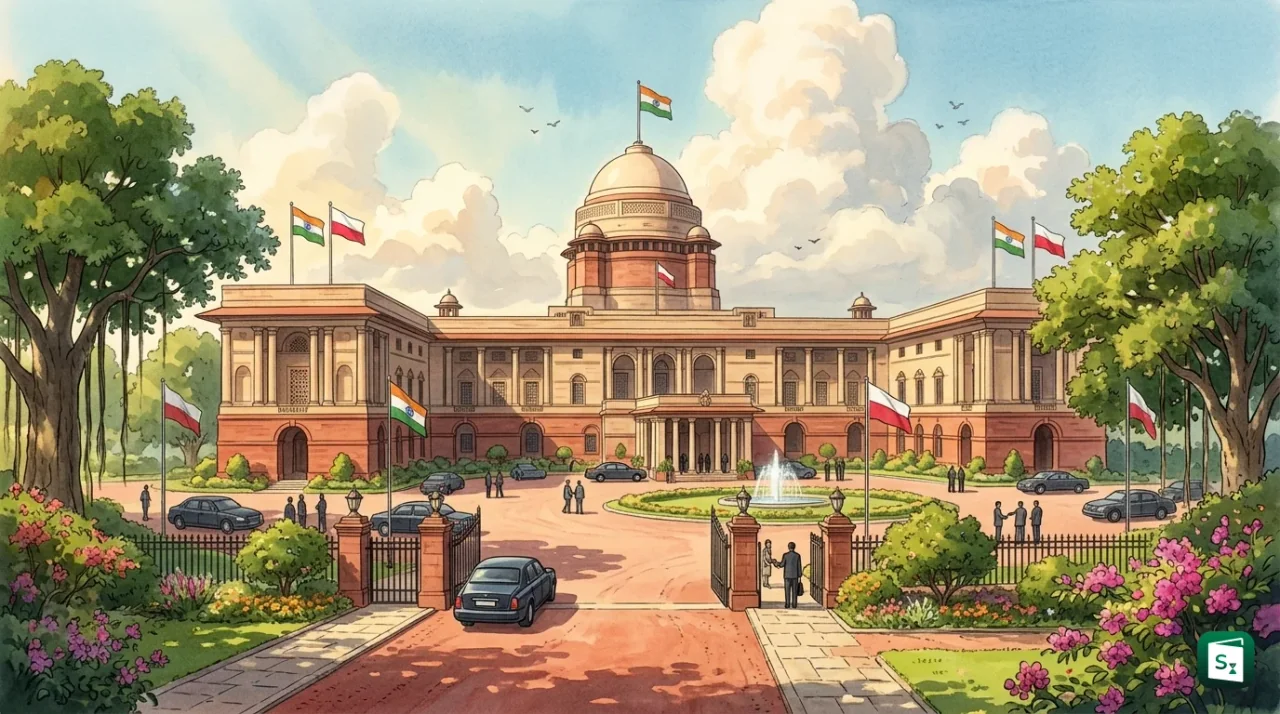
Polish Prime Minister Donald Tusk visited India from 21 to 23 October 2026 to review India Poland relations with Prime Minister Narendra Modi. The two leaders met at Hyderabad House in New Delhi and set a target to double bilateral trade by 2030.
What Modi and Tusk Decided in New Delhi
The India Poland Joint Statement of 22 October 2026 recorded four main outcomes from the talks between Prime Minister Narendra Modi and Polish Prime Minister Donald Tusk. The two leaders held delegation level talks at Hyderabad House in New Delhi on 22 October. Tusk travelled with Poland’s Minister of Finance and Economy Andrzej Domanski and around 100 leading CEOs and industry representatives.
The four outcomes were a target to double bilateral trade by 2030, Poland joining the Coalition for Disaster Resilient Infrastructure (CDRI), a proposal to start a Defence Industry Dialogue, and an agreement to hold a dialogue on counter terrorism. The two sides also endorsed the mid term review of the Action Plan 2024-2028. The review had been completed in Warsaw in September 2026 by External Affairs Minister S. Jaishankar and Polish Deputy Prime Minister and Foreign Minister Radoslaw Sikorski.
Tusk described Modi as his friend and said India and Poland have no conflict of interest. Modi recalled that the Strategic Partnership was created during his visit to Warsaw in August 2024. Tusk invited Modi to visit Poland again. This was the first visit by a Polish Prime Minister to India since 2010.
India Poland Relations From 1954 to Strategic Partnership 2024
India Poland diplomatic relations were established on 30 March 1954. India opened its Embassy in Warsaw in 1957. The two countries shared common views against colonialism and racism. During the Cold War, both had close ties with the Soviet Union, which kept the relationship steady.
The history has a strong humanitarian link. During World War II, Jam Saheb Digvijaysinhji Ranjitsinhji, the Maharaja of Nawanagar in present day Jamnagar, Gujarat, gave shelter to more than 1,000 Polish refugee children. The children had been released from Soviet camps and were housed at Balachadi near Jamnagar, while larger family camps were set up at Valivade near Kolhapur. Poland honours him as the Good Maharaja. A square in Warsaw is named Good Maharaja Square, and eight Polish schools carry his name.
The modern upgrade came in August 2024. Modi became the first Indian Prime Minister in 45 years to visit Poland, after Morarji Desai in 1979. During that visit India and Poland raised ties to a Strategic Partnership and adopted the five year Action Plan 2024-2028. The Action Plan covers political dialogue, defence, trade and investment, climate and energy, mining, science and technology, transport, cyber security, health, culture and people to people ties. It is reviewed every year through political consultations.
| Milestone in India Poland ties | Date and detail |
|---|---|
| Establishment of diplomatic relations | 30 March 1954 |
| Indian Embassy in Warsaw opened | 1957 |
| Modi visit to Warsaw, Strategic Partnership created | August 2024 |
| Adoption of Action Plan | 2024-2028 |
| Mid term review by Jaishankar and Sikorski | September 2026 in Warsaw |
| Tusk visit to New Delhi and Bengaluru | 21 to 23 October 2026 |
Doubling India Poland Bilateral Trade by 2030
The India Poland Joint Statement set the target of doubling bilateral trade by 2030. Current India Poland bilateral trade stands at about $6.36 billion in 2025, with Indian exports of about $4.83 billion and imports of about $1.53 billion. Doubling means taking trade to about $12 billion. Poland is India’s largest trading partner in Central and Eastern Europe.
The India Poland Business Forum met in New Delhi on 22 October and in Bengaluru on 23 October. The forum was organised with the Confederation of Indian Industry (CII), India’s leading industry body founded in 1895 and headquartered in New Delhi, and the Polish Investment and Trade Agency (PAIH), Poland’s state agency for trade and investment promotion. Tusk told the forum that Poland wants to be a gateway to Europe for Indian firms, while India can be a gateway to Asia for Polish firms.
The leaders asked firms to explore partnerships in industrial machinery, defence, infrastructure, pharmaceuticals, mining and critical minerals, energy and information technology. They agreed to restart the bilateral agricultural working group to raise farm and food trade. They also stressed resilient supply chains, support for small and medium enterprises, and digital growth.
A key link is the India EU Free Trade Agreement. The India EU Summit was held in New Delhi on 27 January 2026, and talks on the trade deal were concluded. Modi and Tusk called for its early signing, ratification and timely implementation. The deal will lower tariffs and open new markets for goods such as machinery, chemicals, plastics and engineering products. Modi also congratulated Poland on crossing $1 trillion in GDP.
Defence, Space and Critical Minerals Cooperation
Defence was a central part of the October 2026 talks. The two sides welcomed the 8th Joint Working Group on Defence, held in Warsaw in September 2026. They proposed a new Defence Industry Dialogue to bring Indian and Polish firms together. The aim is to find commercially viable projects for technology partnership, co development and co production, where both sides agree. Modi invited Polish companies to co develop and co produce in India in defence, space and nuclear energy.
The two leaders welcomed the India EU Security and Defence Partnership, signed in January 2026. They agreed to work together on critical and emerging technologies, cyber security and defence innovation. They also expect early signing of an Agreement on Mutual Protection and Exchange of Classified Information, which will allow safe sharing of sensitive defence information.
On technology, the Joint Statement called for joint research on artificial intelligence, semiconductors and quantum technologies, along with stronger startup partnerships. On space, the leaders called space cooperation a key element of the Strategic Partnership and asked institutions and firms to identify joint projects. Poland has growing strengths in small satellites, optics and space data applications, while India offers low cost launch and a large space ecosystem led by the Indian Space Research Organisation (ISRO), established in 1969 and headquartered in Bengaluru.
On minerals and energy, the leaders pointed to the circular economy, battery recycling and refining of rare earth minerals. An MoU on geology, mining and critical minerals is under negotiation. They also discussed cooperation in clean coal technologies, green energy, polar research, direct flights between India and Poland, shipping, port cooperation and the India Middle East Europe Economic Corridor (IMEC).
What Is CDRI and Why Poland Joined It
The Coalition for Disaster Resilient Infrastructure is a global partnership launched by India to make infrastructure strong against climate and disaster risks. It was launched by Prime Minister Narendra Modi at the UN Climate Action Summit in New York on 23 September 2019. Its secretariat is headquartered in New Delhi.
CDRI brings together national governments, UN agencies, multilateral banks, private firms and academic bodies. Its goal is to cut losses from disasters by improving standards, finance, planning and recovery for roads, power, ports, telecom, health and housing systems. The idea was first proposed by Modi in 2016 at the Asian Ministerial Conference on Disaster Risk Reduction in New Delhi. The Union Cabinet approved the coalition on 28 August 2019 with a support of ₹480 crore and a secretariat in New Delhi.
CDRI is governed by a Governing Council of all members, an Executive Committee and a Secretariat led by a Director General. India is the permanent co chair of the Governing Council. In August 2022, the Cabinet gave CDRI the status of an International Organisation under the United Nations (Privileges and Immunities) Act, 1947. Membership is open to all countries that endorse the CDRI Charter. CDRI now has more than 50 member countries and more than 10 member organisations, including the World Bank, the Asian Development Bank, the United Nations Development Programme and the European Union.
| Fact about CDRI India initiative | Detail |
|---|---|
| Full form | Coalition for Disaster Resilient Infrastructure |
| Launched by | Prime Minister Narendra Modi |
| Launch date and place | 23 September 2019, New York at UN Climate Action Summit |
| CDRI headquarters | New Delhi, India |
| Founding members | India plus 12 countries including Australia, Japan, UK, Italy, Fiji and Sri Lanka |
| Flagship for islands | Infrastructure for Resilient Island States (IRIS), launched at COP26 in Glasgow in 2021 |
Poland joining CDRI adds a large Central European economy to the coalition. India also invited Poland to join the International Solar Alliance (ISA), launched in 2015 and headquartered in Gurugram, and the Global Biofuels Alliance, launched in 2023 during India’s G20 presidency.
March 30 as Poland India Partnership Day and Wider Global Ties
Polish Prime Minister Donald Tusk announced that 30 March will be observed every year as Poland India Partnership Day. The date marks the establishment of India Poland diplomatic relations on 30 March 1954. The announcement gives the historical tie a yearly public moment, like other national days that keep a bilateral story alive in schools, media and cultural events.
People to people links featured strongly in the talks. The Joint Statement called the memorials to the Good Maharaja and Kolhapur in Warsaw a living bridge. Two editions of the Jam Saheb Memorial Youth Exchange Programme have been held, with the latest in October 2026. Under the scheme, 20 Polish youth visit India, including Balachadi and Valivade. The two sides also recalled Poland’s help to more than 2,000 Indian students stranded in Ukraine under Operation Ganga in 2022. New agreements on culture, science and higher education, and between the national archives, are to be signed soon.
On global issues, Poland backed India’s bid for a reformed and expanded United Nations Security Council, including support for India’s candidature for a non permanent seat in 2028-29. Both sides condemned terrorism in all forms, including the terrorist attack in Pahalgam, Jammu and Kashmir on 22 April 2025. They called for early adoption of the Comprehensive Convention on International Terrorism (CCIT) and agreed to a counter terrorism dialogue. They also backed a free and open Indo Pacific under the United Nations Convention on the Law of the Sea (UNCLOS) of 1982, and welcomed the first India Visegrad Group (V4) Foreign Ministers meeting. The V4 groups Poland, Hungary, the Czech Republic and the Slovak Republic.
Who Is Donald Tusk
Donald Franciszek Tusk, born on 22 April 1957 in Gdansk, is the Prime Minister of Poland. He belongs to the centrist Civic Platform, which he co founded in 2001. He first served as Prime Minister from 2007 to 2014, becoming the first Polish Prime Minister since 1989 to win re election in 2011.
Tusk then served as President of the European Council from 2014 to 2019 and led the European People’s Party from 2019 to 2022. He returned as Prime Minister on 13 December 2023 at the head of a pro European coalition. Poland follows a parliamentary system in which the President is head of state and the Prime Minister heads the government. Warsaw is the capital of Poland and the zloty is its currency.
Key Takeaways
- Polish Prime Minister Donald Tusk visited India from 21 to 23 October 2026 and met Prime Minister Narendra Modi at Hyderabad House on 22 October.
- India and Poland endorsed the mid term review of the Action Plan 2024-2028, which guides the Strategic Partnership created in August 2024.
- The two sides set a target to double India Poland bilateral trade from about $6.36 billion to about $12 billion by 2030.
- Poland announced joining the Coalition for Disaster Resilient Infrastructure (CDRI), launched in 2019 and headquartered in New Delhi.
- 30 March will be observed as Poland India Partnership Day, marking the establishment of diplomatic relations on 30 March 1954.