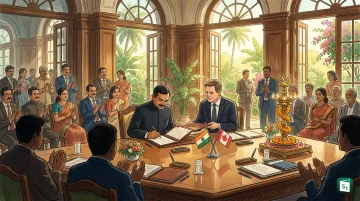
The India-New Zealand Free Trade Agreement (IN-NZ FTA) will officially come into force on October 20, 2026.
Under the agreement, India will gain 100% duty-free access on all 8,284 tariff lines to New Zealand. Additionally, India will liberalise 70.03% of tariff lines, covering 95% of bilateral trade value with key exclusions.
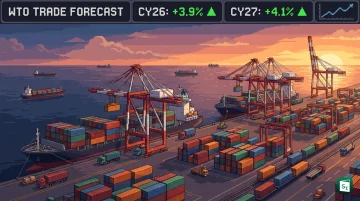
According to the “Global Trade Outlook and Statistics Update: October 2026” report released by the World Trade Organization (WTO), the global merchandise trade growth forecast has been raised to 3.9% for Calendar Year 2026 (CY26), from its previous estimate of 1.9%.
The report projects global trade growth at 4.1% for CY27. Additionally, the global Gross Domestic Product (GDP) growth is projected at 2.6% in CY26 and 2.9% in CY27.
The Ministry of External Affairs has operationalised the resident diplomatic mission of India in San Jose, the capital of Costa Rica, effective from October 10, 2026. The mission was established to expand the diplomatic presence of India in Central America.
The Central Government has notified amendments to the India-Mauritius Double Taxation Avoidance Agreement (DTAA) to prevent treaty abuse and tax avoidance. The amended treaty, whose protocol was signed in 2024, introduces the Principal Purpose Test (PPT) and came into force on August 10, 2026.
Following the amendment, Mauritius-based investors and investment funds claiming treaty benefits may face increased scrutiny regarding the commercial substance and purpose of their transactions.
During the Team Canada Trade Mission at the Canada-India Business Ceremony in Karnataka, Indian and Canadian entities signed 34 commercial agreements and MoUs worth nearly CAD 300 million (₹1,800 crore).
Both countries aim to conclude negotiations for the proposed Comprehensive Economic Partnership Agreement (CEPA) by December 2026 to reduce trade barriers and improve market access.
National Thermal Power Corporation (NTPC) Ltd has signed a cooperation agreement with Africa50, an African infrastructure investment organisation, to jointly develop commercially viable power projects and explore cross-border electricity trading opportunities across Africa.
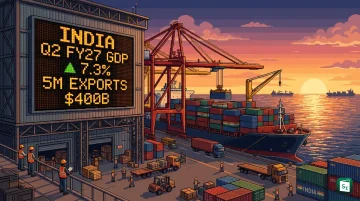
According to the “Trade and Development Report 2026: The Geoeconomics of Development” released by the United Nations Conference on Trade and Development (UNCTAD), the economy of India is projected to grow by 7.3%.
The report projected global economic growth at 2.6% (down from 2.9% in 2025) and growth in developing economies at 4% (down from 4.7% in 2025). Additionally, Asia is expected to contribute 59% of global growth in 2026.
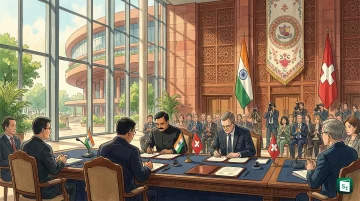
Swiss President Guy Parmelin has visited India at the invitation of PM Narendra Modi to strengthen bilateral cooperation in trade, investment, and technology under the India - European Free Trade Association (EFTA) Trade and Economic Partnership Agreement (TEPA).
Both leaders attended the 2nd India-EFTA Prosperity Summit at Bharat Mandapam in New Delhi, marking the anniversary of the India-EFTA TEPA which came into force on October 01, 2025. They signed 5 key agreements to boost cooperation in mobility, science, and technology.
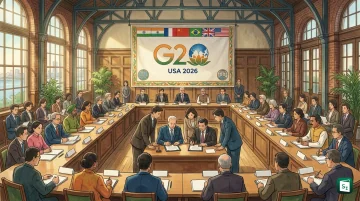
Union Minister Piyush Goyal has attended the Group of Twenty (G20) Trade Ministers’ Meeting held in Milwaukee, USA.
The Joint Ministerial Statement was released by the Office of the US Trade Representative (USTR) and was signed by 15 participating countries, including India and the USA.
The Department of Commerce (DoC), under the Ministry of Commerce and Industry (MoCI), has established a Free Trade Agreement (FTA) Utilisation Cell to assist Indian entrepreneurs and businesses in understanding and leveraging the benefits provided by trade agreements of India.
India has finalized FTAs with several partners, including the European Free Trade Association, UAE, Australia, Mauritius, Oman, New Zealand, UK, and European Union. These agreements provide domestic businesses with access to 32 countries, facilitating largely zero-tariff trade opportunities across global markets.
The Department of Commerce (DOC) under the Ministry of Commerce and Industry (MoC&I) has extended the Remission of Duties and Taxes on Exported Products (RoDTEP) scheme until December 31, 2026.
The Ministry of Textiles (MoT) has also extended the Rebate of State and Central Taxes and Levies (RoSCTL) scheme until December 31, 2026. These extensions are intended to mitigate the impact of geopolitical disruptions in West Asia.
Adani Power Ltd has signed a Shareholders Agreement (SHA) with the state-owned Druk Green Power Corporation (DGPC) of Bhutan to develop the 770 MW Chamkharchhu-I Hydroelectric Project.
The project is located on the Chamkharchhu River in the Zhemgang District of Bhutan. It is to be noted that this venture marks the second major hydropower collaboration between both companies.
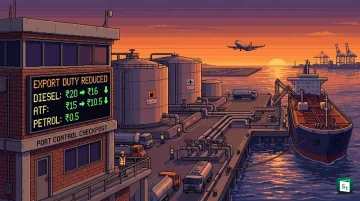
The Ministry of Finance has reduced the windfall tax on the export of diesel and Aviation Turbine Fuel (ATF) effective from October 1, 2026.
The export duty on diesel was lowered to ₹16 per litre from ₹20, and the levy on ATF was reduced to ₹10.5 per litre from ₹15. The government has maintained the export duty on petrol at ₹0.5 per litre for the upcoming fortnight.
The Ministry of Statistics and Programme Implementation has released the Sub-Sectoral Trial Index of Services Production (ISP) for July 2026, utilizing 2024-25 as the base year to monitor 19 service sub-sectors.
The ISP data indicates that 17 out of the 19 sub-sectors achieved positive growth in July 2026, with 10 sub-sectors recording double-digit growth compared to July 2025. Most categories recorded positive Year-on-Year (YoY) growth, with the exceptions of Air Transport and Repair Services.
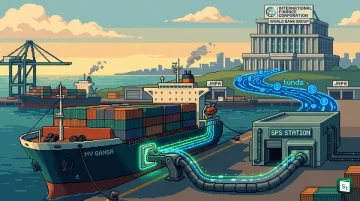
The Jawaharlal Nehru Port Authority (JNPA) has signed an agreement in New Delhi with the International Finance Corporation (IFC), a member of the World Bank Group, for the first blue financing loan in India worth $70 million (₹672 crore).
The loan is structured as a 10-year United States Dollar (USD)-linked External Commercial Borrowing (ECB). The funds will be utilized to develop Shore Power Supply (SPS) infrastructure across the terminals of the JNPA in Navi Mumbai, Maharashtra.
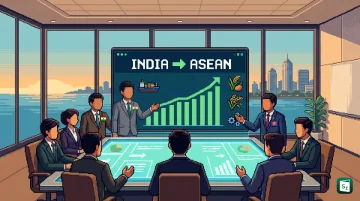
India has participated in the 14th East Asia Summit - Economic Ministers’ Meeting (EAS-EMM) and the 23rd Association of Southeast Asian Nations (ASEAN)-India Economic Ministers Consultation held in Manila, Philippines.
The Indian delegation for these high-level meetings was led by Nitin Kumar Yadav. It is to be noted that the bilateral trade between India and the ASEAN region reached a total of $128.38 billion in 2025-26.
The Ministry of Ports, Shipping and Waterways (MoPSW) has designated four major and commercial facilities as the first “mega ports” of India under Section 73 of the Indian Ports Act, 2025.
The identified ports include the Jawaharlal Nehru Port Trust in Nhava Sheva, Paradip Port, Deendayal Port in Kandla, and the Mundra Port operated by the Adani Group.
The “mega port” status is granted for a 5-year duration, subject to periodic reviews, based on specific operational benchmarks. To qualify for this status, a bulk port must register an annual cargo throughput of at least 150 Million Metric Tonnes (MMT), while a container port is required to handle a minimum of 7.5 Million Twenty-Foot Equivalent Units (MTEUs).
The 2nd India-Italy Joint Working Group (JWG) meeting on tourism was held in New Delhi. During the meeting, both countries agreed to strengthen bilateral cooperation in the tourism sector.
Both nations also agreed to establish focused technical groups and designated points of contact to further advance bilateral tourism cooperation.