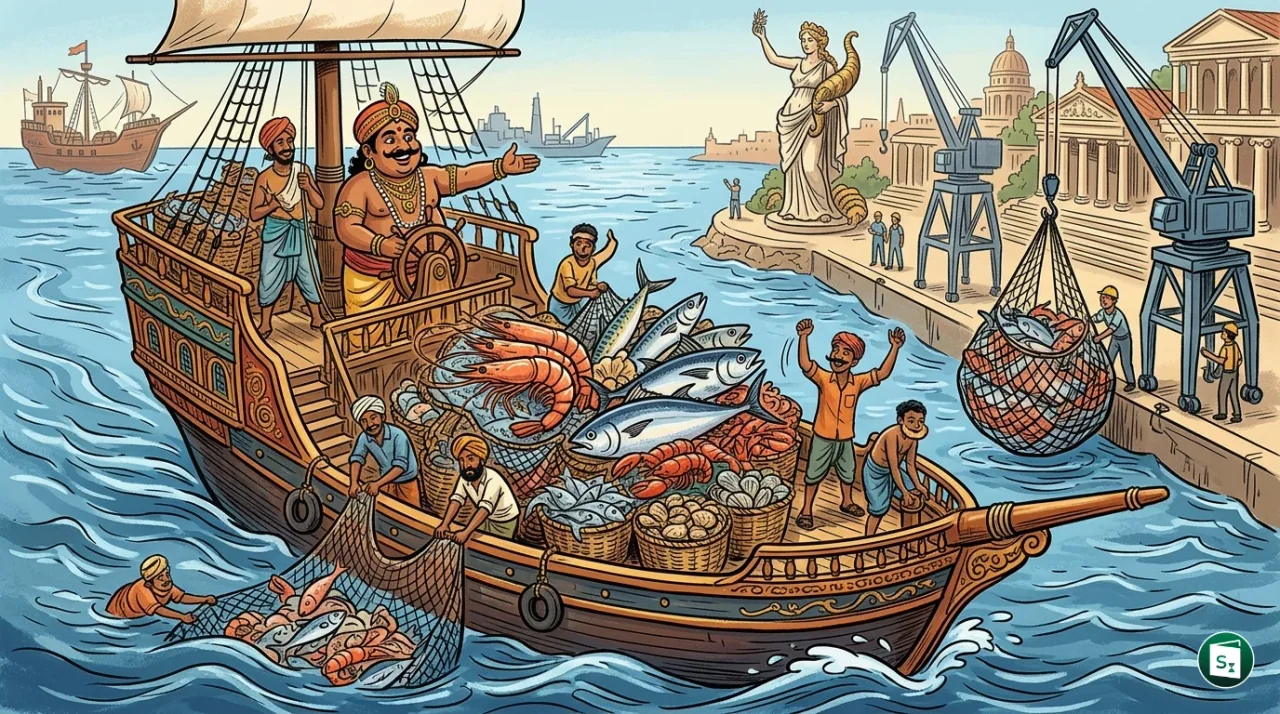
India’s seafood exports reached a historic milestone in the fiscal year 2025–26, with the European Union emerging as the third-largest destination for marine products. Valued at $1.593 billion, shipments to the EU registered robust double-digit growth, successfully offsetting market fluctuations in other major regions. This development solidifies India’s position as a premier global exporter and highlights the growing demand for high-quality Indian seafood in the European market.
Record-Breaking Performance in FY26
India’s total seafood exports achieved an all-time high in FY26, reaching ₹72,325.82 crore, which is approximately $8.28 billion. This performance represents a significant increase in both volume and value compared to the previous fiscal year. The country exported a total of 1.93 million metric tonnes of marine products, setting a new benchmark for the sector.
While the United States remained the largest importer of Indian seafood at $2.32 billion, its market share saw a decline due to trade barriers and reciprocal tariffs. This gap was effectively filled by surging demand in China and the European Union. China solidified its position as the second-largest destination, showing over 22% growth in value, while the EU witnessed the most rapid expansion among the top three markets.
The EU: A Strategic Growth Engine
The European Union has transitioned from being a stable market to a high-growth destination for Indian marine products. In FY26, seafood exports to the EU grew by nearly 38% in value and 35% in volume. Contributing 18.94% to the total export value, the EU now stands as the third-largest buyer of Indian seafood.
This surge is attributed to the diversification of product offerings and the ability of Indian exporters to meet the stringent quality and safety standards mandated by European regulators. The successful technical engagement between Indian authorities and the European Commission has ensured that Indian products remain competitive in one of the world’s most demanding markets.
Frozen Shrimp: The Crown Jewel of Exports
Frozen shrimp continues to dominate India’s marine export basket, accounting for over two-thirds of the total earnings. In FY26, shrimp exports were valued at ₹47,973.13 crore, or $5.51 billion. The demand for farmed shrimp in the EU and China played a crucial role in maintaining this dominance despite a slight dip in consumption in traditional Western markets.
Beyond shrimp, other categories such as frozen fish, squid, and cuttlefish also showed positive growth trends. Value-added products, including surimi and fish oil, are becoming increasingly important, representing about 11% of the total export value. This shift towards value addition is helping Indian exporters secure better margins and cater to the evolving preferences of global consumers.
Overcoming Regulatory Hurdles and Quality Standards
India’s success in the EU market is a result of proactive technical engagement and compliance with international safety norms. The European Union recently included India in its revised draft list for continued aquaculture exports beyond September 2026. This decision followed India’s adherence to the EU’s antimicrobial regulations, which prohibit the use of certain growth promoters and human-reserved medicines in animal products.
The Marine Products Export Development Authority (MPEDA) and the Export Inspection Council (EIC) have been instrumental in upgrading infrastructure and ensuring traceability from farms to the final consumer. These efforts have bolstered the confidence of European importers in the safety and reliability of Indian seafood, paving the way for sustained long-term growth.
MPEDA: Driving India’s Blue Economy
The Marine Products Export Development Authority (MPEDA), a statutory body under the Ministry of Commerce and Industry, serves as the nodal agency for the holistic development of India’s seafood industry. Established in 1972 and headquartered in Kochi, Kerala, MPEDA has spearheaded several initiatives to improve the quality of Indian seafood and promote sustainable fishing practices.
Nearly 64% of the total export value in FY26 was handled by five major ports: Visakhapatnam, JNPT (Mumbai), Kochi, Kolkata, and Chennai. These hubs are equipped with modern cold storage and processing facilities that help maintain the integrity of marine shipments. The strategic focus on the Blue Economy, which refers to the sustainable use of ocean resources for economic growth, is central to India’s vision of becoming a global leader in marine trade.
Key Takeaways
- India’s total seafood exports reached a record $8.28 billion in the fiscal year 2025–26.
- The European Union (EU) emerged as the third-largest export market, accounting for $1.593 billion or 18.94% of the total value.
- Frozen shrimp remains India’s top export item, contributing $5.51 billion, which is more than two-thirds of the total marine earnings.
- The Marine Products Export Development Authority (MPEDA), established in 1972 and headquartered in Kochi, is the nodal agency for seafood exports.
- Five major ports, including Visakhapatnam, JNPT, Kochi, Kolkata, and Chennai, accounted for 64% of India’s total seafood export value in FY26.
- India successfully secured continued access to the EU market by complying with revised antimicrobial and food safety regulations.